Why Astra 28.2 Needs Precise Alignment
Estimated reading time: 17 minutes.
Many users notice that Astra 28.2E behaves differently compared to Astra 19.2E. Even when using the same dish, same LNB, and same receiver, Astra 28.2E often requires much more precise alignment to achieve stable signal. This is not a coincidence. It is a direct result of how the satellite signal is engineered.
The need for precision comes from beam design, signal margin, and reception conditions. Astra 28.2E is optimized for a specific region, and outside that region, the signal becomes more sensitive to small alignment errors. Understanding this behavior is essential for achieving reliable reception.
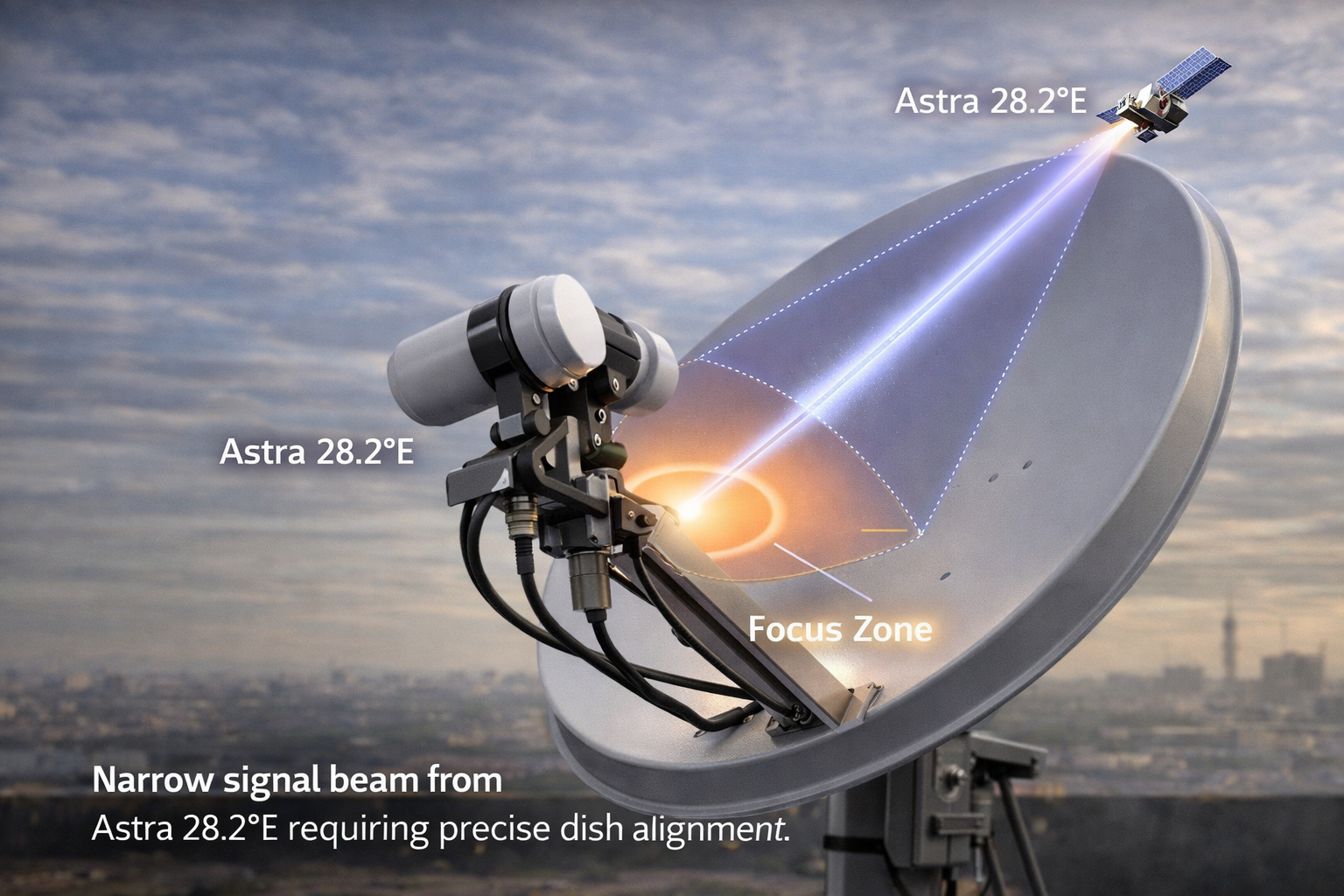
Astra 28.2E uses focused spot beams that concentrate signal in the UK. Outside this area, signal margin is lower, making precise alignment critical for stable reception.
- Beam design and signal focus
- Signal margin and decoding threshold
- Why small alignment errors matter
- Edge of coverage behavior
- Role of LNB positioning and skew
- Real world reception examples
- Comparison with Astra 19.2E behavior
- Analytical alignment sensitivity table
- How to improve alignment accuracy
- FAQ
Beam design and signal focus
Astra 28.2E uses spot beam technology to concentrate signal power in specific regions, mainly the UK.
This focused beam increases signal strength inside the target area but reduces it outside.
As a result, the signal footprint is not uniform, and reception becomes more sensitive to dish alignment.
Signal margin and decoding threshold
Signal margin is the difference between actual signal quality and the minimum required for decoding.
Inside the UK, Astra 28.2E has a high signal margin. Outside this region, the margin becomes smaller.
When margin is low, even small alignment errors can push the signal below the decoding threshold.
Why small alignment errors matter
With Astra 28.2E, a small change in azimuth or elevation can significantly affect signal quality.
This is because the signal beam is narrow and concentrated. The dish must be positioned accurately within this beam.
A deviation that would not affect Astra 19.2E may cause signal loss on Astra 28.2E.
Edge of coverage behavior
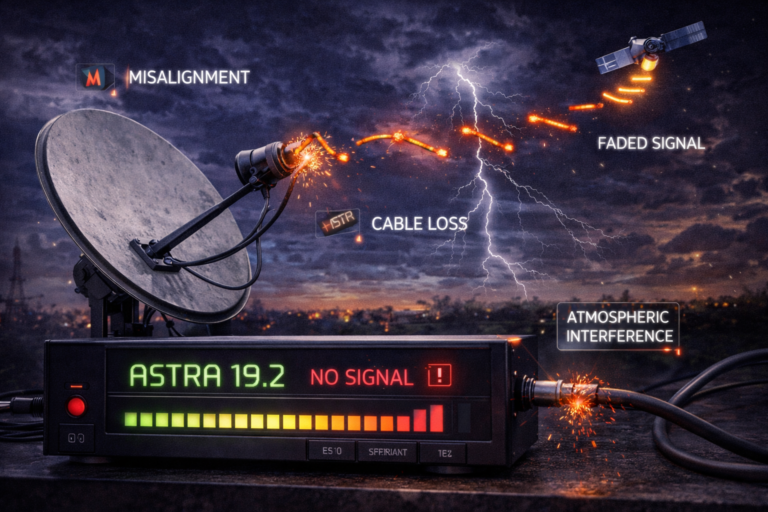
At the edge of the coverage footprint, signal quality becomes unstable.
Many regions outside the UK fall into this edge zone for Astra 28.2E.
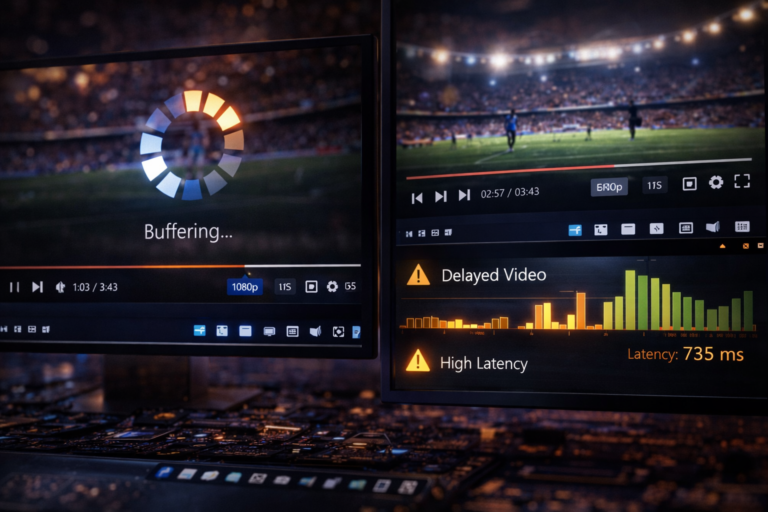
This leads to issues such as freezing, pixelation, and intermittent signal loss.
Role of LNB positioning and skew
LNB positioning becomes more critical when dealing with weak signals.
Incorrect skew or offset positioning reduces signal quality further.
Fine tuning LNB angle and position helps maximize signal capture.
Real world reception examples
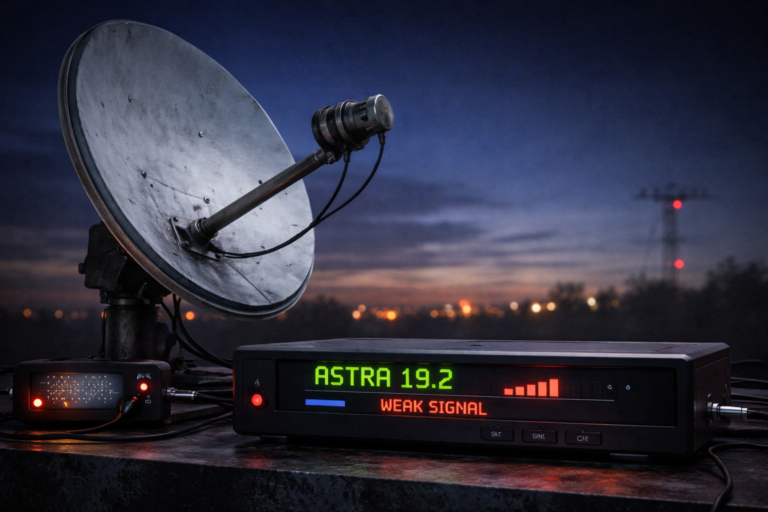
In many European regions, users can easily receive Astra 19.2E but struggle with Astra 28.2E.
The same dish may show strong signal on one satellite and weak or unstable signal on the other.
This difference highlights the importance of alignment precision.
Comparison with Astra 19.2E behavior
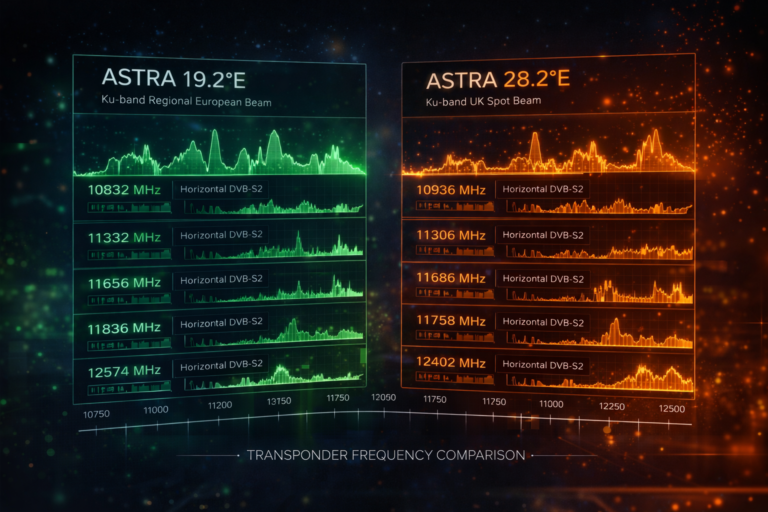
Astra 19.2E uses wide beams that distribute signal evenly across Europe.
This makes it more tolerant to alignment errors and easier to receive.
Astra 28.2E, in contrast, requires more accurate positioning due to its focused beam design.
Analytical alignment sensitivity table
| Factor | Astra 19.2E | Astra 28.2E |
|---|---|---|
| Beam type | Wide beam | Focused spot beam |
| Signal margin | Stable | Lower outside UK |
| Alignment tolerance | High | Low |
| Reception stability | Consistent | Region dependent |
| Sensitivity to errors | Moderate | High |
How to improve alignment accuracy
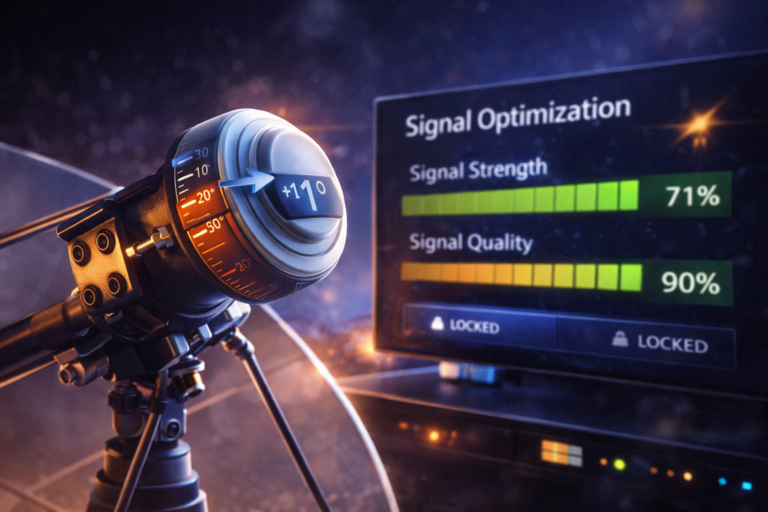
Use a precise signal meter to monitor quality.
Make small adjustments in azimuth and elevation.
Ensure LNB skew is correctly set.
Use a larger dish to increase signal margin.
Secure the dish to avoid movement.
Astra 28.2E is not weaker. It is designed for a specific region, which makes it more sensitive outside its main coverage area.
Astra 28.2E requires precise alignment because of its focused beam and lower signal margin outside the UK. Accurate dish positioning and careful tuning are essential for stable reception, especially in regions near the edge of its coverage.
FAQ
| Question | Answer |
|---|---|
| Why is Astra 28.2E harder to align | Because it uses focused beams with lower margin outside the UK. |
| Does dish size affect alignment | Yes larger dishes improve signal margin. |
| Is Astra 19.2E easier to align | Yes due to wide beam coverage. |
| Can alignment fix weak signal | Yes correct alignment improves signal quality. |
| Do I need special equipment | A signal meter helps but is not required. |