Why Your Receiver Finds Eutelsat 16E But Cannot Lock Channels
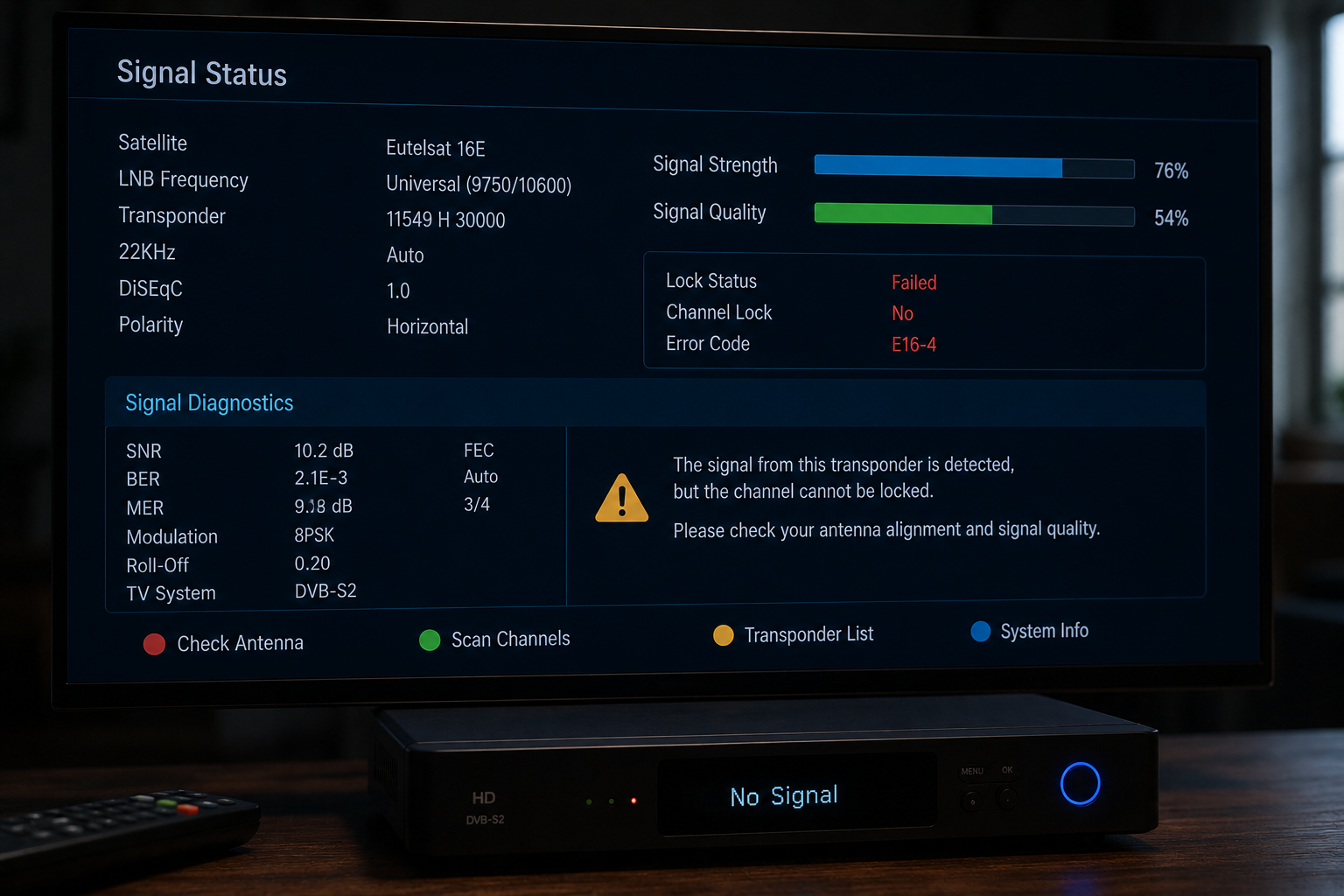
Estimated reading time: 17 minutes.
- Why finding a satellite does not guarantee channel lock.
- Signal strength vs signal quality.
- DVB-S2 synchronization requirements.
- BER and transport stream stability.
- LNB frequency drift effects.
- Weak transponder behavior.
- Receiver lock failure causes.
- How to restore stable channel decoding.
- Finding The Satellite Is Only The First Step
- Why Signal Strength Can Be Misleading
- Signal Quality Determines Channel Lock
- DVB-S2 Requires Accurate Synchronization
- BER Problems And Lock Failure
- LNB Frequency Drift And Tuner Instability
- Why Some Transponders Refuse To Lock
- Receiver Limitations And Tuner Behavior
- Technical Comparison Table
- How To Fix Lock Problems On Eutelsat 16E
- Reality Check
- Final Verdict
- FAQ
Finding The Satellite Is Only The First Step
Many users confuse satellite detection with successful reception.
The receiver first detects RF energy coming from the satellite.
This allows the tuner to recognize that a signal exists.
However, detecting signal energy is only the beginning.
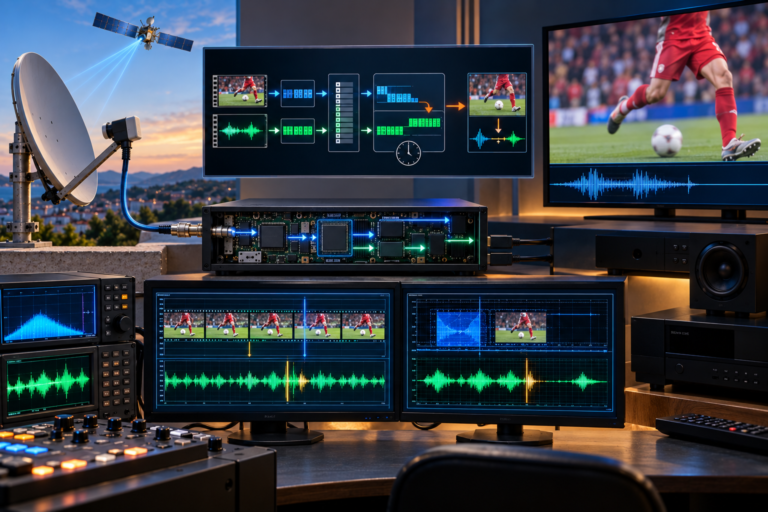
The receiver must still synchronize with the transponder, decode correction data, rebuild the transport stream, and maintain stable lock.
If any of those stages fail, channels will not open correctly.
This explains why signal can appear present while channel decoding remains impossible.
Why Signal Strength Can Be Misleading
Signal strength only measures the amount of RF energy reaching the tuner.
It does not measure how clean or stable that signal is.
A receiver may show strong signal strength even when signal quality is too poor for decoding.
This is one of the biggest misunderstandings in satellite troubleshooting.
Users often focus on strength percentages while ignoring quality readings.
The receiver may still detect the satellite perfectly while failing to maintain synchronization with the digital stream.
Signal Quality Determines Channel Lock
Signal quality is what allows successful channel decoding.
Quality reflects how accurately the receiver can interpret the incoming data.
When quality becomes unstable, synchronization starts breaking down.
The receiver may identify the transponder but fail to lock channels.
Small quality losses become especially important on modern DVB-S2 frequencies.
This is why a dish may appear close to correct alignment while difficult transponders remain unavailable.
DVB-S2 Requires Accurate Synchronization
Most modern Eutelsat 16E HD channels use DVB-S2 transmission.
DVB-S2 improves bandwidth efficiency significantly.
The tradeoff is increased sensitivity.
The receiver must maintain cleaner synchronization conditions.
Weak signal margin affects DVB-S2 frequencies more aggressively than older DVB-S services.
A receiver may detect the transponder but still fail to complete lock if synchronization conditions are unstable.
This often creates the impression that channels are missing even though the transponder remains visible.
BER Problems And Lock Failure
BER stands for Bit Error Rate.
It measures how many transmission errors are reaching the receiver.
Correction systems can repair small errors.
When BER becomes too high, decoding stability collapses.
The receiver may repeatedly attempt synchronization without success.
Sometimes channels appear briefly before disappearing again.
Other times lock never completes.
The signal exists physically, but the digital stream cannot be reconstructed reliably.
LNB Frequency Drift And Tuner Instability
LNB performance plays a major role in channel lock behavior.
The LNB converts satellite frequencies into a lower range the receiver can process.
If oscillator stability becomes weak, frequency drift appears.
Modern DVB-S2 transponders require accurate tuning.
Small drift can prevent successful lock even when signal remains visible.
This is one reason users often find Eutelsat 16E successfully but cannot open certain frequencies.
The transponder is present.
The converted frequency is not stable enough for reliable synchronization.
Why Some Transponders Refuse To Lock
Not all Eutelsat 16E frequencies behave equally.
Different transponders use different symbol rates, modulation methods, and correction settings.
Some frequencies require stronger signal quality.
Others remain more forgiving.
A weak installation may lock easy transponders while failing on difficult ones.
This often confuses users because part of the satellite appears functional.
The issue is not that the satellite is partially working.
Different transponders simply have different decoding requirements.
Receiver Limitations And Tuner Behavior
Receivers do not all perform equally.
Some tuners handle difficult DVB-S2 signals very well.
Others lose synchronization quickly when BER rises.
A receiver with weaker tuning performance may struggle on frequencies that another receiver locks easily.
However, receiver replacement should not be the first troubleshooting step.
Most lock failures still originate from signal quality problems, weak margin, unstable LNB behavior, or alignment issues.
The receiver usually exposes those weaknesses rather than creating them.
Technical Comparison Table
| Condition | Satellite Found But No Lock | Stable Channel Lock |
|---|---|---|
| Signal strength | Often present | Present |
| Signal quality | Weak or unstable | Stable |
| BER behavior | Frequent spikes | Low error rate |
| DVB-S2 synchronization | Fails repeatedly | Maintains lock |
| LNB stability | Possible drift | Stable frequency conversion |
| Channel decoding | Incomplete | Reliable |
How To Fix Lock Problems On Eutelsat 16E
Begin by monitoring signal quality instead of strength alone.
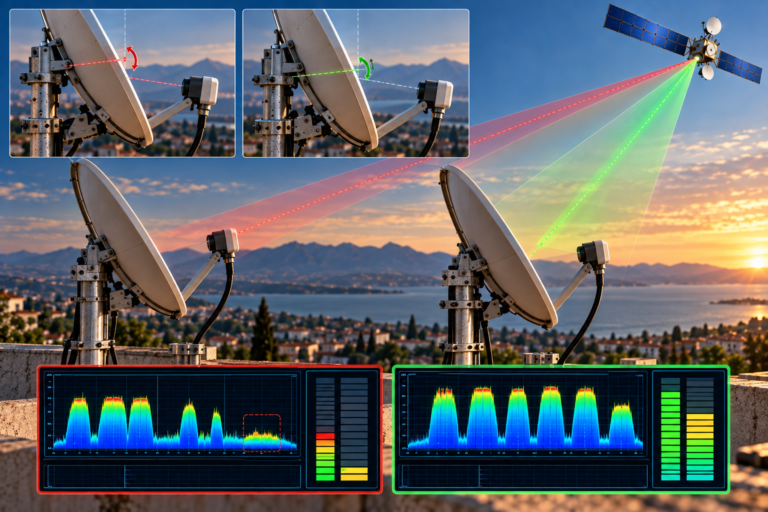
Fine-tune dish alignment carefully.
Small quality improvements often make a major difference on difficult transponders.
Inspect the LNB for instability or age-related drift.
Check connector quality and cable condition.
Moisture damage can create synchronization problems without causing complete signal loss.
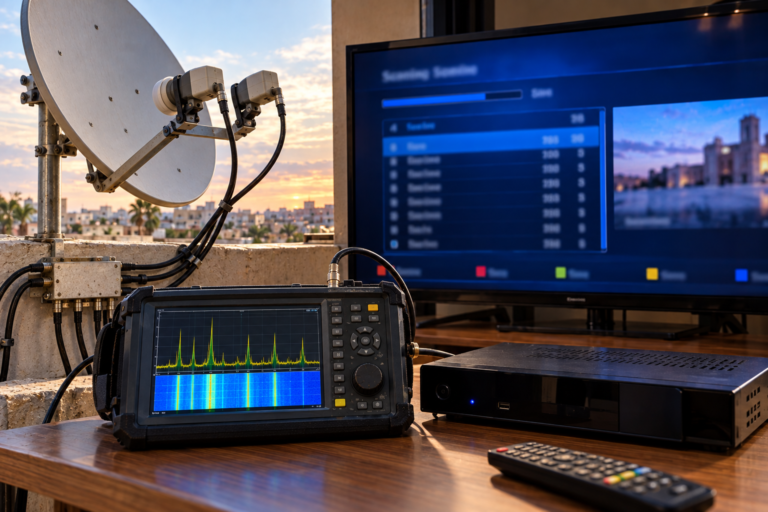
Verify transponder parameters carefully during manual scanning.
Monitor BER behavior whenever possible.
Stable low BER usually predicts reliable lock much better than strength readings.
For a deeper explanation of how evening conditions expose weak reception systems, read What Happens To Eutelsat 16E During Heavy Internet Hours.
Finding Eutelsat 16E does not automatically mean channels can be decoded. Satellite detection only confirms signal presence. Successful channel lock depends on signal quality, BER stability, DVB-S2 synchronization, frequency accuracy, and receiver decoding conditions.
When a receiver finds Eutelsat 16E but cannot lock channels, the real problem is usually not satellite detection. Most cases involve weak signal quality, BER instability, LNB drift, alignment weakness, or DVB-S2 synchronization failure. Once the signal becomes clean enough for stable decoding, channel lock usually returns without needing major receiver changes.
FAQ
| Question | Answer |
|---|---|
| Why does my receiver find the satellite but no channels work? | Because signal presence alone does not guarantee successful digital decoding. |
| Can high signal strength still fail to lock channels? | Yes. Signal quality and BER stability are much more important. |
| Can an LNB cause lock problems? | Yes. Frequency drift often prevents reliable DVB-S2 synchronization. |
| Why do some frequencies lock while others fail? | Different transponders have different decoding requirements and sensitivity levels. |
| Should I replace the receiver first? | Usually no. Check alignment, signal quality, LNB stability, and cabling first. |
| What is the most important reading to monitor? | Signal quality and BER behavior are usually more useful than strength percentages. |