Why Your Dish Looks Correct But Eutelsat 16E Still Fails
Estimated reading time: 18 minutes.
- Why visual alignment can be misleading.
- The difference between pointing and optimization.
- Hidden signal quality problems.
- LNB positioning and skew errors.
- Frequency-specific reception failures.
- Receiver lock limitations.
- Signal margin loss.
- How to diagnose the real cause.
- Why The Dish Looks Correct
- Pointing Is Not Optimization
- The Hidden Role Of Signal Quality
- LNB Position Can Be Wrong Even When Alignment Is Correct
- Signal Margin Explains The Mystery
- Why Some Frequencies Fail First
- Receiver Lock And Synchronization Problems
- Cable And Connector Issues
- Technical Comparison Table
- How To Find The Real Problem
- Reality Check
- Final Verdict
- FAQ
Why The Dish Looks Correct
Most users judge alignment visually.
If the dish points toward the correct part of the sky and channels appear, they assume alignment is perfect.
Unfortunately satellite reception is much more precise than visual inspection.
A difference of less than a degree can reduce signal quality significantly.
The dish may appear correct while still operating below its maximum performance level.
This hidden quality loss often becomes visible only on difficult transponders.
Pointing Is Not Optimization
Finding the satellite and optimizing reception are two different tasks.
Many installations stop once channels appear.
Professional installers continue adjusting until maximum quality is achieved.
A dish that receives channels is not necessarily operating at peak performance.
Small adjustments often reveal additional signal margin that was previously unavailable.
That extra margin frequently determines whether difficult HD channels remain stable.
The Hidden Role Of Signal Quality
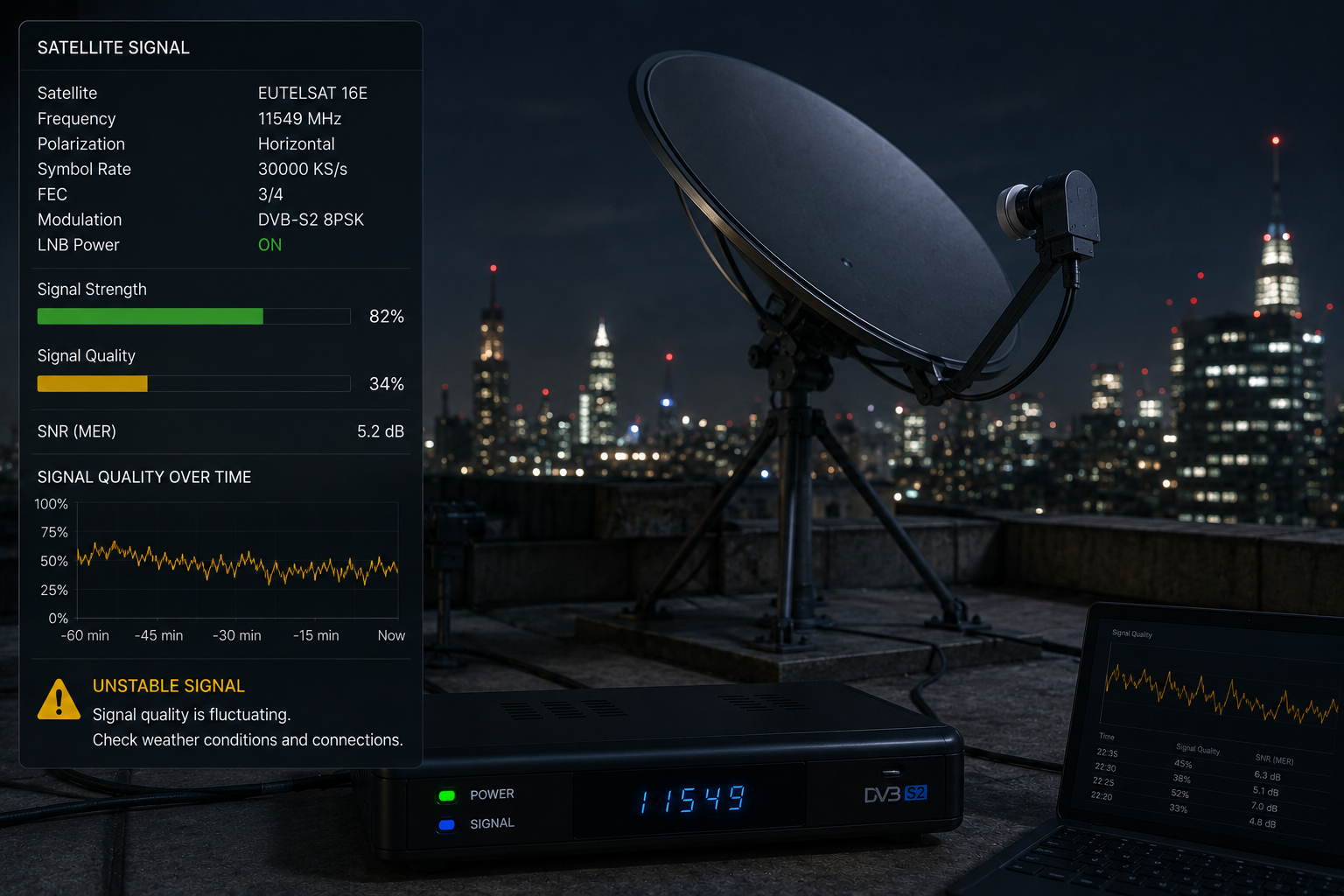
Signal strength measures incoming RF energy.
Signal quality measures how accurately the receiver can decode the digital stream.
Many users focus entirely on strength.
The receiver may show excellent strength while quality remains marginal.
When quality falls, BER rises.
As BER rises, freezing and channel lock failures become more common.
The installation appears healthy even though decoding conditions remain poor.
LNB Position Can Be Wrong Even When Alignment Is Correct
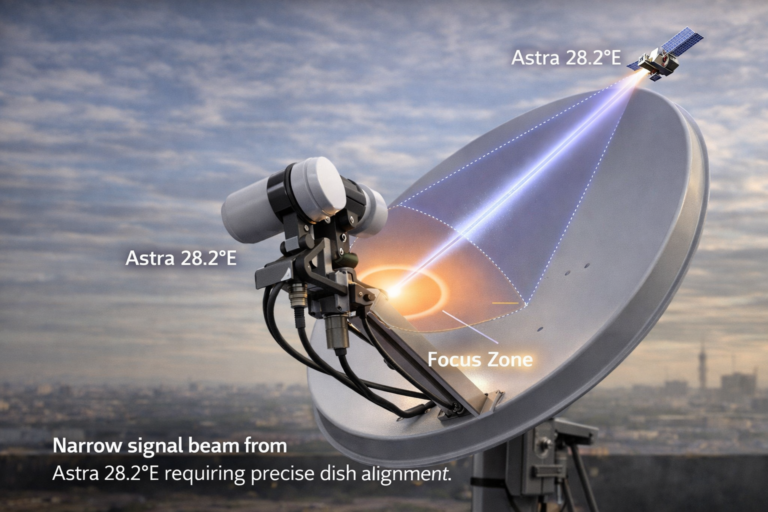
The LNB must sit at the correct focal position of the dish.
It must also have the correct skew angle.
Many users never adjust either parameter.
A dish can point directly at Eutelsat 16E while the LNB remains slightly mispositioned.
This reduces quality without noticeably affecting signal strength.
Difficult DVB-S2 transponders often reveal this problem first.
Signal Margin Explains The Mystery
Signal margin is the reserve above the minimum decoding threshold.
A healthy installation maintains plenty of reserve.
A marginal installation operates dangerously close to the limit.
The dish may appear perfectly functional.
Channels may work most of the time.
However, small environmental changes quickly consume the remaining margin.
The result is freezing, failed scans, and intermittent lock problems.
Why Some Frequencies Fail First
Not all Eutelsat 16E transponders have identical reception requirements.
Some use more demanding DVB-S2 settings.
Others operate closer to decoding thresholds.
A system with limited signal margin may receive strong transponders normally while struggling with more demanding frequencies.
This creates confusion because some channels appear perfect while others fail completely.
The real issue is reception quality rather than satellite coverage.
Receiver Lock And Synchronization Problems
Modern receivers continuously synchronize with incoming digital streams.
When quality remains stable, synchronization is easy.
When BER increases, synchronization becomes more difficult.
The receiver may detect the signal but fail to lock the channel.
Users often mistake this behavior for an alignment problem.
In reality, the signal exists but decoding conditions are insufficient.
Cable And Connector Issues
A perfectly aligned dish cannot compensate for poor signal delivery.
Moisture, oxidation, damaged shielding, and aging cables reduce quality before the signal reaches the receiver.
These losses often affect specific frequencies more severely.
The dish appears correct.
The real problem exists somewhere along the signal path.
Many difficult reception problems are ultimately traced back to connectors rather than alignment.
Technical Comparison Table
| Condition | Optimized Installation | Dish Only Looks Correct |
|---|---|---|
| Signal quality | Maximum possible | Below optimum |
| LNB position | Accurately adjusted | Possibly incorrect |
| Signal margin | Comfortable reserve | Limited reserve |
| DVB-S2 stability | Reliable | Sensitive to failure |
| BER | Low | Higher risk of spikes |
| Reception reliability | Consistent | Intermittent problems |
How To Find The Real Problem
Start by ignoring signal strength and focusing on signal quality.
Fine-tune dish alignment while watching quality readings.
Verify LNB skew and focal position.
Inspect connectors and cables carefully.
Compare performance across multiple transponders.
Monitor BER if your receiver provides that information.
The goal is to maximize signal margin rather than simply receiving channels.
For additional insight into reception problems that appear only after sunset, read Why Some Viewers Lose Eutelsat 16E Only At Night.
A dish can appear perfectly aligned and still fail. Modern satellite reception depends on signal quality, signal margin, LNB accuracy, cable integrity, and receiver synchronization. Visual alignment alone does not guarantee reliable DVB-S2 reception.
The reason your dish looks correct while Eutelsat 16E still fails is that alignment is only one part of the reception system. Hidden quality losses, reduced signal margin, incorrect LNB positioning, BER spikes, and receiver synchronization issues often remain invisible until channels begin freezing or disappearing. True optimization requires maximizing quality across the entire signal path rather than simply pointing the dish at the satellite.
FAQ
| Question | Answer |
|---|---|
| Can a dish be aligned but still have poor reception? | Yes. Alignment alone does not guarantee sufficient signal quality. |
| Why do some channels work while others fail? | Different transponders have different decoding requirements. |
| Can LNB skew affect reception? | Yes. Incorrect skew can reduce signal quality significantly. |
| Does signal strength guarantee stable channels? | No. Signal quality is usually more important. |
| Can bad cables create alignment-like symptoms? | Yes. Signal losses often mimic reception problems. |
| What should I optimize first? | Signal quality and signal margin should always be the priority. |