What Happens To Eutelsat 16E During Heavy Internet Hours
Estimated reading time: 17 minutes.
This article explains:
- Whether internet traffic affects Eutelsat 16E.
- The difference between satellite broadcasting and internet delivery.
- Why problems often appear during evening hours.
- Signal margin and environmental effects.
- Receiver behavior during peak usage periods.
- Local interference and electrical noise.
- Network congestion vs satellite signal physics.
- Real technical reasons behind evening instability.
- The Popular Internet Traffic Myth
- How Satellite Broadcasting Actually Works
- Why Internet Traffic Usually Does Not Affect TV Signals
- Why Problems Often Appear During Evening Hours
- Signal Margin Becomes More Important At Night
- Local Electrical Activity and Interference
- Receiver Behavior During Peak Household Usage
- Environmental Changes After Sunset
- Technical Comparison Table
- How To Diagnose Evening Signal Problems
- Reality Check
- Final Verdict
- FAQ
The Popular Internet Traffic Myth
One of the most common assumptions among satellite users is that Eutelsat 16E becomes overloaded when internet activity increases.
The logic sounds reasonable at first.
People notice reception problems during the same hours when internet networks become busy.
As a result, many assume both systems are directly connected.
In most cases, traditional satellite television transponders do not become weaker because internet usage rises.
Broadcast television works differently from internet streaming.
A satellite TV transponder continuously sends the same transport stream regardless of how many people are watching.
Unlike streaming platforms, the satellite does not need to create additional data sessions for each viewer.
How Satellite Broadcasting Actually Works
Satellite broadcasting uses a one-to-many transmission model.
The signal leaves the uplink station and travels to the satellite.
The satellite retransmits that signal across the coverage area.
Every receiving dish inside the footprint receives the same transmission simultaneously.
Whether one person watches the channel or ten million people watch it, the transponder output remains essentially the same.
This is one reason satellite broadcasting remains extremely efficient for mass television distribution.
Unlike internet streaming systems, bandwidth consumption does not increase with every additional viewer.
Why Internet Traffic Usually Does Not Affect TV Signals
Heavy internet activity primarily affects network infrastructure such as fiber backbones, local ISP congestion, wireless access points, and streaming platforms.
Traditional DVB-S and DVB-S2 satellite television broadcasts remain separate from those internet bottlenecks.
The RF signal arriving from Eutelsat 16E does not automatically weaken because households begin downloading files or watching online video.
The satellite continues transmitting at the same power level.
The receiver continues receiving the same RF signal.
This is why many satellite channels remain perfectly stable even during the busiest internet periods.
The problem usually appears elsewhere.
Why Problems Often Appear During Evening Hours
Evening hours create a combination of conditions that expose weak satellite installations.
More electronic devices become active.
More televisions turn on.
More household electrical systems begin operating simultaneously.
People often notice signal instability at exactly the same time every day.
This creates the illusion that internet traffic caused the problem.
In reality, the installation may already be operating near the decoding threshold.
Even small environmental or electrical changes become enough to trigger BER instability.
Signal Margin Becomes More Important At Night
Signal margin is the safety reserve above the minimum decoding requirement.
Strong installations contain enough reserve to survive changing conditions.
Weak installations operate close to failure.
During evening hours, slight changes in atmospheric behavior, local interference, or equipment temperature can reduce available margin.
The receiver may begin showing pixelation, freezing, or occasional synchronization loss.
The satellite itself remains stable.
The weakness appears because the receiving system lacks enough reserve.
This is one reason why some users experience evening problems while neighboring installations remain unaffected.
Local Electrical Activity and Interference
Many people overlook the role of local electrical noise.
During peak evening hours, homes contain far more active electronic devices.
Routers, LED lighting systems, televisions, chargers, network equipment, and power supplies all generate some level of electromagnetic activity.
Normally these effects remain small.
However, weak satellite installations may become more sensitive to additional interference.
Poor cable shielding increases vulnerability.
Damaged connectors may also allow unwanted noise into the system.
The result may look like satellite instability even though the real issue exists inside the local reception environment.
Receiver Behavior During Peak Household Usage
Modern receivers are complex digital processing systems.
They continuously decode transport streams while correcting transmission errors.
In some households, receivers share electrical circuits with many other active devices.
Voltage fluctuations and electrical noise sometimes become more noticeable during peak activity periods.
Most quality receivers handle these conditions well.
Marginal hardware may become less stable.
This can create symptoms that appear connected to internet usage even though the root cause comes from local electrical behavior.
Environmental Changes After Sunset
Temperature changes also influence satellite reception systems.
As evening arrives, dishes, LNB units, cables, and outdoor equipment begin cooling.
Thermal contraction slightly changes hardware conditions.
Low-quality LNB units sometimes experience oscillator instability during these transitions.
Sensitive DVB-S2 transponders may react more strongly when synchronization conditions become less stable.
Some users notice that difficult frequencies improve later at night after temperatures stabilize.
Others experience the opposite depending on local installation conditions.
The important point is that environmental behavior often explains evening signal changes far better than internet traffic itself.
Technical Comparison Table
| Factor | Internet Congestion | Satellite Reception Instability |
|---|---|---|
| Main cause | Network demand | Signal quality weakness |
| Affects DVB-S2 RF signal directly | No | Yes |
| Related to dish alignment | No | Strongly related |
| Related to BER spikes | Usually no | Yes |
| Influenced by weather | Limited | Highly influenced |
| Solved by signal optimization | No | Usually yes |
How To Diagnose Evening Signal Problems
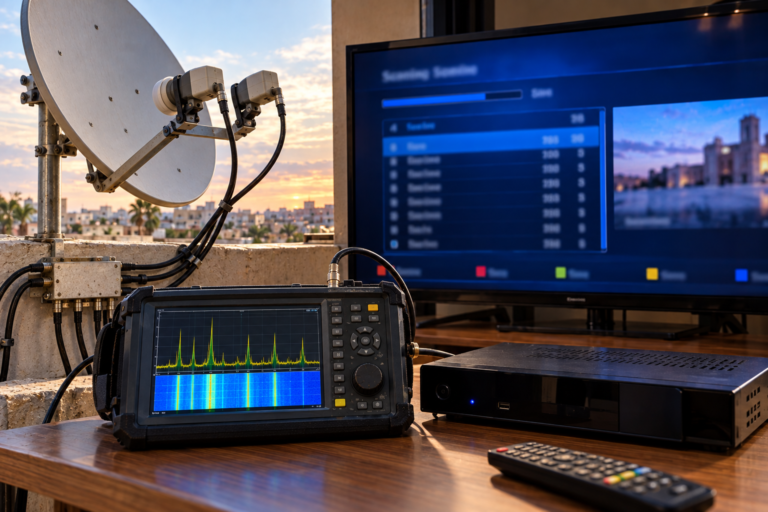
Start by monitoring signal quality rather than signal strength alone.
Watch for BER fluctuations during evening hours.
Check whether the same transponders always become unstable.
Inspect cable condition carefully.
Poor shielding often increases sensitivity to local interference.
Verify connector quality and moisture protection.
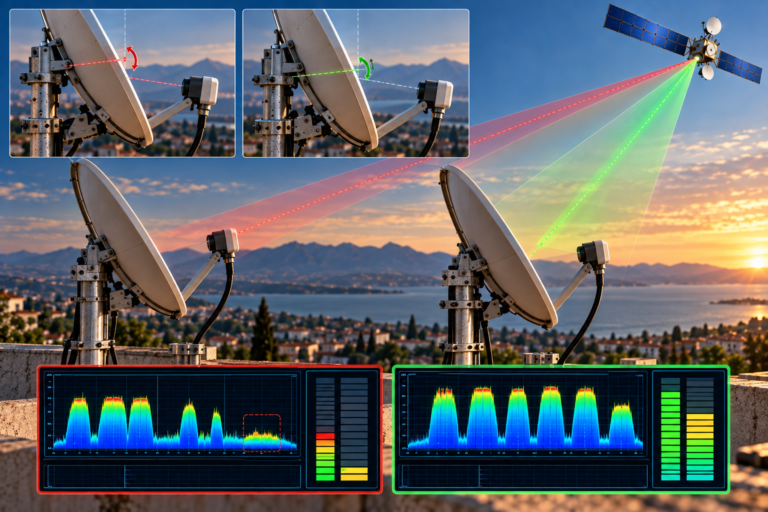
Fine-tune dish alignment to maximize signal margin.
Check LNB stability if problems appear consistently during temperature transitions.
A stronger signal reserve usually solves evening instability much more effectively than focusing on internet activity.
For deeper analysis of sensitive transponders and signal quality behavior, read The Hidden Reason Some Eutelsat 16E Frequencies Feel Unstable.
Most Eutelsat 16E television channels do not become weaker simply because internet usage increases. Satellite broadcasting and internet streaming use different delivery models. Evening problems usually reveal signal margin weaknesses, local interference, environmental changes, or installation issues that become visible during peak household activity.
Heavy internet hours rarely affect traditional Eutelsat 16E satellite broadcasts directly. The more common explanation involves weak signal reserve, environmental transitions, local electrical noise, LNB behavior, or alignment problems becoming visible during evening conditions. Understanding the difference between network congestion and satellite signal physics helps diagnose reception problems far more accurately and prevents unnecessary troubleshooting in the wrong direction.
FAQ
| Question | Answer |
|---|---|
| Does internet traffic weaken Eutelsat 16E signals? | Usually no. Traditional satellite broadcasts are independent from household internet demand. |
| Why do problems often appear in the evening? | Because environmental changes and weak signal margin become more visible during those hours. |
| Can local interference affect satellite reception? | Yes. Poor shielding and weak installations may become sensitive to additional electrical activity. |
| What is signal margin? | The safety reserve above the minimum decoding threshold required for stable reception. |
| Can an LNB behave differently at night? | Yes. Temperature changes may influence oscillator stability in some units. |
| What is the best fix for evening instability? | Improve signal quality margin through alignment, stable hardware, and healthy cabling. |