The Hidden Cause Behind Tring TV Signal Drops
Estimated Reading Time: 10 minutes
One of the most frustrating satellite TV problems is an intermittent signal drop. Tring TV may work perfectly for several minutes before the picture suddenly freezes, the audio disappears, or the receiver briefly reports “No Signal” before everything returns to normal. Because these interruptions happen unexpectedly, many viewers assume the satellite transmission itself is unstable.
In reality, satellite broadcasts are remarkably consistent. Intermittent signal drops are usually the result of small changes occurring inside the receiving system. A slight reduction in signal margin, a drifting LNB oscillator, temporary RF noise, or environmental conditions can push the receiver below its decoding threshold for only a fraction of a second. Although the interruption is brief, the viewer immediately notices it because the DVB-S2 decoder temporarily loses synchronization.
Random signal drops rarely occur without a reason. They are usually caused by changing reception conditions that reduce signal quality just enough for the receiver to momentarily lose lock before quickly recovering.
- Why Signal Drops Seem Random
- How A DVB-S2 Receiver Maintains Lock
- The Hidden Importance Of Signal Margin
- BER And Transport Stream Recovery
- LNB Oscillator Stability And Frequency Drift
- Environmental Factors That Trigger Signal Drops
- Mechanical Problems That Often Go Unnoticed
- Logical Troubleshooting Strategy
- Reality Check
- Final Verdict
- FAQ
Why Signal Drops Seem Random
Most intermittent reception problems are not actually random.
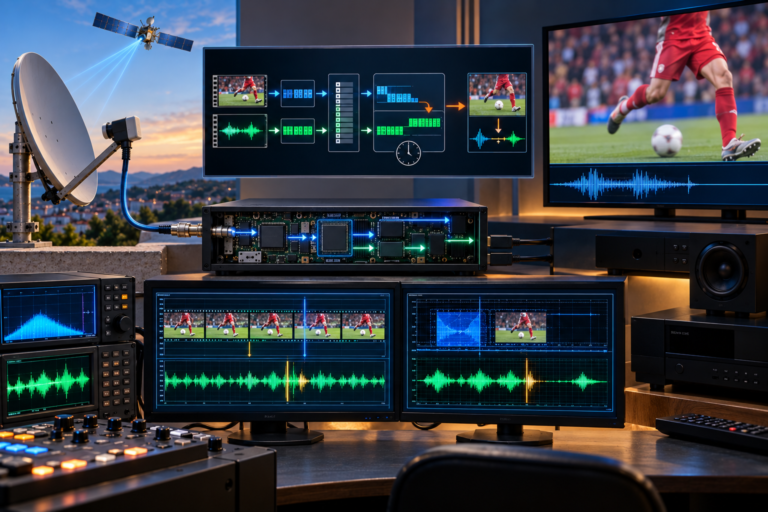
The receiver continuously measures the quality of the incoming DVB-S2 carrier while attempting to maintain carrier synchronization, symbol timing, Forward Error Correction, and transport stream reconstruction. If signal quality falls below the minimum decoding threshold for only a brief moment, synchronization may be interrupted before quickly recovering.
To the viewer, this appears completely unpredictable. From an engineering perspective, however, it is simply the receiver responding to rapidly changing RF conditions.
How A DVB-S2 Receiver Maintains Lock
Receiving satellite television involves much more than detecting RF power.
The tuner must accurately lock onto the carrier frequency before recovering symbol timing and demodulating the incoming signal. The receiver then applies powerful LDPC and BCH Forward Error Correction algorithms to repair transmission errors before rebuilding the MPEG transport stream for video decoding. DVB-S2 was specifically designed to provide reliable operation even under challenging satellite channel conditions through advanced synchronization and error correction techniques. :contentReference[oaicite:0]{index=0}
Every one of these stages depends on receiving a sufficiently clean signal. If synchronization is briefly lost, the receiver must reacquire the carrier before video playback can continue.
The Hidden Importance Of Signal Margin
Signal margin is often the difference between perfectly stable television and frustrating intermittent interruptions.
It represents the safety reserve between current operating conditions and the minimum signal quality required for reliable decoding.
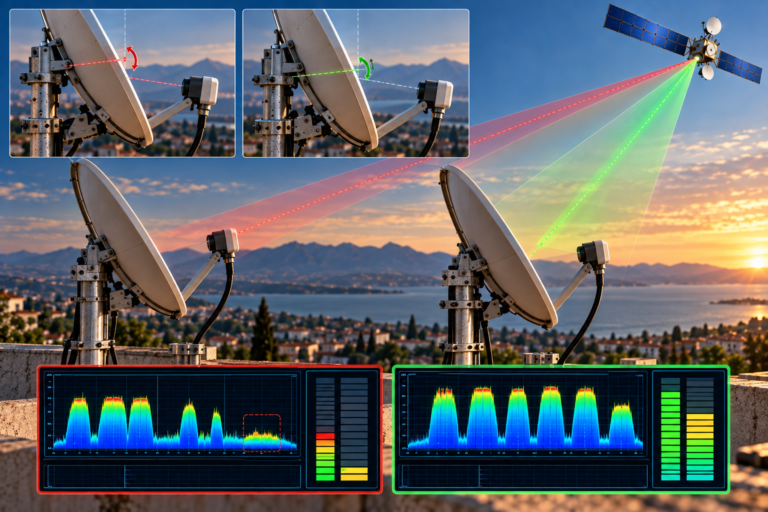
An installation operating with a generous signal margin can tolerate rain, temperature changes, slight dish movement, or temporary RF noise without affecting reception. A system operating very close to the decoding threshold may experience repeated signal drops even though the signal strength meter still appears acceptable.
For this reason, professional installers place much greater emphasis on maximizing signal quality than simply obtaining a high signal strength reading.
BER And Transport Stream Recovery
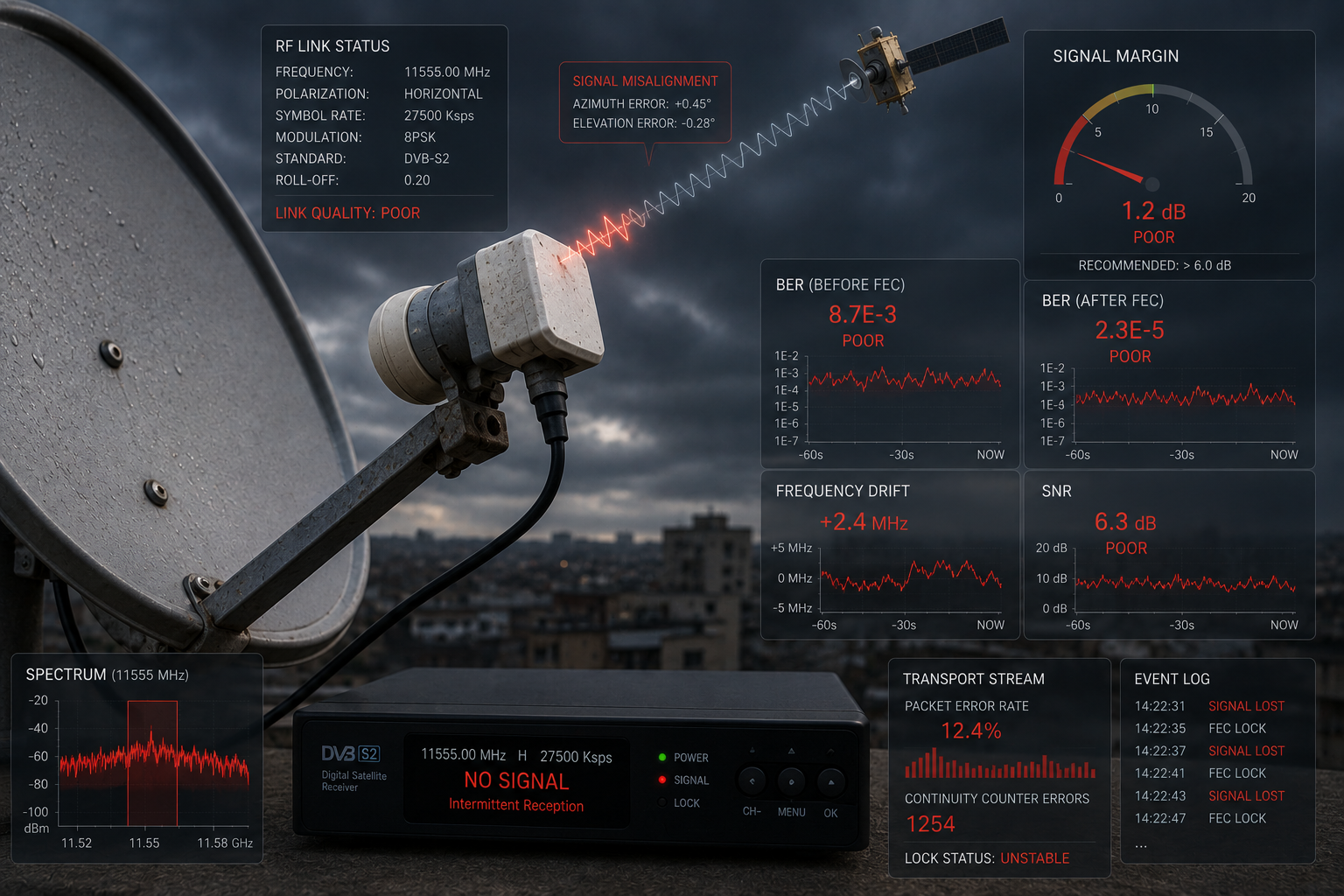
Bit Error Rate, commonly called BER, indicates how many transmission errors are reaching the receiver.
As BER increases, the Forward Error Correction system works harder to repair damaged information. Eventually the number of corrupted bits exceeds what the decoder can successfully recover.
Instead of immediately displaying a black screen, the receiver often attempts to rebuild the transport stream while reacquiring synchronization. During this recovery period viewers may notice freezing, pixelation, muted audio, or a temporary signal loss before normal playback resumes.
This behaviour explains why many interruptions last only a few seconds.
| Reception Condition | Receiver Response | Visible Result |
|---|---|---|
| Excellent signal margin | Continuous synchronization | Stable HD picture |
| Moderate BER | Forward Error Correction repairs errors | No visible interruption |
| Low signal margin | Repeated synchronization corrections | Brief freezing |
| Excessive BER | Transport stream cannot be reconstructed | Temporary signal loss |
LNB Oscillator Stability And Frequency Drift
One hidden cause of intermittent reception is the local oscillator inside the LNB.
Its frequency determines how accurately the received microwave signal is converted into an intermediate frequency for the receiver.
Although modern DVB-S2 receivers automatically compensate for normal oscillator variation, excessive frequency drift caused by aging components, temperature changes, or lower-quality hardware forces the receiver to perform additional carrier tracking. ETSI implementation guidelines identify LNB oscillator instability and phase noise as significant receiver impairments that can affect synchronization performance. :contentReference[oaicite:1]{index=1}
When combined with already limited signal margin, this additional tracking effort may occasionally push the receiver beyond its decoding capability, producing seemingly random signal drops.
Environmental Factors That Trigger Signal Drops
The satellite signal must travel through Earth’s atmosphere before reaching the receiving dish.
Heavy rainfall increases attenuation through rain fade, while strong wind may slightly move the reflector away from its optimal alignment. Water entering outdoor connectors increases signal loss, and nearby objects that partially obstruct the line of sight gradually reduce available signal margin.
Thermal noise also increases as electronic components become warmer during hot afternoons. These individual effects may appear insignificant, but together they can reduce the carrier-to-noise ratio enough to trigger brief decoder recovery events. RF impairments such as thermal noise, weather effects, and oscillator instability are recognized factors influencing DVB-S2 receiver performance. :contentReference[oaicite:2]{index=2}
Mechanical Problems That Often Go Unnoticed
Not every reception problem is electronic.
Loose mounting bolts may allow the dish to move slightly during windy conditions. A coaxial connector that appears secure may contain corrosion inside the connector body. Even a small change in LNB skew can reduce polarization isolation enough to decrease signal quality on selected transponders.
Because these problems develop gradually, viewers often describe the resulting interruptions as random even though the underlying cause is entirely mechanical.
Logical Troubleshooting Strategy
The best diagnostic approach is to observe when the interruptions occur.
If signal drops appear only during rainfall, limited signal margin is the most likely explanation. If they occur during hot afternoons, inspect the LNB and outdoor connections. If every channel experiences identical interruptions regardless of weather, verify dish alignment before replacing any equipment.
Monitoring signal quality instead of signal strength usually provides much more useful information when diagnosing intermittent satellite reception.
If signal drops are often accompanied by digital blocks appearing across the screen before the picture disappears, you may also find our article explaining the strange reason Total TV channels pixelate randomly useful, as it explores how transmission errors become visible before complete signal loss.
Random signal drops rarely indicate a problem with the satellite itself. Most intermittent interruptions originate within the receiving installation, where small changes in signal margin, RF noise, LNB stability, or dish alignment momentarily prevent the receiver from maintaining reliable DVB-S2 synchronization.
The hidden cause behind Tring TV signal drops is usually not a single faulty component but a combination of engineering factors that temporarily reduce reception quality below the DVB-S2 decoding threshold. By understanding signal margin, BER, oscillator stability, environmental attenuation, and receiver synchronization, viewers can diagnose intermittent problems logically instead of replacing equipment unnecessarily.
| Question | Answer |
|---|---|
| Why do Tring TV signal drops disappear by themselves? | The receiver often regains synchronization automatically once signal quality rises above the decoding threshold. |
| Can a healthy signal strength still produce interruptions? | Yes. Signal quality, BER, and signal margin are much better indicators of reliable reception. |
| Does an aging LNB cause intermittent problems? | Yes. Increased oscillator drift or internal noise can reduce receiver stability under marginal conditions. |
| Can wind create random signal drops? | Yes. Small dish movements reduce signal margin and may interrupt DVB-S2 synchronization. |
| Should the receiver always be replaced first? | No. Dish alignment, connectors, coaxial cable, and the LNB should be inspected before replacing the receiver. |