Why a 6° Monoblock Does Not Work on Every Dish
A 6° monoblock LNB sounds like a simple solution for receiving Astra 19.2°E and Hot Bird 13°E on one dish. Buy the monoblock, place it in the LNB holder, configure DiSEqC, and both satellites should appear. But some installations tell a different story. One satellite works perfectly while the other barely locks, even after careful adjustment.
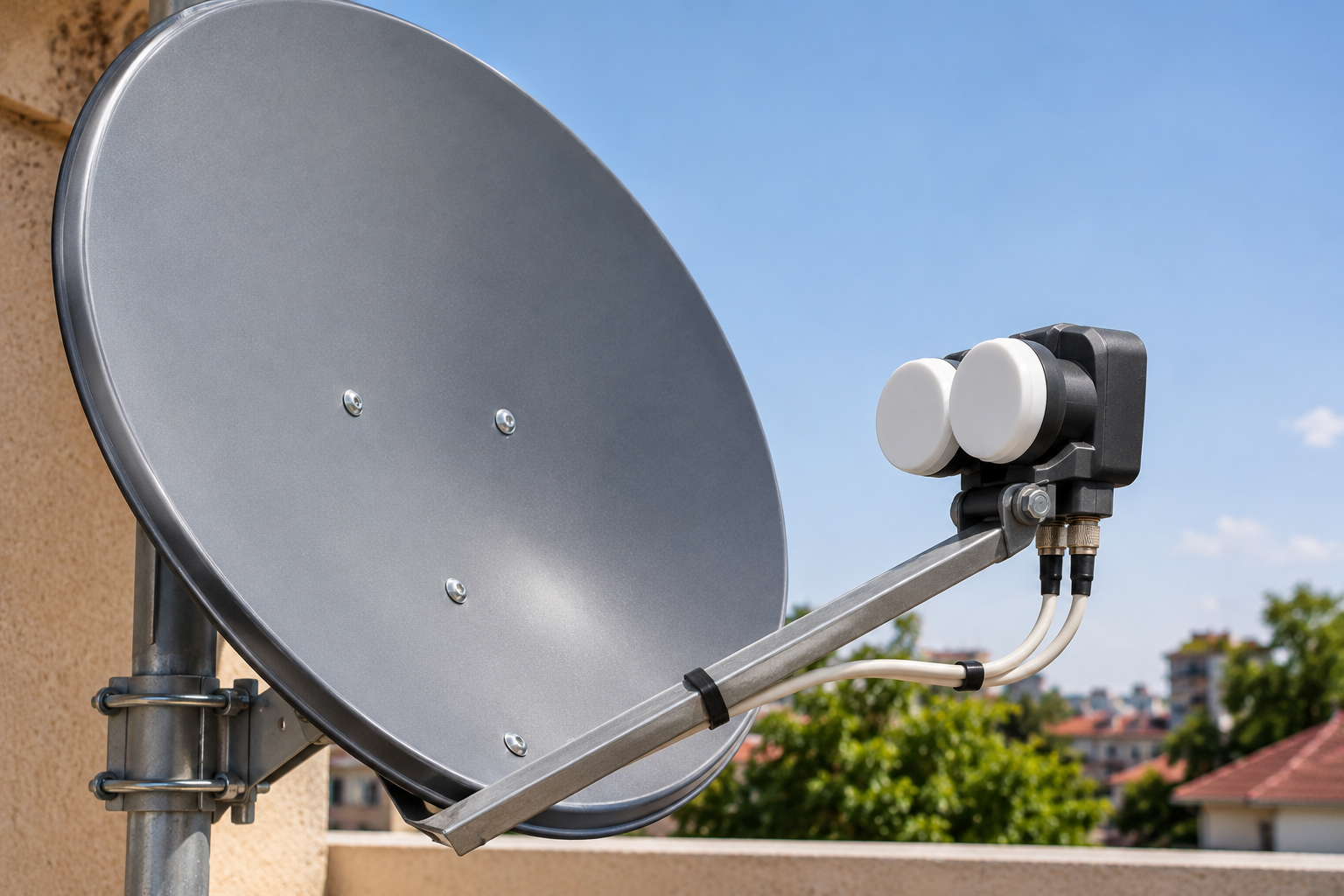
The problem may have nothing to do with defective equipment. A monoblock has two receiving feeds separated by a fixed physical distance, while satellite reflectors differ in focal length, aperture diameter, and optical geometry. A feed arrangement designed for one reflector may not match another, even when both dishes use the same type of mounting collar. The 6° label describes the intended satellite-separation application, not guaranteed compatibility with every satellite dish.
A 6° monoblock is commonly used for neighboring satellite positions such as Hot Bird 13°E and Astra 19.2°E. Their orbital longitudes differ by 6.2 degrees, while their apparent separation in the receiving sky depends on location. The monoblock’s fixed feed spacing must work with the reflector’s focal geometry. Dish diameter, F/D ratio, mounting arrangement, and local receiving requirements all influence the result.
What Does 6° Mean on a Monoblock LNB?
The six-degree designation refers to the nominal separation between the satellite positions the monoblock is designed to receive in a suitable antenna arrangement.
For European direct-to-home reception, a common example is the pair of orbital positions at 13° East and 19.2° East.
These are occupied by the Hot Bird and Astra satellite systems.
Orbital Longitude Is Not the Same as Apparent Separation
The difference between 19.2°E and 13°E is 6.2 degrees of orbital longitude.
However, a receiving antenna observes both satellites from a particular position on Earth.
The angle between the two satellite directions in the local sky depends on that receiving location.
Consequently, the numerical difference between orbital longitudes should not be interpreted as a universally identical mechanical angle at the dish.
Six Degrees Does Not Describe Feed Spacing in Millimeters
The two feedhorns in a monoblock are separated by a physical distance determined during manufacturing.
That distance is not specified simply by stating the orbital separation in degrees.
It must relate to the reflector’s focal geometry and the intended receiving arrangement.
Two different monoblocks advertised for similar satellite separation can therefore have different mechanical designs and compatibility requirements.
Why the Label Alone Is Not Enough
A product advertised as a six-degree monoblock may be intended for a particular range of dish diameters or a specified focal ratio.
Another product with the same nominal separation may have different requirements.
The installation should be evaluated using the manufacturer’s complete specifications rather than the six-degree description alone.
Why Fixed Feed Spacing Creates Compatibility Limits
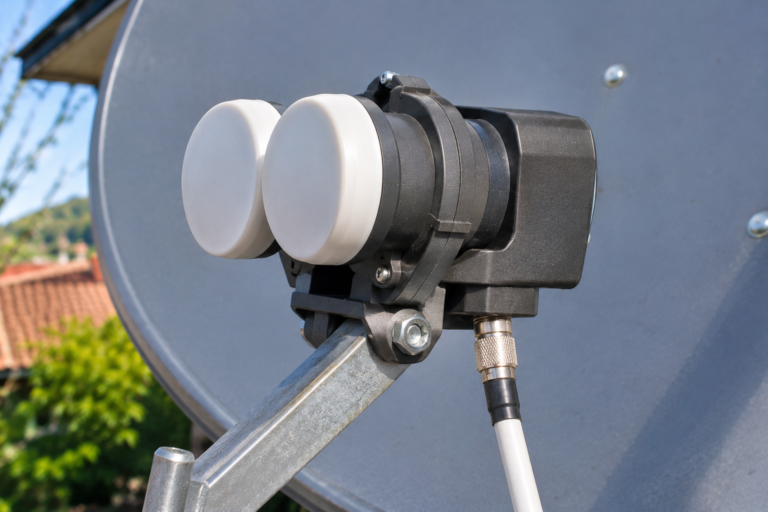
A conventional monoblock integrates two receiving feeds in one housing.
Unlike two separate LNBs on an adjustable bracket, the distance between those feeds is generally fixed.
This makes the installation convenient but limits mechanical flexibility.
How Two Satellite Signals Reach Different Feed Positions
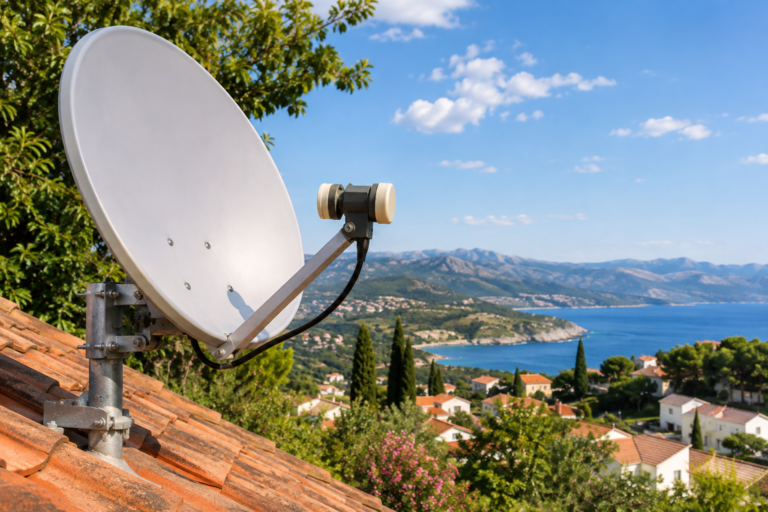
A satellite reflector collects incoming electromagnetic energy and concentrates it toward its receiving region.
Signals arriving from different directions are focused toward different positions.
For a dual-satellite arrangement, each feed must be positioned appropriately to collect energy from its intended orbital position.
If one feed is displaced from its optimum receiving position, the effective gain available on that satellite can be reduced.
Why Reflector Focal Length Influences Spacing
The required displacement between two feed positions depends partly on the reflector’s effective focal length.
For small angular differences in a simplified optical model, lateral feed displacement is approximately proportional to focal length.
Real offset reflectors also introduce off-axis behavior that must be considered.
The main principle remains important: changing the reflector’s geometry changes how its focal region corresponds to incoming satellite directions.
Why You Cannot Simply Adjust the Distance
The two receiving feeds in an ordinary monoblock are integrated into a fixed structure.
The installer generally cannot move them closer together or farther apart independently.
Rotating the housing may alter the secondary feed’s position, but it does not change the fixed distance between the feed assemblies.
If the spacing is fundamentally incompatible with the reflector, ordinary alignment adjustments may not resolve the problem.
Rotating a monoblock, sliding it within a supported mounting collar, and changing the distance between its two integrated feeds are different operations. Most conventional monoblocks do not allow independent adjustment of their internal feed spacing.
How Dish Diameter Influences Monoblock Compatibility
Satellite dish diameter is an important parameter because it influences available antenna gain and beamwidth.
However, diameter alone does not fully describe the reflector’s optical characteristics.
Larger Diameter Usually Means More Potential Gain
At the same receiving frequency and comparable aperture efficiency, a larger parabolic reflector generally provides higher antenna gain.
For two idealized circular apertures, the approximate gain difference is:
Gain Difference = 20 × log10(D2 / D1)
For a change from 60cm to 80cm:
20 × log10(80 / 60) ≈ 2.50 dB
This is a theoretical aperture-gain comparison at equal frequency and efficiency. It is not a guaranteed improvement for an installed monoblock system.
Why a Larger Dish Has a Narrower Main Beam
As aperture diameter increases, the main receiving beam generally becomes narrower at the same frequency.
This can improve directional selectivity but makes accurate alignment more important.
A feed-position error that was tolerable on one reflector may have a more noticeable effect on another.
Why Dish Diameter Does Not Define Feed Spacing
Two dishes of the same nominal diameter can have different focal lengths and optical geometries.
Therefore, they may not require exactly the same secondary-feed placement.
A monoblock compatible with one reflector cannot automatically be assumed compatible with every dish of that diameter.
Why Focal Length and F/D Ratio Matter
The F/D ratio is a basic geometric specification used to describe satellite reflectors.
It relates focal length to aperture diameter.
The relationship is commonly expressed as:
F/D = Focal Length / Diameter
In offset reflectors, the underlying parent paraboloid geometry and the manufacturer’s definition of the reference dimensions must also be considered.
What F/D Tells You
A reflector’s focal ratio helps describe its focal geometry and the feed illumination requirements.
This influences the position and design of receiving feeds.
When selecting a monoblock, an F/D compatibility specification provides more useful information than diameter alone.
Why Two 80cm Dishes Can Behave Differently
Imagine two offset reflectors with the same nominal aperture diameter but different focal geometry.
Both may accept a standard mounting collar.
However, their appropriate feed positions and illumination characteristics may differ.
A fixed-spacing monoblock may operate closer to its intended geometry on one reflector than on the other.
Why F/D Should Not Be Guessed From Appearance
The external shape of a dish does not always provide enough information to determine the manufacturer’s intended focal ratio accurately.
Offset geometry can make simple visual estimates misleading.
Use documented reflector specifications where available.
If the antenna model is unknown, a qualified installer may need to assess its geometry before recommending a fixed-spacing monoblock.
A Real Example: An 80cm Monoblock Designed for F/D = 0.6
Manufacturer specifications demonstrate that six-degree monoblocks are not universal accessories.
For example, Inverto offers a single-output six-degree monoblock intended to receive Hot Bird 13°E and Astra 19.2°E using one 80cm offset reflector.
The relevant product documentation specifies a reflector with F/D = 0.6.
It also identifies Hot Bird as Satellite A and Astra as Satellite B for that particular model.
What This Specification Proves
The manufacturer is defining an intended combination of feed geometry and reflector characteristics.
The six-degree rating is only one part of that combination.
The specified dish diameter and focal ratio are also relevant.
What It Does Not Prove
The specification does not mean every six-degree monoblock requires exactly an 80cm dish.
It does not prove that every dish smaller or larger than 80cm is incompatible with every monoblock model.
Nor does it mean all 80cm dishes have identical focal ratios.
The conclusion is narrower and more useful: compatibility must be evaluated for the exact monoblock and reflector.
Can a 6° Monoblock Work on a 60cm Dish?
The answer depends on the particular monoblock and reflector.
A product designed for an 80cm antenna should not automatically be assumed suitable for a 60cm antenna.
Potential Feed-Spacing Mismatch
If the smaller reflector has a shorter effective focal length, the ideal displacement between the receiving feed positions may be different.
A monoblock with spacing optimized for another reflector may place its secondary feed away from the intended receiving region.
This can reduce the usable gain available from the second satellite.
Reduced Available Aperture Gain
A smaller dish also generally provides less potential receiving gain at comparable efficiency.
That can leave less margin for alignment errors, unfavorable coverage, or weather attenuation.
Feed geometry and link margin may therefore both become limiting factors.
Why Failure Is Not Guaranteed
Some installations may still receive both satellites under favorable conditions despite operating outside a particular product’s recommended geometry.
But successful clear-sky lock does not prove that the arrangement meets its intended performance or reliability requirements.
A manufacturer-supported combination is preferable to relying on accidental or marginal reception.
What About 80cm, 90cm and Larger Satellite Dishes?
Increasing dish diameter does not automatically resolve monoblock compatibility problems.
The answer still depends on reflector geometry and the exact product design.
An 80cm Dish Is Not Automatically Compatible
If the monoblock specifies an 80cm reflector with a particular F/D ratio, the intended focal geometry matters.
Another 80cm dish with substantially different characteristics may not provide equivalent performance.
The physical holder may fit while the secondary feed remains geometrically mismatched.
Why a 90cm Dish Can Introduce Different Geometry
A larger reflector may have a different effective focal length and require a different lateral feed displacement for the same pair of satellite directions.
If the monoblock’s spacing is fixed, that mismatch may influence off-axis reception.
Although the larger reflector offers more potential aperture gain, the secondary feed may not use it efficiently.
Why Larger Is Not Necessarily Worse
A larger dish can still perform well when its geometry is compatible with the monoblock.
The problem is not diameter itself.
It is the assumption that increasing diameter guarantees compatibility without considering optical geometry.
| Dish Size | Potential Consideration | What Must Be Verified |
|---|---|---|
| 60cm | Lower potential gain and possible feed-spacing mismatch | Exact model support and available carrier margin |
| 70cm | Intermediate aperture, but geometry still varies | Recommended reflector range and focal characteristics |
| 80cm | Common target size for certain six-degree monoblocks | F/D ratio, offset geometry and manufacturer requirements |
| 90cm | Higher potential gain but potentially different focal geometry | Feed-spacing compatibility and off-axis performance |
| Larger than 90cm | Greater gain and narrower beam, with increased installation demands | Manufacturer support, mounting stability and feed design |
These scenarios illustrate compatibility considerations. They are not universal manufacturer-approved combinations or guaranteed reception recommendations.
Why the Receiving Location Also Matters
Reflector geometry is only one part of a successful dual-satellite installation.
The receiving location influences the directions of Astra and Hot Bird in the sky.
It also affects the available downlink conditions.
Apparent Satellite Separation Depends on Location
Although Astra and Hot Bird occupy fixed nominal orbital longitudes, their apparent angular relationship varies with the receiving station’s geographic coordinates.
This influences the receiving geometry of a dual-feed arrangement.
A monoblock designed for a particular market and reflector class may not perform identically under every geographic receiving condition.
Different Coverage Can Change the Required Margin
Satellite coverage patterns are not uniform across all receiving locations.
The available EIRP and selected carrier requirements affect the amount of antenna gain needed for reliable reception.
A dual-satellite installation should therefore be evaluated for both its mechanical compatibility and its available link margin.
Why Coverage Cannot Fix Incorrect Feed Geometry
A strong satellite beam may allow a marginally positioned feed to acquire some carriers.
However, favorable coverage does not make an incompatible feed arrangement technically optimal.
The installation may still lose reception under adverse weather or on more demanding carriers.
Why a Monoblock That Fits the LNB Holder May Still Be Incompatible
A physically successful installation does not necessarily prove correct RF performance.
Several important design characteristics may remain mismatched.
Mounting Collar Diameter
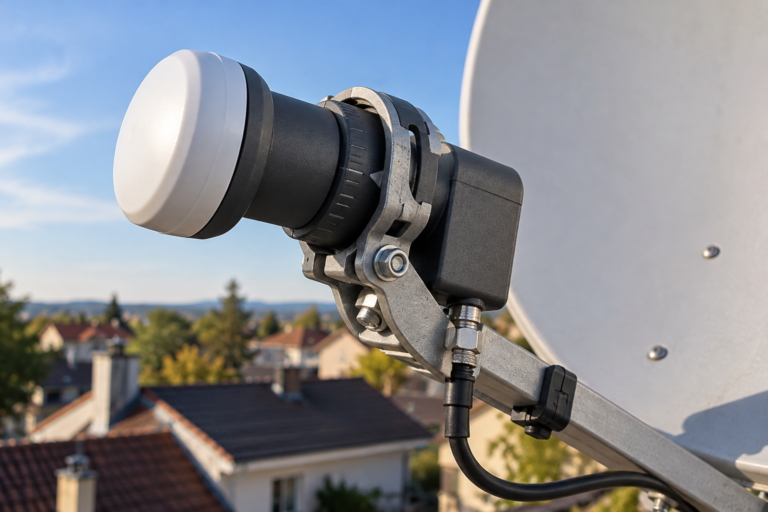
Many satellite reflectors use standardized LNB holders, and some monoblocks include mounting adapters.
A compatible adapter can allow the housing to fit the feed arm mechanically.
However, physical fit does not establish that the reflector’s focal geometry matches the monoblock’s intended design.
Feedhorn and Illumination Characteristics
The feed must illuminate the reflector appropriately to achieve useful antenna efficiency.
Different feedhorn designs may have different radiation patterns and effective phase-center positions.
These differences can influence overall receiving gain and off-axis performance.
Mounting Depth and Rotation
The monoblock’s position along the mounting axis and its rotation can affect the receiving arrangement.
Incorrect positioning may reduce carrier quality even when the nominal feed spacing is appropriate.
Our related article, Why Monoblock LNB Position Matters More Than Size, explains how mounting depth, feed position, and tilt influence reception once the equipment has been selected.
The present decision comes earlier: determining whether the monoblock and dish are compatible enough to justify installation in the first place.
How to Verify 6° Monoblock Compatibility Before Buying
Choosing compatible equipment begins with gathering the correct specifications.
Step 1: Identify the Exact Reflector
Record its manufacturer, model, nominal dimensions, and available technical specifications.
Determine whether it is an offset reflector and whether the relevant focal geometry is documented.
Step 2: Check the Intended Satellite Pair
Confirm that the monoblock is specifically designed for the required orbital positions or an appropriate equivalent separation.
Do not rely solely on the word “dual” or an unspecified six-degree marketing label.
Step 3: Compare Supported Dish Sizes
Read the manufacturer’s recommended reflector diameter or supported range.
Do not assume that a product designed for one size automatically works with every smaller or larger antenna.
Step 4: Verify F/D Requirements
Where the manufacturer specifies a focal ratio, compare it with the reflector’s documented geometry.
Do not substitute diameter for focal ratio.
Step 5: Check Mounting Dimensions
Confirm the required collar diameter, adapter, and supported mounting orientation.
The monoblock must fit securely without damaging the housing or feed arm.
Step 6: Confirm DiSEqC and Output Compatibility
Identify whether the monoblock is Single, Twin, Quad, or another supported architecture.
Check the receiver-control requirements and satellite-to-port assignments.
Do not confuse physical coaxial outputs with logical DiSEqC satellite ports.
Step 7: Consider Local Reception Requirements
Assess the relevant satellite coverage, intended services, and desired weather margin.
Even a compatible monoblock and reflector must provide sufficient link budget for reliable reception.
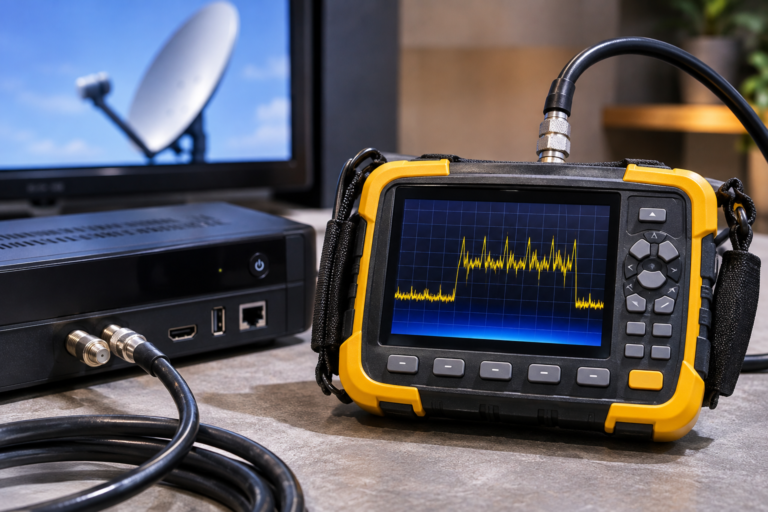
Step 8: Plan for Measurement and Alignment
After installation, verify currently active reference transponders on both satellites.
Record lock status and appropriate carrier-quality measurements rather than relying only on consumer receiver percentages.
- Exact dish model and nominal dimensions identified.
- Monoblock intended for the required satellite pair.
- Recommended dish diameter or range checked.
- Focal geometry and F/D compatibility verified where specified.
- Mounting collar and adapter confirmed.
- DiSEqC assignments and output architecture documented.
- Local coverage and required reception margin considered.
If important specifications are unavailable, contact the manufacturer or obtain a qualified compatibility assessment rather than assuming the hardware will work.
Common Signs of a Monoblock Compatibility Problem
| Observed Problem | Possible Explanation | First Useful Check |
|---|---|---|
| One satellite is strong, the other consistently weak | Feed geometry, alignment, coverage, or carrier-margin difference | Compare model compatibility and measured reception |
| Reception worsens after installing a larger dish | Possible mismatch between fixed feed spacing and new reflector geometry | Check focal ratio and intended reflector size |
| One satellite never locks | Severe geometry mismatch, switching error, or receiving-path fault | Confirm satellite identity and DiSEqC selection |
| Monoblock fits the collar but performs poorly | Physical fit without optical compatibility | Check focal geometry and feed illumination |
| Both satellites work only under clear skies | Insufficient reception margin | Evaluate link budget and representative carriers |
| Changing housing rotation improves one satellite but harms the other | Coupled feed positioning and polarization adjustment | Check manufacturer tilt and mounting instructions |
| Expected channels appear under the wrong satellite name | Receiver database or DiSEqC mapping error | Verify physical feed selection |
| Separate adjustable LNBs work but the monoblock does not | Possible fixed-spacing compatibility limitation | Compare feed geometry under equivalent conditions |
These observations are diagnostic clues. None proves a particular reflector or monoblock is incompatible without appropriate verification.
When Separate Adjustable LNBs May Be a Better Solution
A fixed-spacing monoblock is convenient when its design matches the reflector and intended satellite positions.
However, some installations benefit from greater adjustment flexibility.
Independent Feed Positioning
Two separate LNBs mounted on a suitable multi-feed bracket can allow their relative positions to be adjusted.
This can help accommodate reflector geometry that does not suit an available fixed monoblock.
The actual adjustment range depends on the bracket and dish design.
Independent Polarization Adjustment
Separate LNBs may permit individual polarization rotation.
This can be useful where the ideal skew settings for the two satellite paths differ.
A conventional monoblock generally links both feed assemblies mechanically.
Greater Flexibility Does Not Guarantee Better Reception
An adjustable multi-feed arrangement still requires a compatible reflector, secure mounting, accurate pointing, and suitable receiver switching.
Off-axis antenna performance remains a limitation.
Two separate LNBs are therefore an alternative engineering approach, not an automatic upgrade in every installation.
When a Compatible Monoblock Is Still Preferable
If a monoblock is explicitly designed for the reflector and satellite pair, it can provide a compact and convenient installation.
The fewer independent mechanical adjustments may simplify setup and maintenance.
The important consideration is compatibility, not whether the receiving system uses one integrated housing or two separate units.
Reality Check: The 6° Label Is Not a Universal Compatibility Guarantee
A six-degree monoblock is not guaranteed to work with every satellite reflector.
Its fixed feed spacing is intended for particular optical geometry, and some manufacturers specify a recommended dish diameter and focal ratio.
However, it would also be incorrect to claim that every six-degree monoblock requires exactly the same reflector size.
Different products may have different compatibility requirements.
The correct decision depends on the exact monoblock, reflector geometry, mounting arrangement, receiving location, and required reception margin.
Final Verdict
A 6° monoblock does not work on every dish because the fixed relationship between its two receiving feeds must match the reflector’s focal geometry.
Orbital separation alone does not determine the correct physical feed spacing.
Reflector diameter, focal length, F/D ratio, feed illumination, and mounting configuration all influence dual-satellite performance.
A monoblock designed for an 80cm reflector with a particular focal ratio cannot automatically be assumed suitable for every 60cm, 80cm, or 90cm antenna.
The best installation starts with matching the hardware, not compensating for incompatible geometry through repeated adjustments.
Verify the manufacturer’s specifications, assess the receiving conditions, and confirm actual carrier quality on both Astra 19.2°E and Hot Bird 13°E.
A compatible dish and monoblock combination is more valuable than a six-degree label alone.
Frequently Asked Questions
Can I use a 6° monoblock on any satellite dish?
No. Compatibility depends on the reflector’s geometry and the monoblock’s intended feed spacing, mounting arrangement, and manufacturer requirements. The six-degree designation alone is insufficient.
Will a six-degree monoblock work on a 60cm dish?
It depends on the exact monoblock and reflector. Some products are designed for larger dishes or particular focal ratios. A 60cm installation should not be assumed compatible without checking the manufacturer specifications.
Is an 80cm dish always correct for Astra and Hot Bird monoblocks?
No. Certain six-degree models are designed for 80cm offset dishes, sometimes with a specified F/D ratio. Not every 80cm reflector has identical optical geometry, and different monoblocks may have different requirements.
Can I install an 80cm monoblock on a 90cm dish?
Do not assume compatibility from the nominal sizes alone. The larger reflector may have different focal geometry, changing the appropriate secondary-feed position. Check the exact model specifications.
What does F/D mean on a monoblock specification?
F/D is the focal-length-to-diameter ratio of the reflector. It helps describe the antenna’s optical geometry, which affects feed positioning and compatibility.
Why does one satellite work while the other is missing?
Possible causes include feed-spacing mismatch, incorrect reflector alignment, limited reception margin, wrong DiSEqC assignment, or a hardware fault. Confirm the actual satellite paths before assuming incompatibility.
Does the six-degree rating mean the feeds must be six degrees apart physically?
No. The designation describes the nominal satellite-separation application. The physical spacing between the feeds depends on the monoblock’s mechanical design and the intended reflector geometry.
Are two adjustable LNBs better than a monoblock?
They can offer greater flexibility when fixed feed spacing is unsuitable. However, the dish, multi-feed bracket, switching equipment, and alignment must still be compatible.