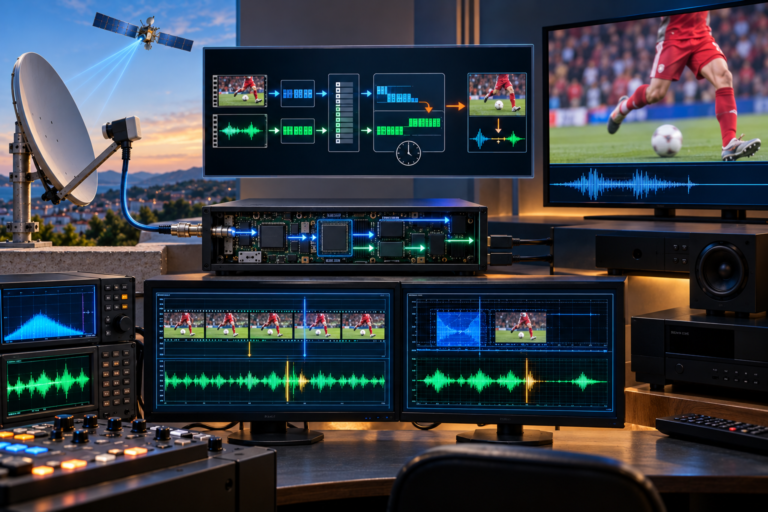
Why Hot Bird Signal Looks Strong but Won’t Lock
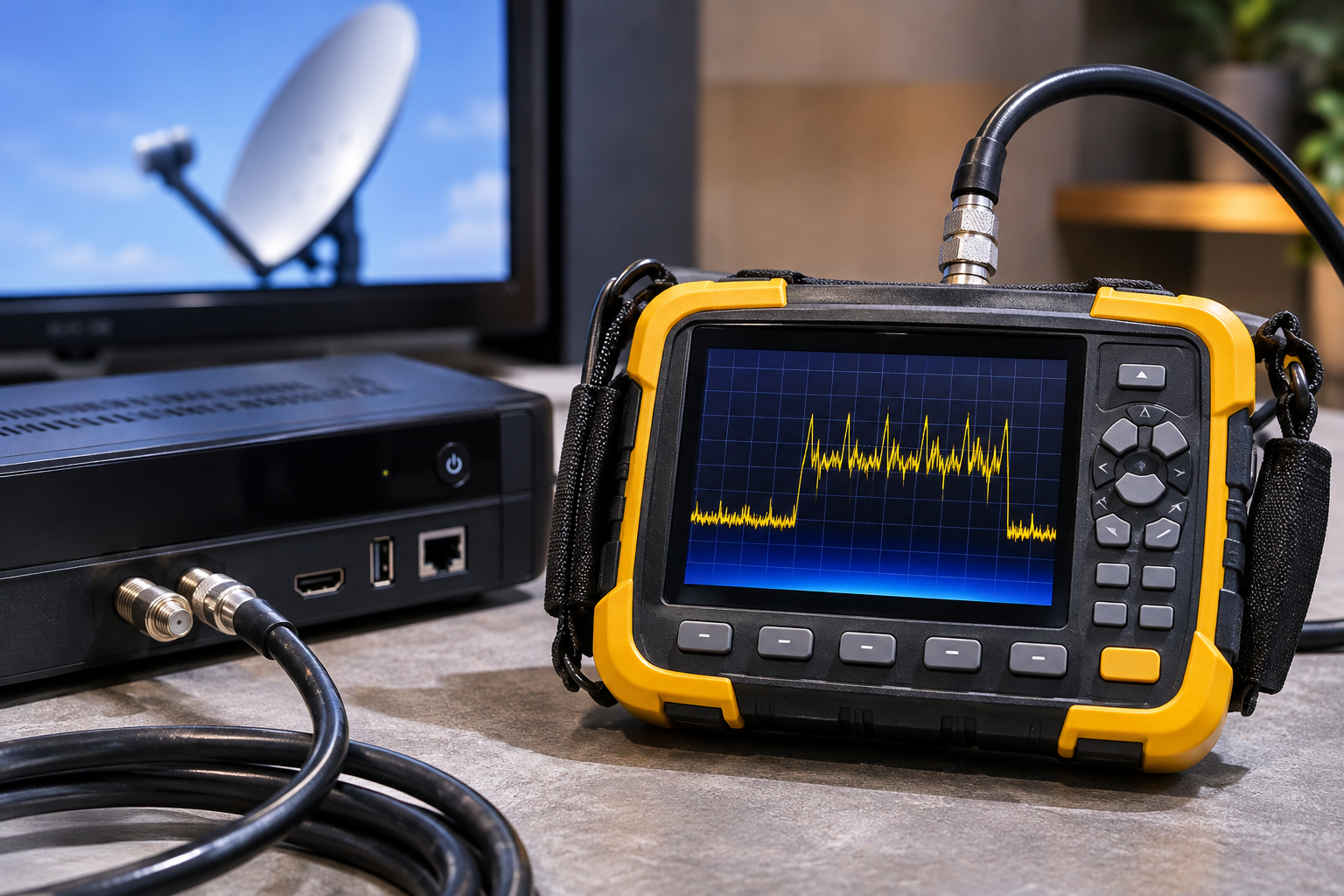
Your satellite receiver shows 90% signal strength on Hot Bird 13°E, yet the signal-quality indicator stays at zero. The transponder refuses to lock, and scanning produces no channels. The number on the screen suggests that plenty of signal is reaching the receiver, so why can’t it decode anything?
The problem is that signal strength and digital carrier lock describe different things. A receiver may detect substantial RF energy without finding a usable transmission at the selected frequency. The apparent strength may come from noise, other satellite carriers, incorrect tuning conditions, or an equipment-specific signal-level calculation. Before adjusting the dish or replacing the LNB, determine whether the receiver is detecting RF power or actually acquiring the intended Hot Bird carrier.
Hot Bird 13°E carries multiple digital satellite transponders. A receiver must select the correct converted frequency, acquire the transmitted waveform, establish synchronization, and recover usable data before services can be discovered. A strength percentage does not independently confirm these operations. The illustrative 90% reading above is not a standardized RF measurement or an actual Hot Bird test result.
What a Strong Satellite Signal Reading Actually Means
Many satellite receivers display two indicators labeled Signal Strength and Signal Quality.
These values may look like precise measurements, but their interpretation depends on the receiver manufacturer and software.
Some strength indicators are derived partly from tuner gain-control behavior or other measurements of received signal level. Others use internal calculations that are not directly comparable with professional RF instruments.
A displayed value of 90% on one receiver does not necessarily represent the same physical input level as 90% on another model.
The Role of Automatic Gain Control
Automatic gain control, or AGC, adjusts receiver gain to help maintain suitable signal levels within the tuner or demodulator processing chain.
Information associated with AGC operation can contribute to a receiver’s signal-level indication, depending on its implementation.
However, AGC behavior does not independently prove that the selected digital carrier has been acquired.
The incoming power may include the desired carrier, unwanted signals, and noise.
That distinction is fundamental when a receiver reports high strength but no lock.
Why Signal Quality Is a Different Indicator
A receiver’s quality indication may reflect demodulator status, error performance, or another implementation-specific measure.
Some receivers show zero quality until a valid lock is established, even when an RF carrier is present.
Therefore, a zero quality percentage does not by itself quantify the amount of noise or interference.
It may simply indicate that the receiver has not reached the state required to calculate or display its quality estimate.
Why RF Power Does Not Guarantee Carrier Lock
Locking a digital satellite transmission involves more than detecting incoming electromagnetic energy.
The receiver must tune the appropriate intermediate frequency, recover symbol timing, establish carrier synchronization, and recognize a supported transmission format.
If one of these operations cannot be completed, the receiver may report No Lock even when substantial RF power reaches its input.
Carrier Energy Versus Usable Modulation
A valid satellite carrier contains structured modulation that the receiver must recognize and process.
Interference, phase noise, frequency error, or insufficient carrier quality can prevent successful synchronization.
In other cases, the incoming RF energy may not contain the selected carrier at all.
For example, a receiver connected to the wrong LNB path may detect power from other transponders while failing to find the specific Hot Bird transmission being requested.
Why a Receiver Cannot Decode Noise
Noise contributes to measured RF power but does not carry the intended digital information.
A high overall input level can therefore coexist with insufficient carrier-to-noise ratio for successful reception.
The same principle applies when an interfering signal contributes significant power within the relevant receiving path.
Increasing the displayed strength does not guarantee improved demodulation.
A Strong Reading Can Come From the Wrong Satellite
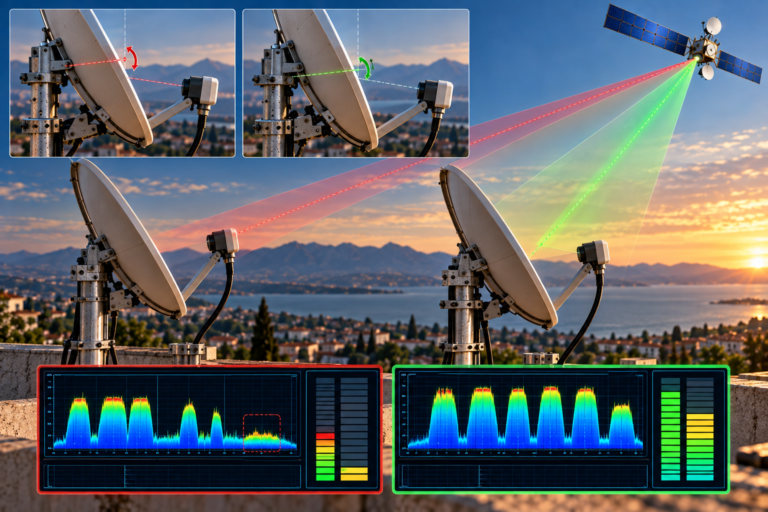
Choosing Hot Bird 13°E in a receiver’s menu does not physically confirm that the antenna is receiving that orbital position.
Hot Bird 13°E and Astra 19.2°E occupy different orbital positions, and installations receiving both may use separate LNBs or a suitable multi-feed arrangement.
If the dish points toward an unintended satellite, or the DiSEqC system selects the wrong feed, the tuner can receive RF energy without acquiring the requested Hot Bird transponder.
Why the Satellite Name Is Not Proof
Receiver satellite names are configuration entries. They typically reference stored transponders and switching settings.
They do not independently identify the origin of every signal reaching the tuner.
A strong signal bar under the Hot Bird name can therefore be misleading.
Use a currently verified reference carrier and, where supported, service or network information to confirm which satellite is actually being received.
A basic signal finder that detects power without identifying carriers is not sufficient for reliable orbital-position verification.
Incorrect Frequency, Symbol Rate or Transmission Settings
Even with the dish correctly aligned, a receiver may fail to lock because it is attempting to tune the wrong transmission parameters.
Satellite broadcasters can change carrier assignments or transmission configurations.
Older receiver databases may contain information that no longer matches the current broadcast.
Frequency and Symbol Rate
The receiver must tune to the relevant carrier frequency after accounting for LNB conversion.
It must also establish the symbol timing required by the transmission.
An incorrect symbol rate can prevent acquisition, particularly when the receiver cannot compensate for the discrepancy within its supported search range.
Some receivers offer automatic symbol-rate detection, but this capability is not universal.
Modulation and Transmission Compatibility
The receiver must support the selected broadcast standard and transmission mode.
A DVB-S-only receiver cannot acquire a DVB-S2 carrier simply by changing its saved channel list.
Likewise, certain advanced transmission modes may require capabilities absent from older hardware.
The correct parameters should be obtained from a reliable, current source rather than copied from an outdated channel list.
LNB Oscillator and Switching Errors
A conventional universal Ku-band LNB converts satellite downlink frequencies into lower intermediate frequencies suitable for transmission through coaxial cable.
Typical nominal local oscillator frequencies are 9,750 MHz for the lower band and 10,600 MHz for the upper band.
The receiver must use matching settings to calculate where the converted carrier should appear.
Incorrect Local Oscillator Configuration
If the receiver uses the wrong LNB oscillator settings, it may tune to an incorrect IF frequency.
RF power can still be present at the input, but the expected carrier may be absent from the selected tuning window.
This can produce strong signal-level indications with no lock.
Polarization and Band Switching
Conventional universal LNBs commonly use nominal 13V and 18V control states for vertical and horizontal polarization, while a 22 kHz tone selects the upper frequency band.
Incorrect control signals can cause the receiver to select the wrong group of transponders.
If the problem consistently affects horizontal or vertical carriers, the polarization-selection path deserves closer examination.
Our related article, Why Hot Bird Signal Changes Between H and V, explains how voltage switching, LNB skew, cabling, and distribution systems can affect reception differently across the two polarizations.
Remember that Quattro/multiswitch and Unicable/SCR installations use different distribution arrangements. Direct universal-LNB troubleshooting procedures should not be applied blindly to these systems.
Why MER and C/N Matter More Than a Strength Percentage
Professional satellite reception measurements distinguish the amount of received energy from the quality of the modulated carrier.
Two important measurements are carrier-to-noise ratio and modulation error ratio.
Carrier-to-Noise Ratio
C/N describes the relationship between carrier power and noise power within a specified measurement bandwidth.
It helps characterize the conditions under which the receiver must recover the digital transmission.
A carrier with inadequate C/N may fail to acquire or maintain synchronization.
Modulation Error Ratio
MER describes the magnitude of modulation errors relative to the ideal signal constellation.
It can reveal impairments associated with noise, interference, distortion, and other deviations from ideal modulation.
MER is valuable when assessing whether a carrier has usable reception margin.
However, reliable MER measurement normally requires the instrument to establish the necessary synchronization. When the carrier cannot be acquired, MER may be unavailable or invalid.
Why No Single MER Threshold Fits Every Transponder
Digital satellite transmission modes have different operating requirements.
Modulation, coding rate, receiver design, and other parameters influence the quality required for reliable reception.
It would be inaccurate to claim that every DVB-S2 transponder requires the same MER or C/N.
| Indicator | What It Describes | Important Limitation |
|---|---|---|
| Signal Strength % | Receiver-specific input-level indication | Does not prove valid carrier lock |
| Signal Quality % | Receiver-specific reception-quality or lock-related indication | Not standardized across devices |
| C/N | Carrier power relative to noise | Requires correct measurement interpretation |
| MER | Modulation error performance | May be unavailable without suitable synchronization |
| Lock Status | Receiver reports successful acquisition at its defined stage | Does not by itself prove that a service can be decoded |
When Interference or Excessive RF Level Prevents Lock
Insufficient signal is not the only RF problem that can stop a receiver from locking.
Unwanted signals and excessive input levels may also interfere with normal operation.
Frequency-Selective Interference
Interference can enter a satellite receiving system through inadequate cable shielding, damaged connectors, faulty distribution equipment, or unwanted emissions from nearby electronic devices.
Depending on its frequency and strength, interference may affect only certain portions of the satellite IF spectrum.
A receiver can then report substantial RF energy while the wanted carrier remains unusable.
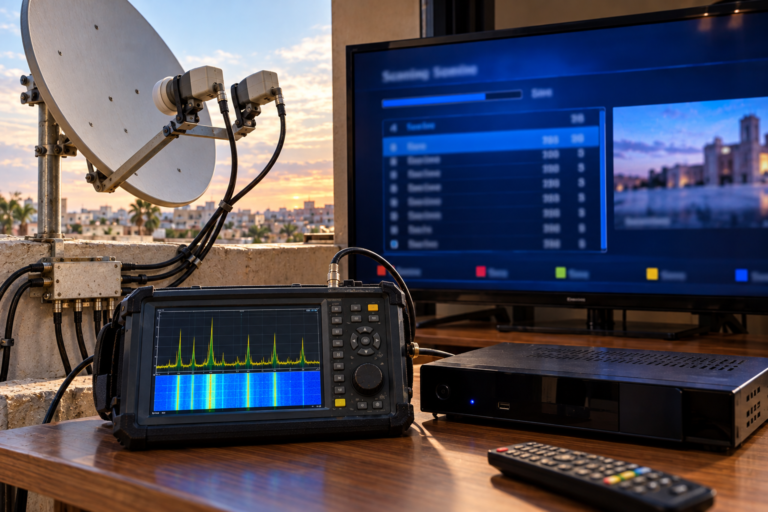
A spectrum analyzer can help identify unexpected peaks, elevated noise, and other abnormal signal characteristics.
However, a visible spectrum peak should not automatically be classified as interference without confirming its source.
Receiver Input Overload
Excessively high levels can drive parts of the receiving system outside their intended linear operating range.
This may produce distortion or intermodulation, particularly where additional distribution amplifiers are used.
The result can be reduced modulation quality despite a high signal-level indication.
Overload should be confirmed through appropriate measurements rather than assumed whenever the strength percentage appears high.
Why Random Amplification Can Make Things Worse
Adding an amplifier may increase the input level without improving the carrier-to-noise conditions.
If the installation already has adequate level, additional gain can introduce distortion or overload.
Amplifiers should be selected to compensate for a demonstrated distribution loss and operated within the specified level limits.
When the Receiver Itself Is the Limitation
Two receivers connected to equivalent signal paths may behave differently when acquiring a satellite carrier.
Their tuner sensitivity, search algorithms, supported modulation modes, oscillator tolerances, and firmware implementations may differ.
A carrier that one receiver locks successfully may be difficult or impossible for another unit to acquire.
Firmware and Transponder Databases
Firmware can affect tuning procedures and the handling of stored transmission parameters.
Updating software may correct known receiver problems, but it cannot provide hardware support for fundamentally unsupported transmission standards.
Use the manufacturer’s supported update procedure and preserve existing settings when appropriate.
Comparing Receivers Correctly
If possible, compare the affected carrier using a second compatible receiver and an equivalent RF path.
Keep the LNB settings, cable conditions, and transponder parameters consistent.
A repeatable difference suggests that receiver behavior deserves further investigation.
It does not automatically prove that one tuner is defective.
What Different Strong-Signal, No-Lock Symptoms Reveal
| Observed Symptom | Possible Explanation | Recommended Check |
|---|---|---|
| High strength, zero quality on every selected Hot Bird carrier | Wrong satellite, LNB settings or RF path | Confirm orbital position and configuration |
| Only certain transponders fail to lock | Incorrect parameters, limited margin or frequency-selective fault | Verify the affected carriers individually |
| All horizontal or vertical carriers fail | Polarization selection or distribution problem | Check H/V routing and control settings |
| Only upper-band carriers fail | Band switching or conversion configuration | Check applicable 22 kHz and LO settings |
| High measured RF level with degraded quality | Interference, distortion or excessive noise | Measure spectrum, C/N and MER where available |
| One receiver locks while another does not | Receiver capability, configuration or tuner behavior | Compare devices on an equivalent signal path |
| Carrier locks after correcting transponder settings | Outdated or incorrect tuning information | Update the relevant receiver entry |
These patterns are diagnostic clues, not definitive fault identification. Confirm the underlying conditions before replacing equipment.
How to Diagnose Strong Hot Bird Signal With No Lock
Step 1: Confirm the Actual Satellite
Start by verifying that the dish or selected LNB feed receives Hot Bird 13°E.
Do not rely solely on the satellite name in the receiver menu or the signal-strength bar.
Use a currently verified reference transponder and appropriate identification information where supported.
Step 2: Verify Current Transponder Parameters
Check frequency, polarization, symbol rate, and required transmission characteristics against a reliable, updated source.
Correct any outdated entries before repeating the tuning attempt.
A blind scan may be useful on compatible equipment, but it cannot guarantee detection of every carrier.
Step 3: Confirm LNB and Switching Configuration
Identify the installed LNB type and distribution arrangement.
Verify local oscillator frequencies, polarization selection, band switching, and applicable DiSEqC settings.
For multiswitch or SCR/dCSS installations, follow the appropriate manufacturer-specific configuration procedure.
Step 4: Check Actual Lock Status
Observe whether the receiver can acquire the selected transponder.
If professional measurement equipment is available, distinguish received RF level from carrier synchronization and valid digital lock.
Do not interpret a zero quality percentage as a calibrated noise measurement.
Step 5: Measure Carrier Quality
Where possible, use a suitable satellite analyzer to inspect the selected carrier.
Measure C/N and, when demodulation permits, MER and relevant error performance.
If the carrier cannot be acquired, examine the spectrum and other available RF measurements rather than assuming a valid MER value exists.
Step 6: Investigate the Signal Path
Inspect cable condition, connectors, switching equipment, and any distribution amplifiers.
Look for excessive attenuation, abnormal RF levels, or interference.
Change only one variable at a time so that any improvement can be attributed to a specific correction.
Step 7: Compare With Known-Good Equipment
When practical, test the same carrier using another compatible receiver or a professional analyzer.
Maintain comparable signal-path conditions.
This can help determine whether the problem follows the receiver or remains present in the antenna and distribution system.
Confirm the satellite → Verify transponder parameters → Check LNB and DiSEqC configuration → Establish lock status → Measure carrier quality → Inspect the RF path → Compare compatible receivers.
Do not start with a factory reset, full channel scan, or LNB replacement when the actual cause has not been identified.
Disconnect the relevant receiver and powered distribution equipment before changing coaxial connections. Avoid shorting the coaxial center conductor to its shield. Powered RF measurements should be performed with suitable satellite test equipment and manufacturer-approved procedures.
Reality Check: Strong Signal Is Not Proof of Hot Bird Reception
A high receiver signal-strength percentage does not establish that the selected Hot Bird transponder is present, correctly tuned, or suitable for demodulation.
The indicated power may include noise or unwanted signals. The receiver may also be connected to the wrong satellite feed or configured with incorrect LNB and transponder parameters.
Even a genuine carrier can fail to lock when the available signal quality or synchronization conditions are inadequate.
The decisive question is whether the receiver can acquire the correct carrier and recover the digital transmission, not how impressive its signal-strength bar looks.
Final Verdict
Hot Bird 13°E can show strong signal strength without achieving lock because received RF power and usable digital carrier quality are fundamentally different measurements.
Incorrect tuning parameters, wrong satellite selection, LNB conversion errors, insufficient C/N, interference, equipment overload, and receiver limitations can all prevent carrier acquisition.
A systematic diagnosis begins by confirming the satellite and transmission parameters, then examining lock status and actual RF quality.
Once the failing stage is identified, corrective action can target the relevant configuration or hardware rather than replacing components based on an unreliable signal percentage.
Frequently Asked Questions
Why does Hot Bird show high signal strength but zero quality?
The receiver may detect RF energy without acquiring the intended carrier. Possible causes include incorrect satellite selection, wrong tuning parameters, insufficient carrier quality, interference, or equipment limitations. Signal percentages are not standardized between receivers.
Can the wrong satellite show a strong signal on the Hot Bird setting?
Yes. The satellite name in the receiver menu does not independently verify the physical signal source. An incorrectly aligned antenna or DiSEqC assignment may deliver energy from another orbital position.
Can a faulty LNB cause strong signal but no lock?
Yes. Incorrect frequency conversion, oscillator instability, switching faults, or other LNB problems can prevent reliable acquisition. However, receiver configuration and the rest of the RF path should be checked before replacing the LNB.
Does 90% signal strength mean the dish is correctly aligned?
No. A strength percentage is usually a receiver-specific indication. It does not prove that the antenna is receiving the intended orbital position or that the selected carrier is available with sufficient quality.
Can excessive signal strength prevent DVB-S2 lock?
Potentially. Excessive RF levels can overload receiving or distribution components and introduce distortion. The actual condition should be verified with measurements rather than inferred from a high percentage display.
Will a full scan fix Hot Bird signal with no lock?
Not when the underlying carrier cannot be acquired. A scan can update service information or help locate transmissions within the receiver’s capabilities, but it cannot repair insufficient RF quality, wrong LNB wiring, or unsupported hardware.
What is the difference between signal level and MER?
Signal level describes received RF power, while MER describes the quality of a recovered modulation constellation relative to its ideal state. A high level does not guarantee good MER, and meaningful MER measurement generally requires appropriate synchronization.