Why Some Viewers Lose Eutelsat 16E Only At Night
Estimated reading time: 18 minutes.
- Why nighttime signal loss happens.
- Temperature effects on LNB performance.
- Signal margin collapse after sunset.
- Frequency drift and synchronization problems.
- Atmospheric changes at night.
- Receiver lock behavior.
- Dish movement caused by cooling.
- Practical fixes for night-only reception issues.
- Why Nighttime Reception Problems Exist
- Temperature Changes After Sunset
- LNB Drift During Evening Hours
- Signal Margin Becomes Critical At Night
- Atmospheric Changes After Dark
- Dish Cooling And Mechanical Movement
- Receiver Synchronization Challenges
- Why HD Channels Usually Fail First
- Technical Comparison Table
- How To Fix Night-Only Signal Loss
- Reality Check
- Final Verdict
- FAQ
Why Nighttime Reception Problems Exist
When reception problems occur only at night, many users assume the satellite changes power levels after sunset.
In most cases, that is not what happens.
The satellite continues operating normally.
The real change occurs within the receiving environment.
As temperatures fall and atmospheric conditions shift, hardware that was already operating close to its limits may begin struggling.
Nighttime signal loss is often a symptom of a marginal installation rather than a satellite transmission issue.
The system works during the day because enough signal margin exists.
At night, that margin becomes smaller.
Temperature Changes After Sunset
Satellite equipment spends its entire life outdoors.
During the day, dishes, brackets, LNBs, and cables absorb heat continuously.
After sunset, temperatures begin dropping.
Different materials cool at different speeds.
These thermal changes affect both electronic and mechanical components.
Although the changes appear small, satellite reception often depends on extremely precise conditions.
A tiny shift in performance may be enough to push a weak installation below the decoding threshold.
LNB Drift During Evening Hours
The LNB is one of the most sensitive components in the reception chain.
Inside the LNB, an oscillator converts incoming satellite frequencies into lower frequencies that the receiver can process.
As temperature changes, oscillator behavior may change as well.
Some LNBs maintain excellent stability.
Others experience noticeable drift.
Modern DVB-S2 transmissions require accurate synchronization.
Even small amounts of frequency drift can increase BER and make certain transponders difficult to decode.
This is one reason some viewers lose channels only after dark.
Signal Margin Becomes Critical At Night
Signal margin is the reserve above the minimum decoding threshold.
Strong installations have a comfortable reserve.
Weak installations operate very close to the limit.
During daytime conditions, the system may maintain enough reserve for stable decoding.
After sunset, thermal changes and frequency instability reduce that reserve.
The receiver suddenly has less room to handle errors.
Channels begin freezing or disappearing.
This often creates the illusion that the satellite becomes weaker at night.
Atmospheric Changes After Dark
The atmosphere changes continuously throughout the day.
Temperature layers shift.
Humidity levels change.
Air density changes.
These effects are usually small but can become important when signal margin is already limited.
Strong installations absorb these variations easily.
Marginal systems may react with visible quality fluctuations.
Nighttime atmospheric conditions can therefore expose weaknesses that remain hidden during the day.
Dish Cooling And Mechanical Movement
Satellite dishes expand when heated and contract when cooled.
The movement is extremely small, but alignment precision matters.
A dish that is already slightly off its quality peak may lose additional performance as temperatures change.
The effect is often invisible during strong daylight conditions.
After sunset, cooling may shift the dish enough to affect sensitive frequencies.
This is particularly noticeable on installations operating close to their reception limits.
Receiver Synchronization Challenges
Receivers continuously synchronize themselves with incoming digital streams.
When signal quality remains stable, synchronization is easy.
When BER rises and signal margin falls, synchronization becomes harder to maintain.
The receiver may repeatedly gain and lose lock.
Channels freeze, recover, then freeze again.
The signal itself still exists.
The receiver simply struggles to maintain reliable decoding conditions.
Why HD Channels Usually Fail First
Most Eutelsat 16E HD channels use DVB-S2 transmission.
DVB-S2 offers excellent efficiency but requires cleaner signal quality.
Small increases in BER affect HD services more quickly.
This is why viewers often notice night-only problems first on HD channels.
The HD transponder is not necessarily weaker.
It simply requires better synchronization and stronger signal margin.
When conditions become marginal, HD channels are usually the first to reveal the problem.
Technical Comparison Table
| Factor | Daytime Reception | Nighttime Reception |
|---|---|---|
| LNB stability | Often stable | Possible drift |
| Signal margin | Larger reserve | Reduced reserve |
| Receiver synchronization | Reliable | More sensitive |
| Dish geometry | Warm structure | Cooling structure |
| BER behavior | Lower error rate | Potential increase |
| HD channel stability | Usually stable | Often affected first |
How To Fix Night-Only Signal Loss
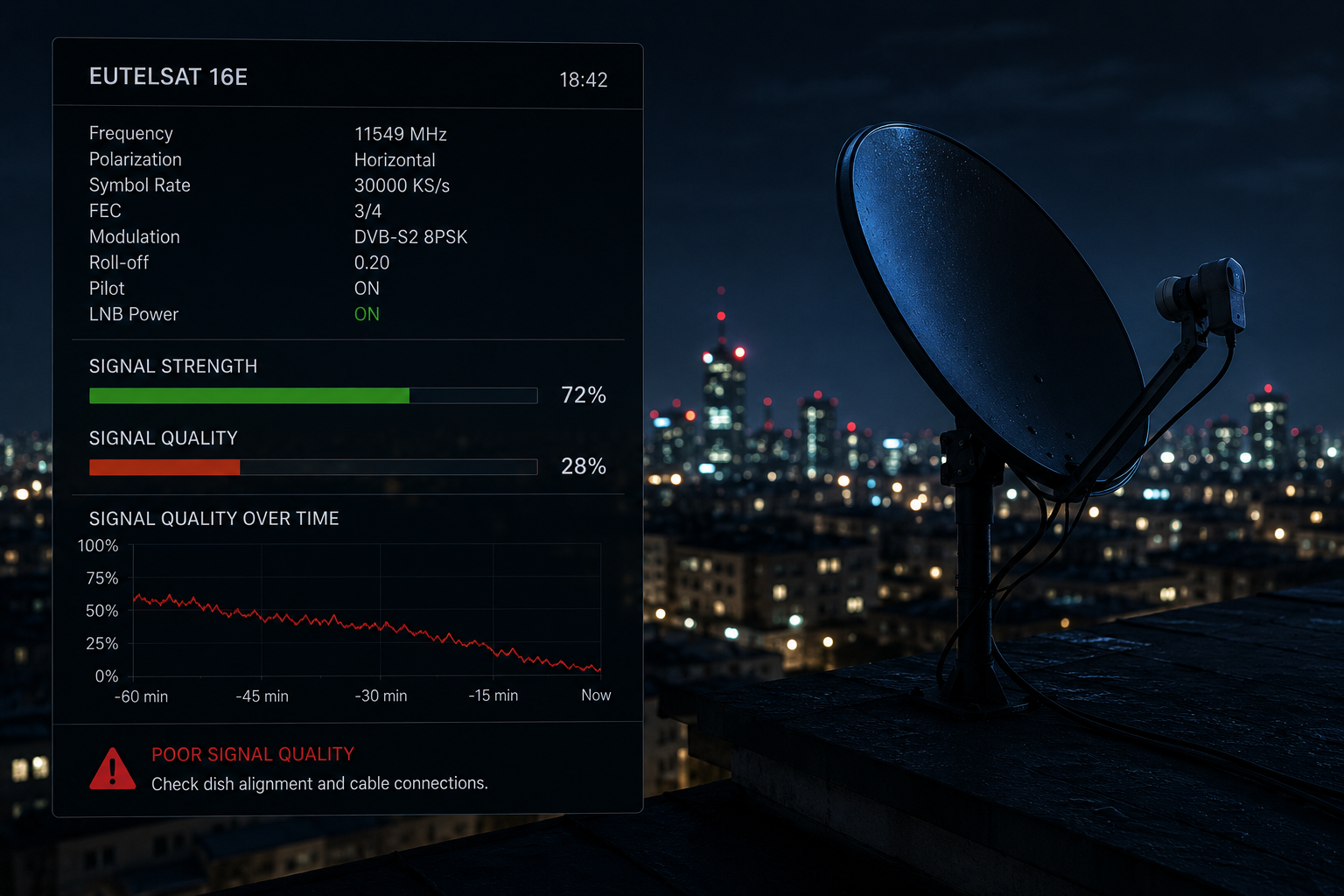
Begin by maximizing signal quality rather than strength.
Fine-tune dish alignment carefully.
Inspect the LNB for instability or age-related degradation.
Verify proper LNB skew adjustment.
Check cables and connectors for moisture or corrosion.
Monitor signal quality during both day and night conditions.
Patterns often reveal whether the problem comes from alignment, thermal drift, or weak signal margin.
In many cases, improving signal margin by only a few percentage points completely eliminates nighttime reception problems.
For additional information about situations where the receiver detects the satellite but struggles to decode channels, read Why Your Receiver Finds Eutelsat 16E But Cannot Lock Channels.
Night-only signal loss rarely means the satellite becomes weaker after dark. Most cases involve local reception issues such as LNB drift, shrinking signal margin, cooling-related alignment changes, or increased synchronization sensitivity. The satellite continues transmitting normally while the receiving system becomes less tolerant of errors.
The reason some viewers lose Eutelsat 16E only at night is usually a combination of thermal changes, LNB behavior, signal margin reduction, and receiver synchronization sensitivity. Nighttime conditions expose weaknesses that remain hidden during the day. By improving alignment, stabilizing the LNB, and increasing signal margin, most night-only reception problems can be eliminated permanently.
FAQ
| Question | Answer |
|---|---|
| Why does Eutelsat 16E work during the day but fail at night? | Usually because nighttime conditions expose weaknesses in signal margin, alignment, or LNB stability. |
| Can temperature affect satellite reception? | Yes. Temperature changes influence both electronic and mechanical components. |
| What is LNB drift? | It is a change in frequency stability caused by oscillator behavior inside the LNB. |
| Why do HD channels fail first? | Because DVB-S2 HD channels require cleaner signal quality and stronger synchronization. |
| Can dish cooling affect reception? | Yes. Small thermal contractions can affect marginal alignments. |
| What is the best fix? | Improve signal quality, maximize signal margin, and verify LNB stability. |