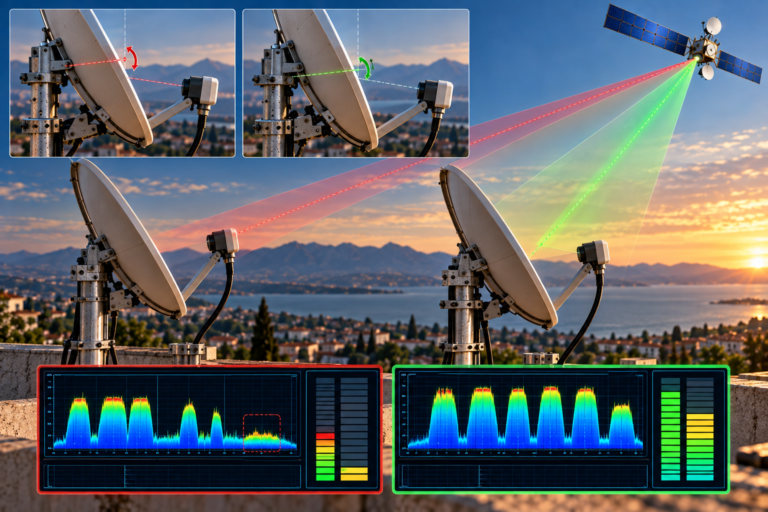
Why Hot Bird Needs Different Dish Sizes in Europe
A small satellite dish receives Hot Bird 13°E reliably at one European home, while another household needs a noticeably larger reflector to watch the same satellite services without interruptions. Both installations point toward the same orbital position, so why should their antenna requirements differ?
The answer is not as simple as assigning one dish diameter to each country. The available satellite power changes across the coverage area, while local elevation angle, antenna efficiency, weather conditions, and receiver requirements also influence reception. A dish that provides comfortable margin at one location may be barely adequate somewhere else. Choosing the correct size means evaluating the complete satellite link budget at the actual receiving location, rather than relying on a general country-based recommendation.
Hot Bird 13°E is served by Eutelsat’s HOTBIRD 13F and 13G satellites, providing Ku-band broadcast coverage across Europe, North Africa, and the Middle East. The receiving antenna size needed for reliable service depends on local coverage, the relevant carrier, receiving-system performance, and the desired weather availability. Coverage maps are useful planning references, but they do not guarantee a particular dish diameter for every installation.
Why Hot Bird Coverage Is Not Identical Across Europe
A geostationary satellite transmits radio signals through antennas designed to illuminate particular geographic regions.
The resulting radiation pattern is commonly represented by a coverage footprint.
Although Hot Bird serves a broad European market, the power available from a particular downlink does not have to be exactly the same at every receiving location.
Changes in the satellite antenna pattern produce different levels of effective radiated power across the coverage area.
One Orbital Position Does Not Mean One Uniform Signal
HOTBIRD 13F and 13G operate at the same nominal orbital position, but the practical reception conditions depend on the satellite, relevant beam, and transmitted service.
Coverage maps can identify broad areas of strong and reduced downlink power.
Individual transponder characteristics and receiving-system requirements still matter.
Receiving one Hot Bird transponder reliably does not prove that every other transmission has identical reception margin.
Why Geographic Position Matters
An installation located within a favorable coverage region may receive sufficient downlink power with a relatively small antenna.
Another location may require additional antenna gain to achieve comparable reliability.
That difference should be evaluated using the appropriate satellite coverage information rather than assuming that all installations in a country receive exactly the same signal.
What EIRP Means for Satellite Dish Requirements
Equivalent isotropically radiated power, or EIRP, describes the effective radiated power of a transmitting system in a specified direction.
Satellite downlink EIRP is commonly expressed in dBW.
It combines transmitter power and transmitting-antenna gain while accounting for applicable losses.
For satellite reception planning, EIRP helps describe how much power is transmitted toward a receiving location.
Why Higher EIRP Can Reduce the Required Dish Size
All else being equal, a higher downlink EIRP can increase the received carrier power.
This may allow a smaller receiving antenna to provide sufficient link margin.
Lower available EIRP may require greater receiving antenna gain to achieve similar operating conditions.
However, EIRP alone does not establish the correct dish diameter.
Free-space path loss, atmospheric attenuation, receiving-system noise performance, interference, and transmission requirements also influence the result.
Why EIRP Is Not a Receiver Signal Percentage
An EIRP value in dBW is an engineering parameter describing the transmitted signal in a direction.
A receiver’s signal-strength percentage is usually a manufacturer-specific indication of received level or tuner behavior.
These measurements should not be treated as interchangeable.
A receiver reporting high signal strength does not automatically demonstrate sufficient carrier quality for successful digital reception.
How to Read a Hot Bird Satellite Footprint Map
A satellite footprint map generally shows coverage boundaries or contours associated with specified downlink power levels.
For example, a series of EIRP contours can indicate how the expected radiated power varies across the intended coverage region.
These contours are useful when comparing receiving locations.
What EIRP Contours Actually Show
Contours connect locations associated with the same modeled or specified downlink EIRP level.
They help planners estimate the available signal power before accounting for all local receiving-system variables.
The contours should be interpreted according to the map’s satellite, beam, frequency assumptions, and documentation.
Why a Footprint Is Not a Hard Reception Boundary
A coverage contour should not be interpreted as a physical wall beyond which reception becomes impossible.
Reception outside a particular contour may still be possible with suitable antenna gain and favorable conditions.
Similarly, reception inside a contour is not guaranteed when the dish is misaligned or the receiving system is defective.
Operator coverage information should be combined with a proper link-budget assessment.
Why National Borders Can Be Misleading
Satellite coverage patterns are determined by transmitting antennas and orbital geometry, not by national boundaries.
Two homes within the same country may occupy different positions relative to the relevant coverage contours.
Local environmental conditions and installation quality can create additional differences.
That is why country-wide dish-size recommendations should be treated as general planning guidance rather than guaranteed technical specifications.
A coverage map describes the satellite’s expected downlink characteristics. It does not independently account for every receiver, LNB, cable installation, local obstruction, or weather-availability requirement.
How Dish Diameter Changes Receiving Antenna Gain
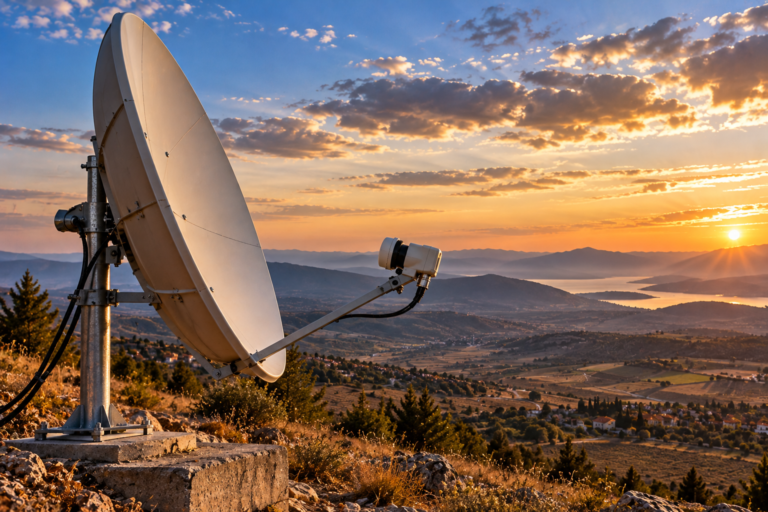
Parabolic satellite dishes concentrate incoming electromagnetic energy toward their feed systems.
For a given operating frequency, increasing effective aperture generally increases receiving antenna gain.
The approximate gain of an idealized aperture can be related to its diameter, wavelength, and aperture efficiency.
G = η × (πD / λ)²
Where:
- G: Linear antenna gain.
- η: Aperture efficiency.
- D: Reflector diameter.
- λ: Signal wavelength.
This relationship is useful for understanding how aperture size influences antenna gain. Real reflector performance also depends on feed illumination, mechanical accuracy, and installation geometry.
Why an 80cm Dish Can Have More Gain Than a 60cm Dish
At the same frequency and aperture efficiency, the theoretical gain difference between two circular receiving apertures can be calculated from their diameters.
For 60cm and 80cm:
Gain difference = 20 × log10(80 / 60) ≈ 2.50 dB.
This is a theoretical comparison, not a measured Hot Bird reception result.
Actual reflectors may differ in aperture efficiency, feed design, and mechanical construction.
Why a Few Decibels Can Matter
Digital satellite reception requires sufficient carrier quality for the selected modulation and coding configuration.
A carrier with comfortable margin may remain stable through moderate changes in reception conditions.
A marginal carrier may lose lock after a comparatively small deterioration.
Additional receiving antenna gain can therefore improve reliability when insufficient link margin is the actual limitation.
Why Satellite Elevation Angle Matters Across Europe
Hot Bird is located at a nominal geostationary orbital longitude of 13° East.
Its apparent direction in the sky varies with the receiving station’s geographic coordinates.
The elevation angle describes how high the satellite appears above the local horizon.
How Elevation Changes the Propagation Path
At lower elevation angles, a satellite signal generally travels through a longer slant path within the atmosphere.
This geometry can influence atmospheric attenuation and propagation effects.
The actual impact depends on frequency, location, atmospheric conditions, and other factors.
Elevation angle should therefore be included in a receiving-link assessment, particularly when weather availability is important.
Local Obstructions Can Be More Important Than Beam Coverage
A building, hillside, tree, or other obstruction can block or weaken the line of sight toward the satellite.
Even a location with favorable satellite EIRP may experience unreliable reception when the antenna does not have a sufficiently clear view.
Increasing dish diameter cannot automatically overcome a physical obstruction in the signal path.
Choosing a suitable mounting location may be more important than purchasing a larger reflector.
Why Weather Margin Changes Dish-Size Requirements
Ku-band satellite signals can experience attenuation during rainfall.
The amount of attenuation depends on factors such as rain intensity, operating frequency, polarization, and propagation geometry.
A system designed only to work during clear weather may become unreliable when additional attenuation occurs.
Clear-Sky Reception Is Not the Same as Reliable Reception
Successful reception on a clear afternoon demonstrates that the system can decode the selected carrier under those conditions.
It does not establish how much additional attenuation the system can tolerate.
The receiving system should provide sufficient margin for the desired service reliability.
That requirement may justify using an antenna larger than the minimum needed for clear-sky lock.
Why Different Locations Can Need Different Weather Reserves
Rainfall characteristics and satellite elevation geometry vary geographically.
Installations designed for different service-availability objectives may therefore require different margins.
For example, a system intended to remain available through a high proportion of adverse-weather conditions may require more reserve than an installation designed for ordinary household use with occasional interruptions accepted.
However, no practical dish size guarantees reception during every severe storm.
Why Rain Margin Is a Link-Budget Decision
Appropriate antenna sizing should consider the expected propagation losses and the minimum reception conditions required by the selected transmission.
Recommendations such as ITU-R P.618 provide methods for evaluating propagation effects on Earth-space communication paths.
They do not assign one universal satellite dish diameter to every European country.
Why Identical Dishes Can Perform Differently in Two Homes
Suppose two households use nominally identical satellite dishes and compatible receivers.
Even then, their actual reception may not be identical.
Possible differences include:
- The relevant EIRP at each receiving location.
- Satellite elevation and atmospheric conditions.
- Reflector pointing accuracy.
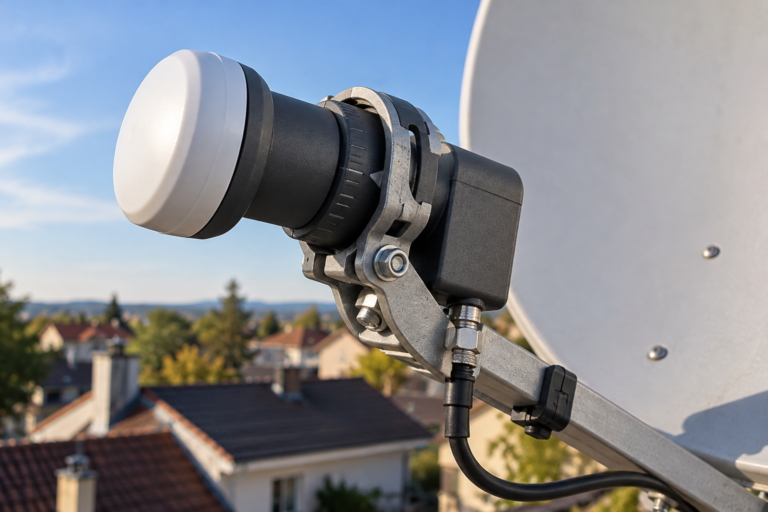
- LNB feed positioning and polarization alignment.
- Coaxial cable length and condition.
- Receiving-system noise performance.
- Local interference and obstructions.
- Mechanical stability during wind.
Some of these variables influence received carrier power, while others affect modulation quality, interference, or the ability to select the intended signal.
Why Signal Strength Alone Cannot Set Dish Size
A receiver may display substantial RF strength while failing to lock the selected satellite carrier.
This can occur when tuning parameters, LNB switching, interference, or actual carrier quality are unsuitable.
Our related guide, Why Hot Bird Signal Looks Strong but Won’t Lock, explains why receiver strength percentages do not independently confirm successful DVB-S2 reception.
Dish sizing should therefore be based on usable link margin, not simply on the highest number displayed by the receiver.
When 60cm, 80cm or Larger Dishes May Be Appropriate
Dish size should be selected according to the actual receiving conditions rather than a universal rule.
The following scenarios illustrate how different sizes may be evaluated.
| Dish Size | Possible Use Case | Important Consideration |
|---|---|---|
| 60cm | Locations with favorable coverage and sufficient link margin | Clear-sky success does not guarantee adequate rain margin |
| 70cm | Installations needing a modest gain increase | Actual benefit depends on reflector efficiency |
| 80cm | Installations requiring more antenna gain or weather reserve | Accurate alignment and suitable mounting remain essential |
| 90cm or larger | Locations or services requiring greater receiving gain | Evaluate beam coverage, mounting loads and complete link budget |
These are general engineering scenarios, not official Eutelsat country-by-country dish requirements.
The appropriate size may be smaller or larger depending on the actual transmission and installation.
Why the Smallest Working Dish Is Not Always the Best Choice
A dish that barely locks a carrier in clear weather may provide insufficient reserve when the receiving conditions deteriorate.
Choosing an antenna with suitable additional margin can improve reliability.
However, using a larger reflector than necessary can increase mounting complexity, wind loading, and installation cost.
The goal is adequate performance, not maximum diameter.
How to Choose the Right Hot Bird Dish Size
Step 1: Identify the Exact Receiving Location
Use the actual installation coordinates rather than a country-wide average.
Confirm that the antenna location provides a suitable line of sight toward 13°E.
Step 2: Identify the Required Services
Determine which Hot Bird transponders the installation must receive.
Verify their current transmission characteristics and avoid relying on obsolete channel lists.
Different carriers may have different reception requirements.
Step 3: Consult Appropriate Coverage Information
Review the operator’s coverage map for the relevant satellite and beam.
Estimate the expected EIRP at the receiving location.
Do not treat one general coverage contour as a complete guarantee for every service.
Step 4: Estimate the Required Link Margin
Consider the operating requirements of the relevant transmission, receiving-system noise performance, and desired weather availability.
Account for appropriate propagation losses and installation characteristics.
A professional link-budget calculation is preferable when reliable service availability is critical.
Step 5: Compare Actual Antenna Specifications
Use manufacturer-provided gain and mechanical specifications for candidate reflectors.
Nominal diameter alone does not describe every aspect of antenna performance.
Feed compatibility and reflector efficiency also matter.
Step 6: Check Mechanical and Installation Requirements
Confirm that the chosen antenna can be installed with accurate pointing and sufficient structural stability.
Larger dishes generally create greater wind-loading demands and require suitable mounting hardware.
Follow applicable local safety and installation requirements.
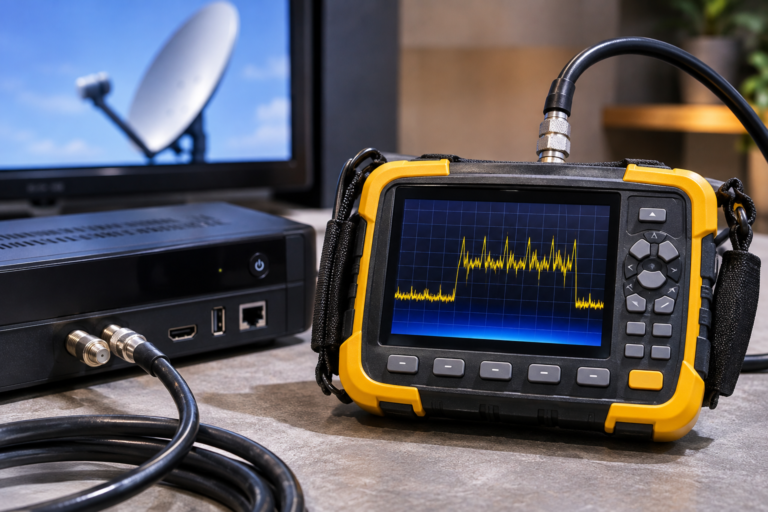
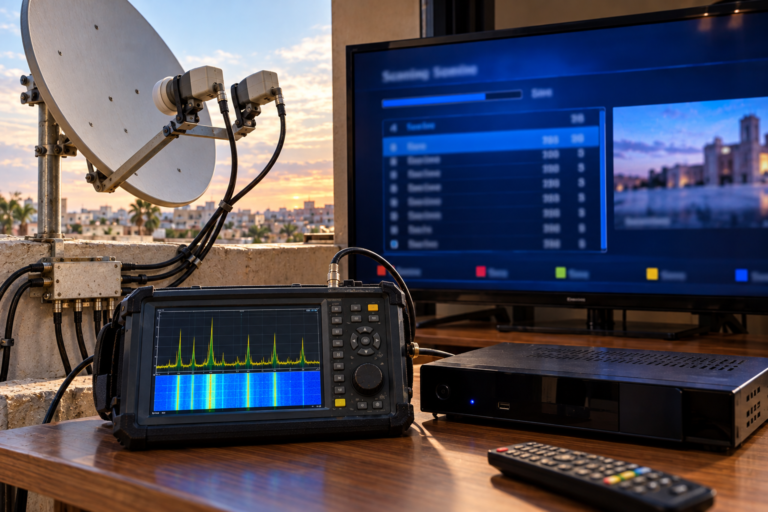
Step 7: Verify the Installation With Measurements
After installation, check representative transponders using suitable signal-quality measurements.
Record lock status, C/N, MER, and relevant error information where supported.
Evaluate several carriers rather than treating one strong transponder as proof of complete reception.
Exact location → Required services → Relevant coverage map → Link-budget estimate → Antenna specifications → Installation requirements → Measured reception margin.
This method provides a stronger technical basis for dish selection than a generalized country-based chart.
Common Mistakes When Reading Hot Bird Coverage Maps
Several common assumptions can lead to poor antenna-sizing decisions.
Mistake 1: Assuming One Dish Size Works Everywhere
A broad European coverage footprint does not establish identical received power or weather margin at every location.
Mistake 2: Treating a Footprint Edge as a Reception Wall
Coverage contours describe specified signal conditions. They do not prove that reception becomes physically impossible immediately outside a marked boundary.
Mistake 3: Using EIRP Without Considering Receiver Requirements
The required carrier quality depends on the actual transmission and receiving system.
Received power alone is insufficient for determining whether a particular carrier will decode reliably.
Mistake 4: Ignoring Weather Availability
An installation that works under clear skies may lack sufficient reserve during adverse propagation conditions.
Mistake 5: Assuming a Larger Dish Repairs Every Reception Fault
Incorrect LNB settings, faulty cabling, incompatible transmission modes, or wrong satellite selection cannot be corrected simply by increasing reflector diameter.
Reality Check: Dish Size Cannot Be Determined From Country Name Alone
Hot Bird serves a wide geographic area, but antenna requirements depend on the actual receiving location and the specific services being received.
A country name does not provide enough information to calculate expected EIRP, atmospheric path conditions, antenna performance, and required reception margin.
Likewise, a successful carrier lock with a small dish does not guarantee dependable reception during adverse weather.
The correct dish size is an engineering choice based on coverage, link budget, installation quality, and service-availability requirements, not a universal national rule.
Final Verdict
Hot Bird 13°E may require different satellite dish sizes across Europe because receiving locations do not share identical downlink power, propagation conditions, or installation requirements.
EIRP contours help describe differences in satellite coverage, while antenna gain, elevation angle, receiving-system noise performance, and weather margin determine the practical reception result.
A smaller dish may be sufficient in favorable conditions. A larger reflector may be justified where additional receiving gain or weather reserve is needed.
The most reliable approach is to identify the exact location and required transponders, review appropriate coverage information, estimate the necessary margin, and verify the completed installation with meaningful carrier-quality measurements.
Choose the antenna that provides reliable service under the intended operating conditions, rather than assuming one reflector diameter is correct for every European household.
Frequently Asked Questions
What dish size is needed for Hot Bird 13E in Europe?
There is no single diameter appropriate for every installation. The required size depends on local coverage, receiving-system performance, the selected transponders, installation quality, and desired weather margin.
Can a 60cm dish receive Hot Bird everywhere in Europe?
Not necessarily. A 60cm dish may be sufficient in favorable receiving conditions, but local EIRP, carrier requirements, weather margin, and installation losses must be considered before relying on that size.
Why does the same satellite need different dish sizes in different places?
Satellite antenna coverage is not perfectly uniform, and receiving locations can have different elevation angles and propagation conditions. These factors influence the antenna gain required for reliable reception.
What does EIRP mean on a Hot Bird coverage map?
EIRP means equivalent isotropically radiated power. It describes effective transmitted power in a given direction, commonly expressed in dBW. It helps assess expected receiving conditions but is not itself a dish-size guarantee.
Does satellite elevation affect the dish size?
Elevation influences the atmospheric path and local obstruction geometry. It can affect link-budget considerations, but dish size should be determined from the complete receiving conditions rather than elevation alone.
Is an 80cm dish always better for Hot Bird reception?
An 80cm reflector can provide more receiving gain than a smaller equal-efficiency antenna, but that does not mean it is necessary everywhere or that it fixes configuration, cabling, or compatibility problems.
Can I receive Hot Bird outside the published footprint?
Reception may be possible beyond a particular plotted contour when sufficient antenna gain and suitable conditions are available. However, it should not be assumed or guaranteed without an appropriate technical assessment.
Should I use the smallest dish that gives a picture?
Not necessarily. An antenna that barely provides a usable picture under clear skies may lack sufficient margin during rain or other reception impairments. Choose a size that meets the desired reliability requirements.