What Happens During Astra Satellite Maintenance
Estimated Reading Time: 12 minutes
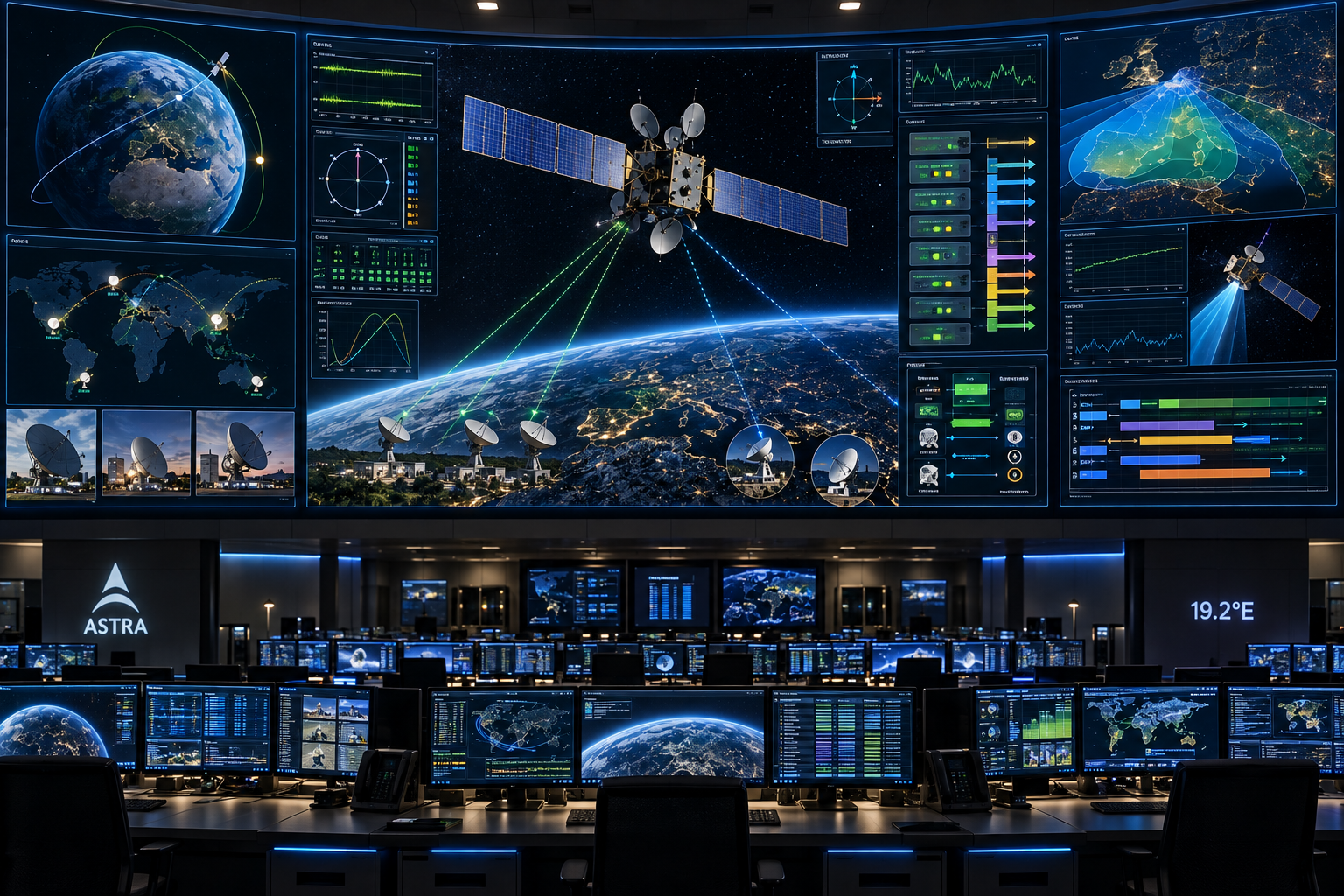
When viewers hear that an Astra satellite is undergoing maintenance, it is easy to imagine technicians physically repairing equipment in orbit. That is not how routine geostationary satellite operations work. Most maintenance is performed remotely from satellite control centres through telemetry, tracking, command, orbital manoeuvres, payload configuration, performance monitoring, redundancy management, and carefully planned operational procedures.
SES says its satellite flight operations infrastructure is staffed 24 hours a day, 365 days a year, with geographically separated operations centres and redundant ground systems. Its work includes performance trending, anomaly resolution, payload management, configuration changes, tracking and command, and in-orbit testing. The objective is normally to keep the spacecraft healthy while making the maintenance invisible to viewers whenever possible. :contentReference[oaicite:0]{index=0}
Satellite maintenance is mostly remote spacecraft management. Engineers monitor thousands of telemetry values, maintain the satellite’s orbital position, configure payload hardware, investigate anomalies, switch to redundant systems when required, test new spacecraft, and plan replacement capacity years before an older satellite reaches the end of its useful life.
- What Satellite Maintenance Really Means
- How Engineers Monitor Astra Satellites
- What Telemetry, Tracking and Command Mean
- Why Geostationary Satellites Need Station Keeping
- What Happens During an Orbital Correction
- How Payload Health Is Monitored
- Why Transponders May Be Reconfigured
- How Redundant Hardware Protects Services
- What Happens When Engineers Detect an Anomaly
- Why Backup Control Centres Matter
- What In-Orbit Testing Is
- How a New Astra Satellite Enters Service
- Why Maintenance Usually Does Not Interrupt TV
- When Viewers Can Notice an Interruption
- How Traffic Can Be Moved Between Satellite Resources
- Why Satellite Replacement Is Part of Maintenance
- Reality Check
- Final Verdict
- FAQ
What Satellite Maintenance Really Means
A communications satellite in geostationary orbit cannot normally be serviced like equipment in a terrestrial broadcast centre.
Routine operations therefore focus on keeping the spacecraft healthy through remote monitoring and control.
Engineers continuously analyse spacecraft status, orbital position, power systems, thermal conditions, payload configuration, communications subsystems, and other engineering telemetry.
Maintenance can include planned commands, configuration changes, manoeuvres, software procedures, payload switching, or contingency actions.
SES describes its satellite operations as covering the full spacecraft lifecycle and says its procedures include performance trending, anomaly resolution, payload management, and configuration. :contentReference[oaicite:1]{index=1}
How Engineers Monitor Astra Satellites
A satellite constantly sends engineering information back to Earth.
These telemetry streams allow controllers to monitor whether spacecraft systems are operating within approved limits.
Typical telemetry can include electrical voltages, currents, temperatures, battery condition, solar-array performance, propulsion status, attitude-control data, payload parameters, and communications subsystem health.
Operational software can flag values that move outside expected ranges.
SES has described constant telemetry monitoring and out-of-limit reporting as part of its normal satellite control procedures. :contentReference[oaicite:2]{index=2}
What Telemetry, Tracking and Command Mean
Satellite operators often group three fundamental control functions under the term TT&C: telemetry, tracking, and command.
Telemetry sends spacecraft health and status information to Earth.
Tracking helps determine the satellite’s precise position and motion.
Command allows the control centre to send instructions back to the spacecraft.
Together, these systems form the basic operational link between the satellite and its controllers.
| Operation | Purpose |
|---|---|
| Telemetry | Reports spacecraft health, temperatures, electrical status, subsystem performance, and payload conditions. |
| Tracking | Determines the spacecraft’s orbit and verifies its position relative to the assigned orbital slot. |
| Command | Sends instructions for manoeuvres, configuration changes, payload switching, and contingency actions. |
| Station Keeping | Maintains the satellite close to its assigned geostationary position. |
| Payload Management | Controls operational RF resources, routing, transponder configuration, and related payload functions. |
| Performance Trending | Looks for gradual changes that may indicate ageing or developing technical issues. |
| Anomaly Resolution | Diagnoses unexpected behaviour and applies approved recovery procedures. |
| In-Orbit Testing | Verifies spacecraft and payload performance before or after major operational changes. |
Why Geostationary Satellites Need Station Keeping
A geostationary satellite appears fixed in the sky because it orbits Earth once per sidereal day near the equatorial plane.
But the spacecraft does not remain perfectly fixed without correction.
Gravitational effects from the Moon and Sun, Earth’s nonspherical gravity field, solar radiation pressure, and other perturbations gradually alter its orbit.
Controllers therefore perform station-keeping manoeuvres to keep the satellite within its permitted orbital control box.
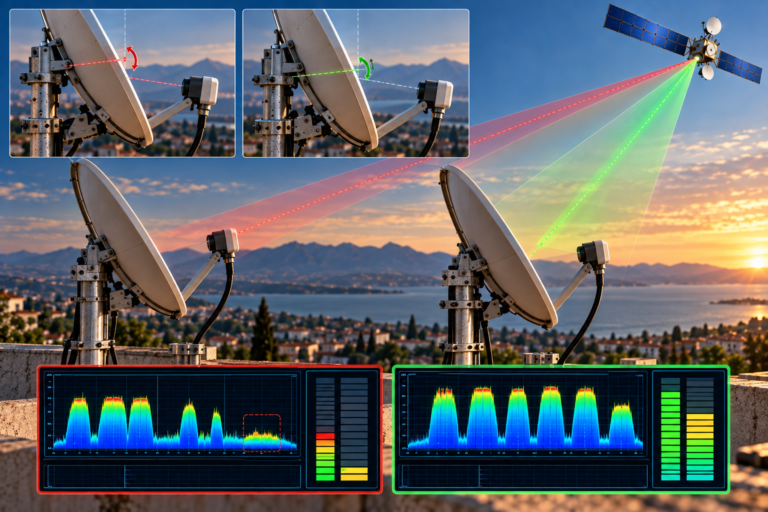
For a major television position such as Astra 19.2E, maintaining accurate orbital position is essential because millions of fixed dishes are pointed toward the same nominal longitude.
What Happens During an Orbital Correction
Engineers first determine the satellite’s current orbital state and calculate the required correction.
A command sequence is prepared, checked, and executed using the spacecraft propulsion and attitude-control systems.
The manoeuvre may correct east-west drift, orbital inclination, or another orbital parameter depending on the requirement.
After the manoeuvre, tracking data is analysed to confirm that the spacecraft moved as expected.
Routine station keeping is designed so that normal broadcast service continues throughout the operation.
SES has stated that validated electronic procedures for station keeping and regular operations are applied across its fleet. :contentReference[oaicite:3]{index=3}
How Payload Health Is Monitored
The communications payload is the part of the satellite that handles customer signals.
For television distribution, that includes RF paths, filters, frequency conversion equipment, amplifiers, switching networks, antennas, and transponder resources.
Engineers monitor performance to detect abnormal temperature, output-power changes, amplifier behaviour, switching problems, or other signs of degradation.
Trending is particularly important because some faults develop gradually rather than appearing as an immediate failure.
By identifying abnormal behaviour early, controllers may be able to change configuration before customers are affected.
Why Transponders May Be Reconfigured
A transponder configuration is not necessarily fixed forever.
Depending on spacecraft design, operators may be able to change routing, switch payload components, alter operational assignments, or transfer traffic to alternative resources.
Such changes can be made for capacity planning, customer requirements, testing, anomaly recovery, or lifecycle management.
This does not mean engineers routinely change television frequencies without coordination. Broadcast frequency changes involve ground infrastructure and customer planning as well as spacecraft configuration.
How Redundant Hardware Protects Services
Communications satellites are designed with redundancy because replacing failed hardware after launch is usually impossible.
Critical systems may therefore include backup components or alternate signal paths.
If one piece of hardware develops a fault, engineers may command the spacecraft to use another available unit.
Redundancy can exist in spacecraft control systems, communications payload hardware, ground stations, networks, and control centres.
SES says its satellite operations infrastructure includes redundant and geographically diverse operations centres, redundant data centres, and multiple ground-station connectivity paths. :contentReference[oaicite:4]{index=4}
What Happens When Engineers Detect an Anomaly
An anomaly is unexpected spacecraft behaviour that requires investigation.
The first step is normally to determine whether the event is real, transient, or caused by another subsystem.
Controllers analyse telemetry, compare current data with historical trends, and follow predefined escalation procedures.
Depending on severity, engineers may isolate hardware, switch to a redundant component, modify payload configuration, place part of the spacecraft into a protective mode, or execute another approved recovery procedure.
SES states that its operational procedures cover both nominal situations and technical emergencies, including anomaly escalation and transfer of operations to backup centres. :contentReference[oaicite:5]{index=5}
Why Backup Control Centres Matter
Satellite control infrastructure on Earth can also fail.
A data-centre outage, power failure, network problem, severe weather event, or local emergency should not remove the operator’s ability to command an expensive spacecraft.
SES therefore operates geographically diverse satellite flight operations centres.
Its current flight-operations information says two centres are staffed continuously and supported by redundant data centres and multiple tracking, telemetry, and command antenna systems. :contentReference[oaicite:6]{index=6}
This terrestrial redundancy is just as important as redundancy onboard the satellite.
What In-Orbit Testing Is
Before a new communications satellite is trusted with commercial traffic, engineers must prove that its payload performs correctly in space.
This process is called in-orbit testing, or IOT.
Tests can verify RF output, frequency response, transponder operation, antenna coverage, polarization performance, switching functions, and other payload characteristics.
SES says its in-orbit testing services include test-plan generation, automated measurement stations, regulatory coordination, and support for Ku-band and other payloads. :contentReference[oaicite:7]{index=7}
The goal is to confirm that the spacecraft performs as expected before customer traffic depends on it.
How a New Astra Satellite Enters Service
Astra 1P is a useful recent example.
It was launched in June 2024 for the 19.2E orbital neighbourhood. After orbital raising and comprehensive performance testing, SES announced on December 19, 2024 that Astra 1P had become fully operational. :contentReference[oaicite:8]{index=8}
SES describes Astra 1P as the most powerful wide-beam satellite to operate at 19.2E. The spacecraft has 80 transponders and was introduced to strengthen long-term television distribution from the orbital position. :contentReference[oaicite:9]{index=9}
This illustrates that fleet maintenance is not limited to correcting faults. Introducing replacement spacecraft before older satellites reach end of life is a central part of maintaining long-term service continuity.
Why Maintenance Usually Does Not Interrupt TV
The ideal satellite maintenance operation is one the viewer never notices.
Routine telemetry monitoring does not interrupt television.
Normal station-keeping manoeuvres are planned around continued service.
Many payload configuration changes can also be performed without affecting customer traffic when sufficient redundancy and alternate resources are available.
Ground infrastructure is similarly designed around backup systems.
This is why a viewer should not assume that every period of satellite engineering work will produce a blank screen.
When Viewers Can Notice an Interruption
Service interruptions are still possible.
A transponder may need to be temporarily unavailable for testing or reconfiguration.
An unexpected spacecraft anomaly can affect one payload chain before traffic is restored or moved.
Uplink equipment on the ground can also fail, creating an outage even when the satellite itself is healthy.
In other cases, broadcasters may intentionally change frequencies, transponders, symbol rates, or multiplex structures during planned network migrations.
A temporary loss of channels therefore does not prove that the spacecraft itself is being physically repaired.
How Traffic Can Be Moved Between Satellite Resources
Astra 19.2E is an orbital neighbourhood rather than a single spacecraft.
This architecture gives SES more flexibility than relying on one satellite alone.
Multiple colocated satellites or replacement capacity can allow services to be transferred as fleets evolve, subject to available frequencies, payload compatibility, coverage, coordination, and ground-system changes.
From the household’s perspective, these spacecraft are close enough to the same geostationary longitude that the receiving dish normally remains pointed at 19.2E.
This makes fleet renewal much less disruptive than moving television services to a completely different orbital location.
Why Satellite Replacement Is Part of Maintenance
Every satellite has a finite operational lifetime.
Propellant availability, battery ageing, solar-array degradation, component condition, redundancy status, and overall spacecraft health influence how long it can remain useful.
Operators therefore plan replacements years in advance.
SES ordered Astra 1P and Astra 1Q as replacement satellites for its 19.2E television neighbourhood, specifically to maintain long-term services for European broadcasters. :contentReference[oaicite:10]{index=10}
Astra 1P entered service in 2024, while SES’s current 19.2E fleet plan describes the newer generation as progressively replacing older capacity. :contentReference[oaicite:11]{index=11}
This planned overlap is one of the reasons a mature satellite platform can continue operating for decades even though individual spacecraft eventually retire.
For more on how this architecture works, see why Astra uses multiple transponders, which explains how frequencies, payload resources, multiplexes, and independent RF carriers divide television capacity across the orbital neighbourhood.
Most Astra satellite maintenance does not involve switching the satellite off.
Routine work includes monitoring telemetry, performing orbital corrections, managing payload configuration, testing redundancy, analysing performance trends, and responding to anomalies while commercial services continue operating.
Likewise, not every channel outage originates in space. Ground uplink failures, broadcaster equipment, multiplex problems, fibre contribution links, planned frequency changes, and household reception faults can all produce symptoms that viewers may mistakenly call “satellite maintenance.”
Determining the true cause requires identifying whether the problem affects one service, one multiplex, one transponder, several transponders, or the entire orbital position.
Astra satellite maintenance is primarily a continuous remote engineering process rather than occasional physical repair.
Controllers monitor spacecraft telemetry around the clock, maintain the satellite’s orbital position, analyse long-term subsystem performance, manage payload resources, command configuration changes, and respond to anomalies. Redundant spacecraft hardware, geographically separated control centres, backup ground stations, and alternate operational procedures are designed to keep services available even when individual components develop problems. :contentReference[oaicite:12]{index=12}
Maintenance also extends beyond the existing spacecraft. New satellites are tested in orbit and introduced before ageing capacity becomes unsuitable for long-term service. Astra 1P’s transition from launch in June 2024 to full commercial operation in December 2024 is a clear example of this lifecycle approach. :contentReference[oaicite:13]{index=13}
For the viewer, the best maintenance event is therefore one that is never noticed. The engineering work is happening constantly behind the scenes so that the dish remains pointed at the same orbital position and the television channels continue to arrive normally.
| Question | Answer |
|---|---|
| Can technicians physically repair an Astra satellite in orbit? | Routine maintenance is performed remotely. Geostationary communications satellites are normally managed through telemetry, commands, orbital manoeuvres, configuration changes, redundancy, and fleet replacement rather than on-site servicing. |
| What is TT&C? | TT&C means telemetry, tracking, and command, the core systems used to monitor a satellite, determine its position, and send instructions to it. |
| Why does an Astra satellite need station keeping? | Gravitational and other orbital perturbations gradually move a geostationary satellite away from its assigned position, so periodic manoeuvres are required. |
| Does station keeping interrupt TV channels? | Routine station-keeping manoeuvres are normally planned so commercial services can continue operating. |
| What happens if a satellite component fails? | Controllers analyse telemetry and may isolate the fault, switch to redundant hardware, change configuration, or use another approved recovery strategy where the satellite design permits it. |
| Does SES monitor satellites continuously? | Yes. SES says its geographically diverse satellite flight operations centres are staffed 24/7/365. :contentReference[oaicite:14]{index=14} |
| What is in-orbit testing? | It is the process of verifying satellite and payload performance in space before commercial service or after major operational changes. |
| Was Astra 1P tested before entering service? | Yes. SES said Astra 1P completed orbital raising and comprehensive performance testing before becoming fully operational on December 19, 2024. :contentReference[oaicite:15]{index=15} |
| Can maintenance cause a temporary channel outage? | Yes, in some cases, particularly during payload reconfiguration, testing, traffic migration, or unexpected anomalies, although routine operations are designed to minimize disruption. |
| Does every Astra outage mean the satellite has a fault? | No. Uplink equipment, terrestrial contribution links, broadcaster systems, multiplexes, transponder configuration, and home reception equipment can also cause outages. |
| Why are replacement satellites needed? | Satellites have finite operational lives, so replacement spacecraft are introduced to preserve capacity, reliability, and long-term service continuity. |
| Why can Astra replace a satellite without moving home dishes? | Replacement spacecraft can be colocated at the same nominal orbital neighbourhood, such as 19.2E, allowing fixed dishes to continue pointing in essentially the same direction. |