Why DVB-S Receivers Miss Modern HD Satellite Channels

Estimated Reading Time: 8 minutes
An older satellite receiver can show strong RF activity from a dish and still fail to display a modern HD channel. The problem is often not the dish, LNB or even the basic presence of the satellite signal. The receiver may simply be unable to demodulate the transmission standard used by the carrier.
This is especially important with the transition from DVB-S to DVB-S2. Modern HD services often use DVB-S2 and modulation such as 8PSK, while older receivers may support only DVB-S with QPSK. Even after the RF carrier has been recovered successfully, another compatibility problem can appear later if the receiver cannot decode the programme’s video or audio codec.
Satellite reception happens in stages. A receiver must first detect and lock the RF carrier, then recover the transport stream, identify the programme and finally decode its video and audio. A failure at any one of these stages can produce a missing channel, black screen or “unsupported” message.
- The Satellite Reception Chain
- What DVB-S Receivers Were Designed For
- Why DVB-S2 Changed the Physical Layer
- Why 8PSK Can Break Compatibility
- FEC Is Part of the Difference
- Why Signal Strength Can Still Appear
- What Happens After Carrier Lock
- DVB-S2 Compatibility Is Not the Same as Video Codec Compatibility
- Why German SD Shutdowns Exposed Old Receivers
- How to Identify Where the Receiver Is Failing
- Do You Need a New Dish?
- Reality Check
- Final Verdict
- FAQ
The Satellite Reception Chain
When a satellite channel appears on a television screen, several technical stages have already succeeded.
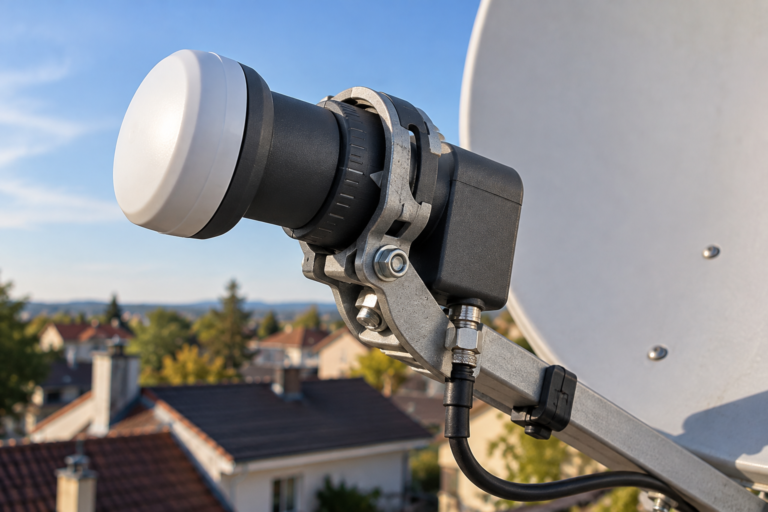
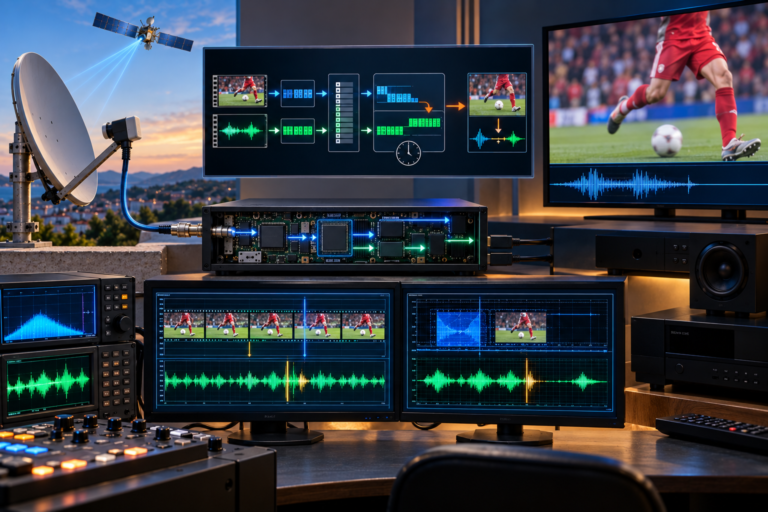
The dish collects the Ku-band signal from the satellite. The LNB amplifies and frequency-converts that signal before sending it through coaxial cable to the receiver.
The receiver tuner selects the required RF carrier. The demodulator then attempts to lock the modulation and recover the transmitted digital information.
Forward error correction is applied, the MPEG transport stream is reconstructed, the selected service is identified, and its video and audio streams are passed to the appropriate decoders.
Dish → LNB → tuner → DVB demodulator → FEC → transport stream → service selection → video/audio decoder → display output.
The important point is that “receiving a satellite channel” is not one technical operation. It is a chain.
An old receiver can succeed at the beginning and fail in the middle.
What DVB-S Receivers Were Designed For
DVB-S was developed for first-generation digital satellite broadcasting and became widely used across Europe.
Traditional DVB-S receivers were commonly designed around QPSK modulation and the forward error correction mechanisms defined by that standard.
For many years, this was sufficient for large numbers of SD television services.
But satellite operators and broadcasters needed more efficient use of bandwidth. As HD distribution expanded, the industry increasingly adopted DVB-S2.
The important distinction is that DVB-S2 is not simply a software label added to DVB-S.
It introduces significant changes at the physical transmission layer.
A receiver built only for DVB-S does not automatically know how to process a DVB-S2 carrier.
Why DVB-S2 Changed the Physical Layer
DVB-S2 was designed to improve spectral and power efficiency compared with DVB-S.
It supports additional modulation and coding combinations and more advanced error correction. This allows broadcasters to use satellite capacity more efficiently or achieve different trade-offs between capacity and robustness.
For direct-to-home television, one major practical change was the widespread use of DVB-S2 with 8PSK for HD multiplexes.
A DVB-S-only demodulator cannot necessarily recover such a carrier.
The receiver may tune to the correct frequency. Its front end may detect RF power. But if its demodulator does not understand the DVB-S2 waveform, it cannot reconstruct the transmitted data.
The failure occurs before the receiver even reaches the programme-level video stream.
Why 8PSK Can Break Compatibility
Modulation determines how digital information is represented on the RF carrier.
QPSK uses four constellation states and carries two raw bits per modulation symbol before coding overhead.
8PSK uses eight constellation states and carries three raw bits per symbol before coding overhead.
This improves spectral efficiency, but it also changes what the receiver’s demodulator must be able to interpret.
| Feature | Typical DVB-S Receiver | Modern DVB-S2 Receiver |
|---|---|---|
| DVB-S | Supported | Normally supported |
| DVB-S2 | Usually unsupported | Supported |
| QPSK | Supported | Supported |
| 8PSK | Typically unsupported in legacy DVB-S hardware | Supported when implemented by the receiver |
| Modern DVB-S2 FEC | Unsupported | Supported |
This means an old receiver can be connected to a perfectly aligned dish and still fail completely on a modern carrier.
The antenna cannot solve a demodulation-standard mismatch.
FEC Is Part of the Difference
Forward error correction allows a receiver to detect and correct transmission errors without requesting the satellite to send the data again.
This is essential in broadcast systems because the downlink is one-way.
DVB-S2 uses powerful LDPC and BCH coding.
These mechanisms are fundamentally part of the DVB-S2 transmission chain.
An older DVB-S receiver does not simply need to recognize 8PSK. It also needs the correct physical-layer processing and error-correction architecture.
This is another reason firmware updates cannot generally turn a DVB-S-only receiver into a true DVB-S2 receiver.
The limitation is often in dedicated demodulation hardware.
Why Signal Strength Can Still Appear
This is where satellite troubleshooting becomes confusing.
A receiver may display 70%, 80% or even 90% “signal strength” while showing no picture and no valid channel lock.
That is possible because the receiver may be measuring RF energy at or near the tuner input rather than proving that it has successfully demodulated the wanted digital carrier.
Signal strength percentages on consumer receivers are also not standardized engineering measurements.
Different receiver manufacturers can map completely different tuner readings onto similar-looking percentages.
The more useful question is whether the receiver has achieved a valid carrier lock with sufficient quality.
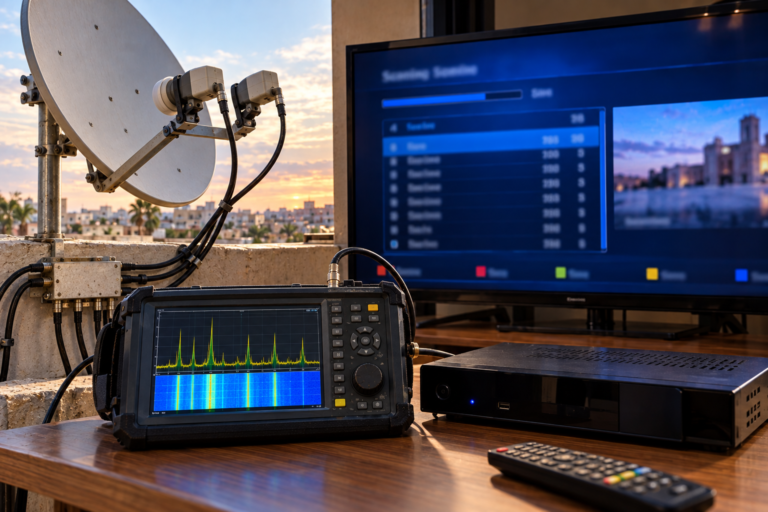
Measurements such as MER and BER are far more informative when suitable equipment is available.
RF power detected does not mean DVB-S2 demodulation succeeded. Demodulation succeeded does not mean the video codec can be decoded. Each stage must be considered separately.
What Happens After Carrier Lock
Suppose the receiver does support DVB-S2 and successfully locks the carrier.
The next stage is recovering the transport stream.
One RF carrier can contain multiple television channels, radio services and associated data inside an MPEG Transport Stream.
The receiver reads service information and identifies the video, audio and other components associated with the selected programme.
This explains why a receiver can sometimes find a channel name during a scan but still fail to display the programme correctly.
At that point, RF reception may already be working.
The remaining problem may exist at the decoding layer.
DVB-S2 Compatibility Is Not the Same as Video Codec Compatibility
This distinction is one of the most important in modern satellite television.
DVB-S2 describes how digital data crosses the satellite RF link.
H.264/AVC or HEVC describes how video pictures are compressed.
They are not the same technology.
A receiver may support DVB-S2 and therefore recover the complete transport stream successfully, yet still be unable to display a programme encoded with a codec its video decoder does not support.
An older receiver can therefore fail in several different ways:
| Stage | Possible Result | Likely Compatibility Problem |
|---|---|---|
| RF detection | Signal indication appears | No proof of successful digital lock yet |
| Carrier demodulation | No lock | Unsupported DVB-S2, modulation or transmission parameters |
| Transport stream recovery | Channel may be discovered | Physical layer is probably working |
| Video decoding | Audio or channel information may appear but picture does not | Unsupported video codec or profile |
| Audio decoding | Picture appears without sound | Unsupported audio codec or format |
| Output stage | Receiver decodes service but display output fails | HDMI, resolution or output compatibility issue |
This is why describing an old receiver simply as “not supporting HD” can hide the real cause.
The actual limitation may be DVB-S2 demodulation, 8PSK support, FEC processing, H.264 decoding or another part of the chain.
Why German SD Shutdowns Exposed Old Receivers
Germany’s move away from legacy SD satellite distribution made these compatibility differences much more visible.
On 7 January 2025, ARD ended the SD satellite distribution of Das Erste and the regional Dritten programmes.
On 18 November 2025, ZDF, ZDFneo, ZDFinfo, 3sat and KiKA became satellite HD-only.
For example, the current ZDF HD and ZDFneo HD multiplex uses:
Frequency: 11.362 GHz Horizontal
Symbol Rate: 22000
FEC: 2/3
Transmission: DVB-S2
Modulation: 8PSK
Another multiplex carrying ZDFinfo HD, 3sat HD and KiKA HD uses 11.347 GHz Vertical with the same 22000 symbol rate, 2/3 FEC, DVB-S2 and 8PSK.
The former ZDF SD multiplex used DVB-S and continued on older-compatible technology until it ended in November 2025.
For viewers using DVB-S-only receivers, the practical result was straightforward: the old SD service disappeared, while the remaining HD service required capabilities the legacy receiver did not have.
This did not mean the satellite signal had vanished.
It meant the transmission system had moved beyond the receiver’s hardware capability.
For a broader explanation of older receiver compatibility, see Why Older Receivers Cannot Decode New German Channels.
How to Identify Where the Receiver Is Failing
Instead of replacing equipment at random, diagnose the reception chain in order.
Start with the RF layer.
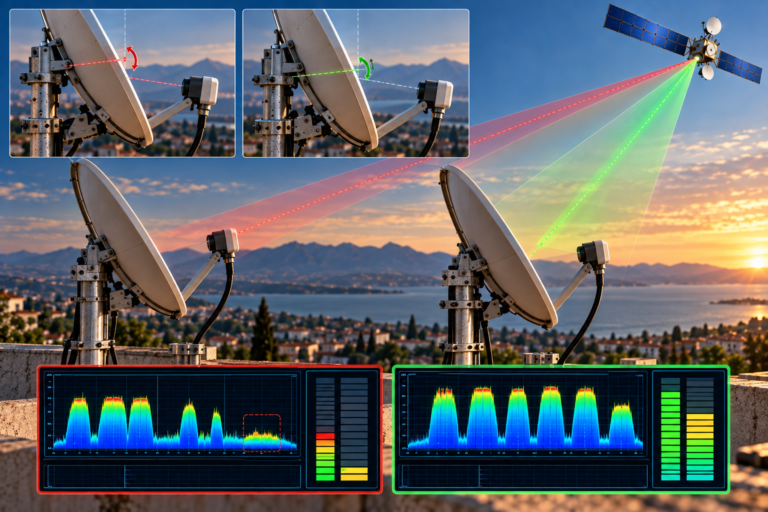
Is the dish correctly aligned? Is the LNB functioning? Is the correct frequency and polarization being selected? Is the coaxial cable intact?
Then check whether the receiver actually locks the carrier.
If the receiver sees RF strength but reports no quality or lock, verify whether the target carrier uses DVB-S2 or modulation unsupported by the receiver.
If the carrier locks and the channel appears in the service list but the picture remains blank, move to the codec layer.
Check whether the receiver supports the video and audio formats used by the service.
1. RF present?
2. Correct frequency and polarization?
3. Carrier lock?
4. Correct DVB-S or DVB-S2 capability?
5. Correct modulation and FEC support?
6. Transport stream recovered?
7. Service detected?
8. Video and audio codecs supported?
9. HDMI or display output compatible?
This sequence helps separate RF faults from receiver-generation limitations.
Do You Need a New Dish?
Often, no.
If the existing dish is correctly sized, properly aligned and already receives the relevant orbital position with sufficient margin, the reflector itself may remain completely usable after a broadcaster migrates from DVB-S to DVB-S2.
The LNB may also continue working because a universal Ku-band LNB is primarily responsible for receiving and frequency-converting the satellite signal. It does not need to decode DVB-S2.
The compatibility problem is usually inside the receiver’s tuner/demodulator or decoder architecture.
That means replacing a legacy receiver with a DVB-S2-capable model can sometimes restore reception without changing the outdoor antenna system.
However, this should not be turned into a universal rule.
If the dish is too small, poorly aligned, damaged or operating with insufficient margin, a new receiver will not repair those RF problems.
Reality Check
Modern HD channels do not disappear from old receivers simply because they are HD. HD resolution itself is not an RF transmission standard.
The real reasons can include DVB-S2 instead of DVB-S, 8PSK instead of legacy QPSK, different FEC requirements, unsupported video codecs or other receiver limitations.
It is equally wrong to assume that every modern HD service uses HEVC. Codec use must be verified for the specific service rather than inferred from the fact that the programme is HD.
The technically correct approach is to identify the exact stage where compatibility fails.
Final Verdict
Older DVB-S receivers miss many modern HD satellite channels because the broadcast chain has evolved at several different layers.
A DVB-S-only receiver may detect RF energy but fail to demodulate a DVB-S2 carrier. If the service uses 8PSK and DVB-S2 FEC, legacy hardware may be unable to recover the transport stream at all.
A receiver that does support DVB-S2 can still fail later if its video or audio decoder does not support the codec used by the programme.
This is why “no HD” is an incomplete diagnosis. The correct sequence is RF reception, carrier lock, DVB demodulation, error correction, transport-stream recovery and finally video/audio decoding.
In many cases, the existing dish and LNB can remain in service. The component that has become obsolete is the receiver.
Frequently Asked Questions
| Question | Answer |
|---|---|
| Can a DVB-S receiver receive DVB-S2 channels? | A DVB-S-only receiver normally cannot demodulate DVB-S2 carriers. DVB-S2 requires compatible physical-layer hardware and processing. |
| Why does my old receiver show signal strength but no channel? | The tuner may detect RF energy even though the demodulator cannot lock the required DVB-S2 or 8PSK carrier. Signal strength alone does not prove successful digital reception. |
| Is DVB-S2 the same as HD? | No. DVB-S2 is a satellite transmission standard. HD describes video resolution. SD or HD content can theoretically be transported through different satellite transmission systems. |
| Is DVB-S2 the same as H.264? | No. DVB-S2 handles the satellite RF transmission layer. H.264 is a video compression codec used after the transport stream has been recovered. |
| Can a receiver support DVB-S2 but still fail to show a channel? | Yes. It may successfully demodulate the carrier but lack support for the video’s codec, audio format or another part of the service. |
| Will rescanning fix an unsupported DVB-S2 receiver? | No. A scan can locate services only within the hardware capabilities of the receiver. It cannot add DVB-S2 demodulation support to DVB-S-only hardware. |
| Do I need a new satellite dish when German SD channels close? | Not necessarily. If the existing dish and LNB already receive the relevant satellite position correctly, replacing the receiver with suitable DVB-S2-capable equipment may be enough. |
| Does every new German HD channel use HEVC? | No. Codec use must be checked service by service. HD does not automatically mean HEVC. |
| Why did some old receivers stop receiving ZDF services after November 2025? | ZDF ended its legacy SD satellite distribution on 18 November 2025. The remaining HD services use DVB-S2 transmission, including 8PSK on the main ZDF HD multiplexes, which older DVB-S-only receivers cannot demodulate. |