Why Satellite-to-Phone Uses Mobile Spectrum
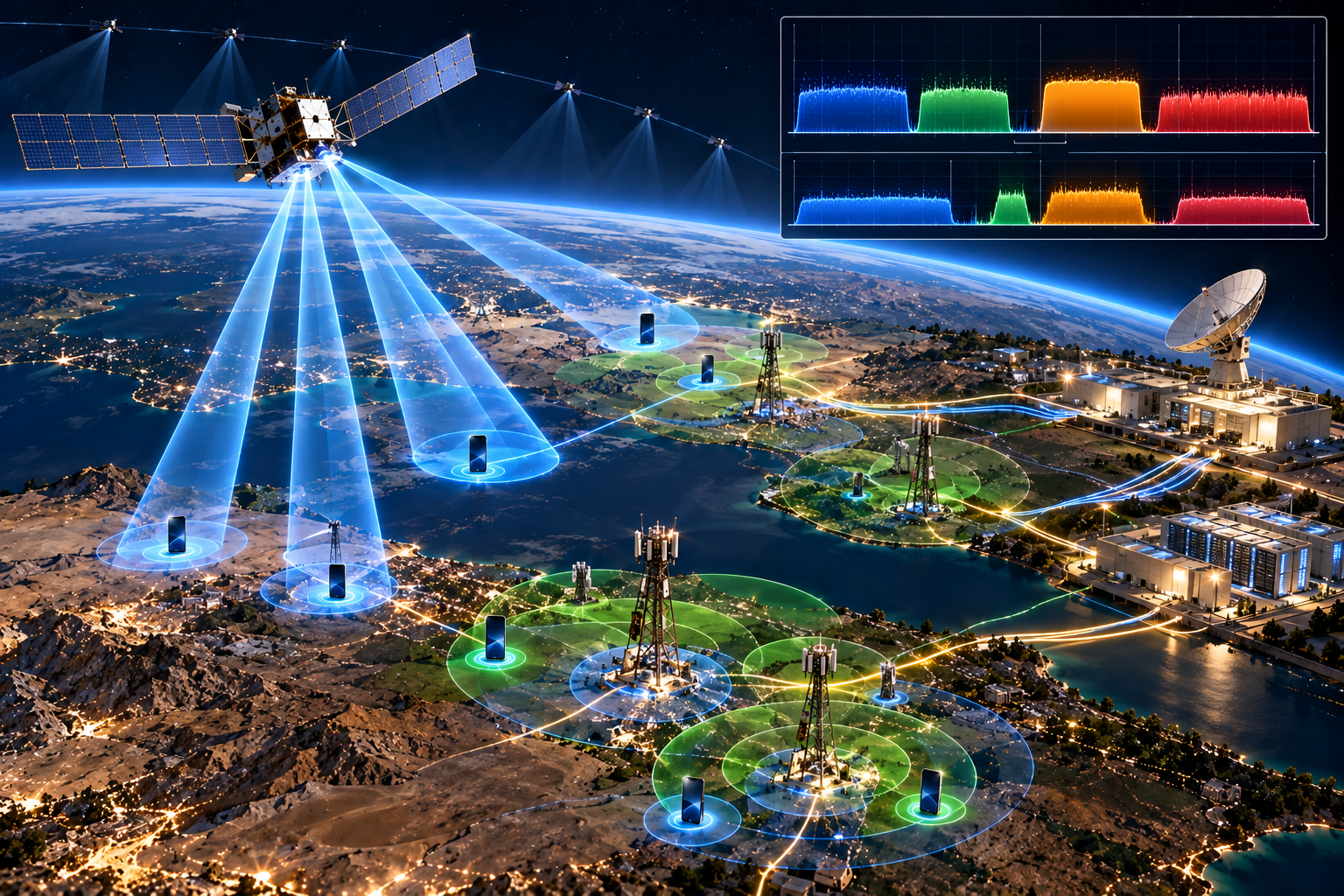
A normal smartphone is designed to communicate with cellular towers, not traditional satellite networks. Yet some new direct-to-device systems can connect ordinary phones to satellites without adding a large external antenna or replacing the handset with a dedicated satellite phone. One of the keys is surprisingly familiar: mobile spectrum.
Instead of forcing every phone to become a traditional satellite terminal, some D2D architectures allow satellites to communicate using spectrum associated with terrestrial mobile networks. Other systems take a different route and use spectrum allocated to the Mobile-Satellite Service. Both approaches are important, and understanding the difference explains why spectrum has become one of the biggest technical and regulatory questions in satellite-to-phone communication.
There is no single spectrum model for satellite-to-phone. Some D2D systems use traditional Mobile-Satellite Service spectrum. Others use terrestrial mobile or IMT spectrum through partnerships with mobile operators. The ITU highlighted both approaches in 2026 as D2D moves deeper into the global mobile ecosystem. :chatgpt-content-reference{index=”0″}
- What Does Mobile Spectrum Actually Mean?
- Why the Smartphone Determines the Spectrum Problem
- The Two Main Spectrum Approaches
- Why Use Terrestrial Mobile Spectrum From Space?
- Why Some D2D Networks Use MSS Spectrum Instead
- Why the Mobile Operator Matters
- The Biggest Problem: Interference
- Why National Borders Matter From Space
- Why Low-Band Spectrum Is Attractive
- Why More Spectrum Means More Capacity
- What Supplemental Coverage From Space Means
- Where 3GPP NTN Fits
- Why WRC-27 Matters
- Reality Check
- Final Verdict
- FAQ
What Does Mobile Spectrum Actually Mean?
Radio spectrum is the range of electromagnetic frequencies used to carry wireless signals.
Mobile networks do not transmit wherever they want. Regulators authorize particular frequency bands for specific services and license or otherwise authorize operators to use them under defined technical conditions.
Your smartphone is built around those bands.
Its antennas, filters, power amplifiers, low-noise amplifiers and radio-frequency front end are designed to support specific cellular frequency ranges and technologies.
That creates an obvious problem for satellite-to-phone communication.
If a satellite transmits on a completely different frequency that the smartphone’s hardware cannot receive, the phone cannot simply solve the problem through an app or software update.
The RF hardware must support the relevant band.
One way around that problem is to make the satellite communicate using spectrum the phone already understands.
Why the Smartphone Determines the Spectrum Problem
A dedicated satellite phone can be designed around a satellite network from the beginning.
The manufacturer can install antennas, filters and radio hardware for the frequencies used by that service.
An ordinary smartphone is different.
Billions of existing devices were designed primarily around terrestrial cellular bands.
If the goal is to connect those existing devices without hardware modification, compatibility with their existing radio capabilities becomes extremely valuable.
This is why some D2D networks are designed around terrestrial mobile spectrum.
The basic idea is powerful:
Instead of changing the phone to match a traditional satellite network, change part of the satellite network so it can communicate using radio resources the phone already supports.
This does not mean the satellite link becomes identical to a terrestrial tower. The distance, antenna geometry, Doppler, timing and interference environment remain very different.
But radio-band compatibility removes one major obstacle.
The Two Main Spectrum Approaches
Modern satellite-to-device systems should not all be placed into one technical category.
At a high level, two important spectrum approaches are developing.
| Approach | Basic Idea | Key Advantage |
|---|---|---|
| Mobile-Satellite Service spectrum | Use frequencies already allocated for satellite mobile communication | Works within an established satellite-spectrum framework |
| Terrestrial mobile / IMT spectrum | Satellite communicates using frequencies associated with terrestrial cellular service | Can target existing commercial mobile devices using compatible cellular bands |
The ITU highlighted this distinction in 2026. Globalstar represents the established MSS approach using L- and S-band resources, while newer architectures include systems combining satellite connectivity with terrestrial mobile or IMT spectrum. :chatgpt-content-reference{index=”1″}
Neither approach makes the other obsolete.
They solve the device-compatibility and spectrum problem in different ways.
Why Use Terrestrial Mobile Spectrum From Space?
The biggest attraction is the installed base of smartphones.
A terrestrial mobile band is already supported by many handsets in the market. The phone contains compatible RF components, and the cellular ecosystem already understands how to use that spectrum.
If a satellite network can legally and technically operate with the same compatible mobile spectrum, it becomes possible to extend an operator’s coverage beyond the reach of its terrestrial towers.
The satellite effectively becomes another radio-access layer.
This is particularly valuable in areas where constructing conventional infrastructure is difficult or uneconomic: remote roads, mountains, deserts, offshore areas and sparsely populated regions.
The ITU noted in April 2026 that D2D increasingly involves reuse of terrestrial IMT spectrum, which is also why new regulatory frameworks and interference-management techniques are needed. :chatgpt-content-reference{index=”2″}
That last point is critical.
Using mobile spectrum from orbit sounds simple until the same frequencies are already being used by thousands of terrestrial base stations below.
Why Some D2D Networks Use MSS Spectrum Instead
There is another solution: use spectrum already allocated to Mobile-Satellite Service.
MSS frequencies have a regulatory history specifically associated with communication involving mobile earth stations and satellites.
That can avoid some of the unusual regulatory problems created when a satellite starts transmitting in a band historically designed for terrestrial mobile networks.
The tradeoff is device compatibility.
A smartphone still needs radio hardware capable of operating in the relevant MSS frequency band.
This approach has become increasingly practical as handset chipsets add standardized non-terrestrial capabilities.
The ITU has described D2D in MSS bands and D2D using terrestrial mobile-service bands as two distinct variants, with different regulatory and technical tradeoffs. :chatgpt-content-reference{index=”3″}
“Satellite-to-phone uses mobile spectrum” is therefore only partly true. Some important D2D systems do. Others use dedicated MSS spectrum supported by compatible devices.
Why the Mobile Operator Matters
Terrestrial mobile spectrum is normally controlled through national licensing and authorization frameworks.
A satellite operator cannot simply decide that a useful cellular frequency looks empty over a rural area and begin transmitting on it.
The terrestrial mobile operator may hold the rights to use that spectrum in the country.
This is why partnerships between mobile network operators and satellite companies are central to many D2D business models.
The mobile operator contributes more than spectrum.
It already has subscribers, SIM authentication, a mobile core, telephone numbers, billing systems, roaming relationships and terrestrial infrastructure.
The satellite provider adds a new coverage layer where towers are unavailable.
Instead of building a completely separate consumer network, D2D can become an extension of the operator’s existing service.
The Biggest Problem: Interference
Reusing terrestrial mobile spectrum from orbit creates a difficult engineering question:
How do you allow a satellite to transmit into a mobile band without damaging terrestrial networks using the same or nearby frequencies?
Satellite coverage is enormous compared with a normal cellular site.
A terrestrial tower can be engineered around relatively local geographic boundaries. A spacecraft hundreds of kilometers above Earth can potentially illuminate a much larger region.
Interference can occur in several ways.
A satellite downlink could interfere with terrestrial receivers. Smartphone uplinks intended for the satellite may interact with terrestrial networks. Neighboring operators may use related spectrum. Adjacent countries may have different licensing arrangements.
The ITU has identified active interference management as a core requirement as D2D increasingly reuses terrestrial IMT spectrum. It also noted that the United Kingdom consulted neighboring jurisdictions before D2D rollout because of concern about interference into other mobile services. :chatgpt-content-reference{index=”4″}
This is why spectrum regulation is not an administrative detail added after the satellite is built.
It is part of the engineering architecture.
Why National Borders Matter From Space
A terrestrial base station can be positioned so its coverage fits reasonably well within the intended service area.
A satellite sees borders differently.
From orbit, a political boundary is an invisible line across the surface.
But spectrum licenses are often national.
A mobile operator may be authorized to use a frequency in one country while a different operator uses the same or adjacent spectrum across the border.
Satellite beams therefore need geographic control.
Modern phased arrays can electronically shape and steer coverage cells. That gives operators much greater control over where energy is concentrated.
AST SpaceMobile told the ITU in 2026 that its architecture can shape cells with national boundaries in mind. :chatgpt-content-reference{index=”5″}
Perfect RF containment at a political border is not physically realistic, so international coordination and interference limits remain necessary.
Why Low-Band Spectrum Is Attractive
Not all mobile spectrum behaves the same way.
Lower-frequency cellular bands generally offer useful propagation characteristics for wide-area coverage and can perform better around certain obstructions than much higher frequencies.
That makes low-band spectrum particularly attractive when the objective is coverage rather than extreme peak capacity.
For a direct-to-device link, this matters because the handset has a small antenna and limited transmit power.
The ITU reported in 2026 that the GSMA considers access to low-band IMT spectrum particularly important for D2D capacity in populated rural areas. :chatgpt-content-reference{index=”6″}
Lower frequency does not eliminate the satellite link-budget problem, and spectrum cannot be selected on propagation alone.
Bandwidth availability, antenna efficiency, existing mobile deployments, licensing and interference all influence the final choice.
This also helps explain why indoor D2D performance can vary so much. For more detail, see Why Satellite-to-Phone Struggles Inside Buildings.
Why More Spectrum Means More Capacity
Coverage and capacity are different problems.
A satellite may be able to detect a phone across a huge geographic area, but every user still needs radio resources.
Messaging consumes relatively little capacity. Voice requires more continuous resources. Broadband data can require substantially more.
This is one reason the evolution from emergency messaging toward voice and broadband makes spectrum increasingly important.
Modern D2D satellites can divide their footprints into many electronically formed cells and reuse frequencies spatially, much like terrestrial cellular networks reuse spectrum across separated cells.
But frequency reuse requires careful beam design and interference control.
More spectrum can increase potential system capacity, but only if it can be legally accessed and technically reused without unacceptable interference.
What Supplemental Coverage From Space Means
The United States provides a useful example of how regulators are adapting terrestrial spectrum rules for D2D.
The Federal Communications Commission established a framework known as Supplemental Coverage from Space, or SCS.
The concept allows satellite operators and terrestrial mobile licensees to collaborate so satellite systems can provide supplementary coverage to ordinary consumer handsets using certain spectrum previously allocated for terrestrial service.
The FCC describes SCS as a way to extend a terrestrial licensee’s coverage, particularly into remote, unserved and underserved areas. :chatgpt-content-reference{index=”7″}
The word “supplemental” is important.
The satellite is not necessarily replacing the terrestrial network.
It fills geographic gaps in that network.
Terrestrial tower available: use the conventional mobile network.
Terrestrial coverage unavailable: a compatible satellite layer may provide supplementary connectivity.
Other countries can adopt different regulatory frameworks, so SCS should not be treated as a universal global rule.
Where 3GPP NTN Fits
3GPP Non-Terrestrial Networks add another important piece to the spectrum story.
NTN standards allow cellular technologies to be adapted specifically for communication through satellites and other non-terrestrial platforms.
This includes mechanisms for dealing with challenges such as long propagation delays, rapidly changing Doppler and moving satellite coverage.
But NTN does not mean every implementation must use terrestrial mobile spectrum.
Standardized NTN can also operate using spectrum allocated to satellite services when supported by compatible devices.
This distinction is crucial:
| Term | What It Describes |
|---|---|
| D2D / Direct-to-Device | Broad concept of connecting user devices directly through satellite systems |
| Direct-to-Cell | D2D approach focused on cellular handsets and mobile-network integration |
| NTN | 3GPP framework for extending cellular standards to non-terrestrial networks |
| MSS Spectrum | Frequencies allocated for Mobile-Satellite Service |
| IMT / Mobile Spectrum | Spectrum associated with terrestrial mobile broadband networks |
These terms overlap, but they are not interchangeable.
Why WRC-27 Matters
The spectrum question is still evolving.
The ITU World Radiocommunication Conference in 2027 will consider spectrum issues directly relevant to satellite connections with IMT handsets.
One major study area concerns possible Mobile-Satellite Service allocations that could support direct connectivity between space stations and IMT user equipment across bands between roughly 694/698 MHz and 2.7 GHz. :chatgpt-content-reference{index=”8″}
This matters because D2D is pushing together two radio worlds that historically had clearer boundaries: satellite spectrum and terrestrial cellular spectrum.
Future global rules need to balance several objectives.
They must allow new satellite services to develop while protecting terrestrial networks, neighboring countries, existing satellite systems and other radio services from harmful interference.
As D2D scales from emergency messaging toward mainstream voice and data, those spectrum decisions become increasingly important.
Reality Check
Satellite-to-phone does not universally use ordinary mobile spectrum.
That is one important architecture, especially for systems designed to connect existing cellular handsets using spectrum associated with mobile operators.
But another major approach uses frequencies already allocated to Mobile-Satellite Service, combined with smartphones or chipsets capable of supporting those bands and standardized NTN technologies.
The ITU’s 2026 overview of the sector specifically describes multiple competing D2D approaches, including established MSS models and systems using terrestrial mobile or IMT spectrum. :chatgpt-content-reference{index=”9″}
The important breakthrough is therefore not one particular frequency band. It is the growing ability to integrate satellite radio access with the hardware, standards, spectrum and core networks of the mobile ecosystem.
Final Verdict
Some satellite-to-phone systems use mobile spectrum because the phone in your pocket already knows how to use it.
That can remove one of the biggest barriers to direct satellite connectivity: requiring consumers to carry completely different radio hardware.
But the solution creates a new challenge.
Terrestrial mobile spectrum was built around networks of ground-based cells. Reusing those frequencies from orbit requires coordination with mobile operators, precise beam control, national authorization and strict interference management.
Other D2D networks solve the compatibility problem differently by using established MSS spectrum with devices designed to support satellite bands and 3GPP NTN capabilities.
So the future is unlikely to be one universal satellite frequency replacing everything else.
It is a hybrid spectrum ecosystem where terrestrial mobile bands, MSS spectrum, satellite networks and cellular standards increasingly work together to make the boundary between a tower on Earth and a network in space less visible to the user.
Frequently Asked Questions
| Question | Answer |
|---|---|
| Why does satellite-to-phone use mobile spectrum? | Some D2D systems use terrestrial mobile spectrum because ordinary smartphones already contain radio hardware designed for those cellular bands. |
| Do all satellite-to-phone networks use cellular spectrum? | No. Some systems use spectrum allocated to Mobile-Satellite Service instead, particularly with devices that support satellite-compatible bands and NTN technology. |
| What is MSS spectrum? | MSS stands for Mobile-Satellite Service. It refers to radio-frequency allocations intended for communication involving mobile terminals and satellite systems. |
| What is IMT spectrum? | IMT is the ITU framework associated with generations of mobile broadband technology. IMT spectrum includes frequency resources used by terrestrial mobile networks under national and international regulatory arrangements. |
| Can a satellite operator simply use a mobile operator’s frequency? | No. Spectrum use requires appropriate regulatory authorization and, in many D2D architectures, coordination or partnership with the terrestrial spectrum licensee. |
| Why is interference a problem for D2D? | The same or nearby frequencies may already be used by terrestrial mobile networks. Satellite beams must therefore be carefully controlled to avoid harmful interference. |
| Why are low mobile frequencies useful for satellite-to-phone? | Lower cellular frequencies can offer useful wide-area propagation and penetration characteristics, although capacity, antenna design, licensing and interference also matter. |
| What is Supplemental Coverage from Space? | SCS is a U.S. regulatory framework that allows authorized satellite and terrestrial mobile operators to collaborate to extend cellular coverage using certain terrestrial spectrum bands. |
| Is Direct-to-Cell the same as 5G NTN? | Not necessarily. Direct-to-Cell is a broader service architecture for connecting cellular devices from space, while 5G NTN refers to standardized 3GPP technology designed specifically for non-terrestrial networks. |
| Why will spectrum remain important as D2D grows? | Moving from limited messaging toward voice and broadband increases capacity requirements, while large satellite constellations make interference, frequency reuse and international coordination increasingly important. |