Why One HD Channel Works While Another Doesn’t
Estimated Reading Time: 12 minutes
It is common to find one HD satellite channel working perfectly while another HD channel pixelates, freezes, or refuses to open. Because both channels are labelled HD, viewers often expect them to require exactly the same reception conditions. In reality, HD describes the video resolution, not the RF path carrying that video from the satellite to the receiver.
Two HD channels can be transmitted on completely different transponders using different frequencies, polarizations, satellite beams, symbol rates, DVB-S2 modulation formats, Forward Error Correction settings, and video codecs. One may operate with generous signal margin while the other sits close to the decoder threshold. The real cause of the difference therefore lies in the complete transmission and decoding chain, not simply in the fact that both programmes are high definition.
If one HD channel works and another does not, first determine whether they share the same transponder. Channels on different transponders can have very different RF conditions. If they share the same transponder but only one service fails, the problem is more likely to be related to codec support, service configuration, access control, or receiver software than to dish alignment.
- HD Is a Video Format, Not an RF Condition
- Different HD Channels Can Use Different Transponders
- Why Satellite Beam Coverage Matters
- Frequency and Polarization Can Change Reception
- QPSK and 8PSK Do Not Have the Same Requirements
- How FEC Changes the Decoding Threshold
- Signal Margin Explains Why One Channel Fails First
- How MER and BER Reveal the Difference
- Why LNB Skew Can Affect One HD Group More Than Another
- Low Band and High Band Problems
- How Cable Loss Can Affect Selected HD Transponders
- H.264 and HEVC Can Create a Different Kind of Failure
- Why One Service Can Fail on a Working Transponder
- Receiver Hardware and Software Compatibility
- How to Separate an RF Fault From a Decoder Fault
- How to Troubleshoot the Problem Logically
- Reality Check
- Final Verdict
- FAQ
HD Is a Video Format, Not an RF Condition
High Definition describes the resolution of the television picture. It says nothing by itself about how the programme is transmitted through the satellite RF link.
Before the receiver can even determine that a programme is HD, it must successfully tune and demodulate the complete transponder carrying that programme.
The tuner sees a DVB-S or DVB-S2 carrier first. The video resolution becomes relevant only after the transport stream has been recovered and the individual service has been separated.
This means two HD channels can behave very differently despite appearing identical from the viewer’s perspective.
Different HD Channels Can Use Different Transponders
A satellite transponder is an RF carrier that can contain several television, radio, and data services.
One HD channel may be carried on a transponder at one frequency, while another HD channel uses a completely separate transponder elsewhere in the band.
Those transponders may use different polarization, symbol rate, modulation, FEC, beam coverage, and power levels.
If one carrier has strong margin and the other is marginal, the first channel will remain stable while the second may pixelate or disappear.
This is why troubleshooting should always begin with transponder information rather than comparing channels only by picture resolution.
Why Satellite Beam Coverage Matters
Satellite operators can use different antenna beams from the same orbital position.
One beam may cover a large part of Europe strongly, while another concentrates energy toward a smaller region.
If the receiving location is near the centre of the first beam but close to the edge of the second, the two HD transponders can arrive with very different carrier levels.
The weaker beam may still work during clear weather but provide much less reserve against rain, dish movement, or additional noise.
The channel therefore appears unreliable even though another HD service from the same satellite remains completely stable.
Frequency and Polarization Can Change Reception
Frequency affects the entire receiving chain.
The LNB, coaxial cable, switches, wall plates, and tuner do not have perfectly identical performance at every frequency.
Cable loss normally increases as intermediate frequency rises. LNB gain and noise performance can also vary slightly across the band.
Polarization creates another variable. Horizontal and vertical services depend on correct receiver voltage and proper LNB orientation.
A fault affecting one polarization can therefore make a group of HD channels fail while another group continues working normally.
| Difference Between HD Channels | Possible Technical Effect | Visible Result |
|---|---|---|
| Different transponder | Different RF conditions | One channel stable, another weak |
| Different beam | Different received power at location | Regional channel may fail first |
| QPSK versus 8PSK | Different required modulation quality | 8PSK service may need more margin |
| Different FEC rate | Different error correction robustness | One carrier reaches threshold sooner |
| Different polarization | Possible skew or voltage problem | One channel group disappears |
| Different frequency band | LNB switching or cable loss difference | High-band or low-band channels fail |
| H.264 versus HEVC | Different decoder requirement | Strong signal but black video |
QPSK and 8PSK Do Not Have the Same Requirements
Many DVB-S2 television services use QPSK or 8PSK modulation.
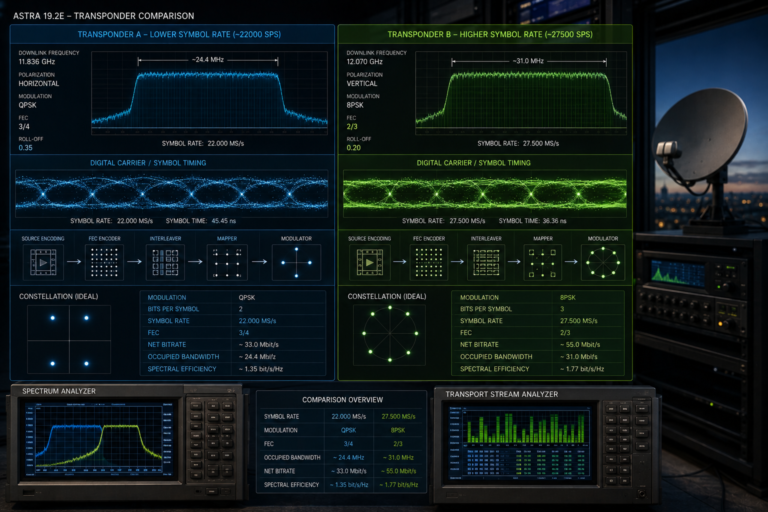
QPSK has four principal constellation states. 8PSK has eight, allowing more bits to be transmitted per symbol.
The additional efficiency comes with a tradeoff. The constellation points in 8PSK are closer together, so the receiver generally needs cleaner phase and amplitude information to distinguish them reliably.
An HD channel transmitted using a robust QPSK configuration can therefore remain stable while another HD service using 8PSK begins producing errors.
The important factor is the actual MODCOD, not the fact that both channels are HD.
How FEC Changes the Decoding Threshold
Forward Error Correction adds redundant information that allows the receiver to repair transmission errors.
Different coding rates provide different balances between protection and usable data capacity.
A more robust FEC configuration provides greater resistance to errors but consumes more transmission capacity.
A more efficient coding rate leaves less redundancy and generally needs cleaner reception.
Two HD carriers using the same modulation can therefore have different decoding thresholds because their FEC settings are different.
Signal Margin Explains Why One Channel Fails First
Signal margin is the difference between current reception quality and the minimum quality required for reliable decoding.
Two HD channels may both appear perfect while conditions are good, yet one might have much less margin.
When rain begins or the dish moves slightly, the marginal carrier crosses its threshold first.
The stronger carrier continues working because it still has enough reserve.
This explains why a channel can appear completely healthy for hours and then suddenly fail while another HD service remains unaffected.
How MER and BER Reveal the Difference
Signal strength alone often cannot explain why two HD transponders behave differently.
MER measures how accurately the received modulation matches its ideal constellation. BER measures the errors produced when symbols are recovered incorrectly.
A marginal HD carrier often shows lower MER and higher pre-FEC BER than a stable one even if their strength bars appear similar.
Forward Error Correction initially repairs those errors, so both pictures can look perfect.
Once the weaker carrier loses additional margin, the correction system reaches its practical limit and post-FEC errors begin damaging the transport stream.
Why LNB Skew Can Affect One HD Group More Than Another
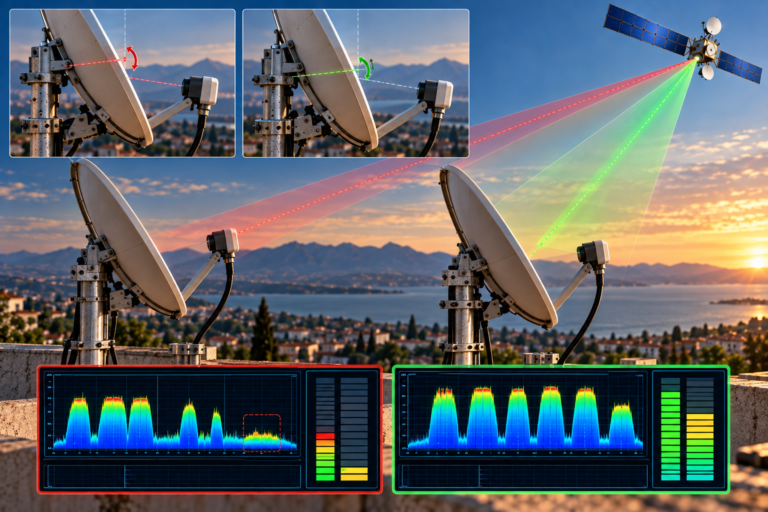
The LNB must be rotated correctly to separate opposite polarizations.
Incorrect skew allows unwanted cross-polarized energy into the receiver.
This additional RF power acts as interference rather than useful signal.
A strong transponder may tolerate the problem. Another carrier with less margin may suffer a significant MER reduction and begin pixelating.
The receiver can therefore show one HD channel working perfectly while another channel on the opposite polarization behaves badly.
Low Band and High Band Problems
A Universal Ku-band LNB normally uses separate local oscillator settings for the low and high parts of the satellite band.
The receiver sends a 22 kHz tone to select the high band.
If this control tone is missing or the LNB switching circuit is defective, high-band transponders may fail while low-band HD channels continue working.
An internal local oscillator problem can create a similar pattern.
When every failed channel belongs to the same frequency band, this pattern should be investigated before adjusting dish alignment.
How Cable Loss Can Affect Selected HD Transponders
The frequency produced by the LNB determines where each transponder appears inside the coaxial intermediate-frequency range.
Cable attenuation generally becomes greater at higher frequencies.
On short, good-quality cable this normally creates no problem.
Long cable runs, old coaxial cable, poor connectors, multiswitches, and wall plates can make the difference more significant.
A marginal transponder at a higher IF frequency may therefore lose enough additional level in the distribution system to become unstable while a lower-frequency HD service remains healthy.
H.264 and HEVC Can Create a Different Kind of Failure
Not every HD failure is caused by satellite reception.
Two HD channels can use different video codecs. One may use H.264, while another uses HEVC.
An older satellite receiver can support DVB-S2 and H.264 but lack hardware support for HEVC.
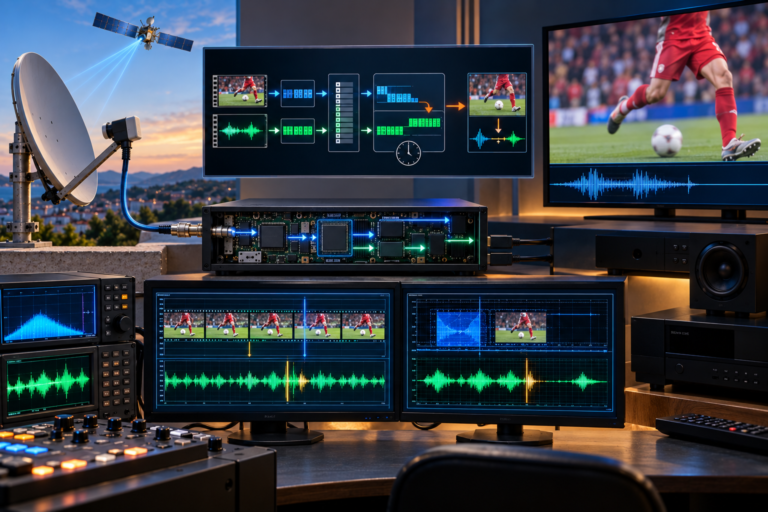
In that situation, the receiver may lock onto both transponders perfectly. Signal quality and BER can look excellent. The receiver may even display the HEVC service name and programme information.
The picture remains black because the failure happens after RF reception, inside the video decoding stage.
Why One Service Can Fail on a Working Transponder
Several channels can share one DVB-S2 transponder.
If one individual HD service fails while every other service on the same carrier continues working with stable audio and video, the dish is unlikely to be the primary cause.
All of those channels passed through the same tuner, demodulator, MER conditions, BER conditions, and Forward Error Correction path.
A single-service failure instead points toward differences inside the recovered transport stream.
Possible causes include codec compatibility, service configuration, conditional access, audio or video PID changes, receiver firmware, or corrupted channel-list information.
Receiver Hardware and Software Compatibility
Satellite receiver capability extends beyond DVB-S2 support.
The receiver also needs sufficient processing hardware, memory, video-decoder support, audio-decoder support, and suitable firmware.
A modern transponder may use a video format that did not exist when an older receiver was designed.
Firmware problems can also affect particular services after broadcasters change programme parameters.
A channel rescan can sometimes resolve outdated service information, while unsupported video hardware requires a compatible receiver.
How to Separate an RF Fault From a Decoder Fault
The easiest method is to compare other services on the same transponder.
If every channel on that transponder pixelates or disappears together, the fault is probably before service separation. Dish alignment, LNB performance, polarization, interference, cable loss, BER, and MER should be investigated.
If other services on the same transponder remain completely stable, the physical RF carrier is probably being received correctly.
The investigation should then move toward the individual service, codec, receiver firmware, access system, or programme configuration.
This distinction prevents unnecessary dish adjustments when the RF signal is already healthy.
How to Troubleshoot the Problem Logically
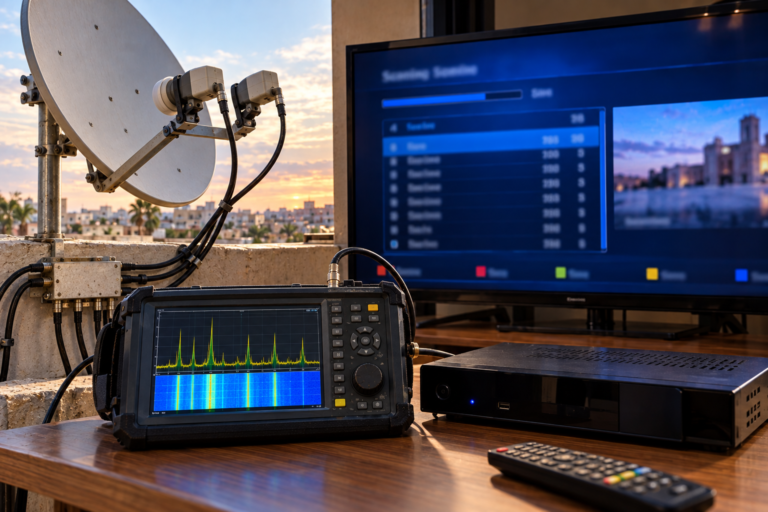
Start by recording the transponder frequency, polarization, symbol rate, modulation, and FEC used by the working and failing channels.
Check whether they share the same transponder. If they do not, compare their signal quality, MER, and BER.
If the failing carrier shows worse MER or higher BER, inspect dish alignment, LNB skew, beam coverage, cable condition, and available signal margin.
If all failed channels are on one polarization, verify receiver voltage, cable resistance, switches, and LNB polarization control.
If all failed channels belong to the high or low band, investigate 22 kHz switching and the corresponding LNB local oscillator.
If the failing HD service has excellent signal quality and other channels on the same transponder work normally, confirm whether it uses H.264, HEVC, or another codec supported by the receiver.
Transponder differences are particularly important when several apparently similar channels behave differently. Our guide explaining why some satellite frequencies work better than others examines how beam coverage, modulation, FEC, polarization, LNB response, and distribution losses create these differences.
One HD channel failing while another works does not prove that HD reception is weak.
HD describes video resolution. The two services may use completely different satellite transponders and may therefore have different beams, frequencies, modulation formats, FEC rates, polarizations, signal margins, and decoder requirements.
If both services share the same transponder and only one fails, the problem is much more likely to occur after DVB-S2 reception than at the dish.
One HD channel can work while another does not because the two channels may travel through completely different RF and decoding paths.
Different transponders can have different beam coverage, received power, frequencies, polarizations, QPSK or 8PSK modulation, FEC configurations, MER, BER, and signal margins. The receiving system can add further differences through LNB skew, band switching, cable attenuation, interference, and tuner performance.
Even when RF reception is perfect, one service can still fail because its video codec or service configuration is different.
The correct troubleshooting method is therefore to identify whether the failure occurs at the transponder level or the individual service level. Once that distinction is made, the problem becomes much easier to diagnose logically.
| Question | Answer |
|---|---|
| Why does one HD satellite channel work while another has no signal? | They may use different transponders with different beams, frequencies, polarizations, modulation formats, FEC rates, and reception margins. |
| Does HD resolution determine signal strength? | No. HD describes the video picture. Satellite reception depends on the RF transponder carrying that video. |
| Can two HD channels use different modulation? | Yes. One transponder may use QPSK while another uses 8PSK or another supported DVB-S2 configuration. |
| Why does one HD channel fail during rain first? | Its transponder may have less signal margin or use a more demanding modulation and coding configuration. |
| Can LNB skew affect one HD channel more than another? | Yes. Channels on different polarizations or frequencies can respond differently to cross-polarization interference. |
| Why do only high-band HD channels fail? | The problem may involve 22 kHz switching, the high-band local oscillator, cable loss, or a band-specific LNB fault. |
| Can cable quality affect one HD transponder? | Yes. Frequency-dependent attenuation and local faults can reduce some intermediate frequencies more than others. |
| Why does a channel show full quality but no video? | The DVB-S2 carrier may be received correctly while the receiver lacks support for the service’s video codec, such as HEVC. |
| If other channels on the same transponder work, is the dish faulty? | Probably not. Stable services on the same carrier suggest that RF reception is healthy and the fault is service-specific. |
| Should I compare signal strength between the two HD channels? | Quality, MER, BER, modulation, FEC, and signal margin are usually more useful than raw strength. |
| Can an old receiver support one HD channel but not another? | Yes. It may support H.264 but not HEVC, or it may have limitations with newer service or modulation configurations. |
| What is the first troubleshooting step? | Check whether the working and failing channels share the same transponder. That immediately separates many RF faults from service-level decoding problems. |