Why RTL HD Needs Better Reception Than SD
Estimated Reading Time: 12 minutes
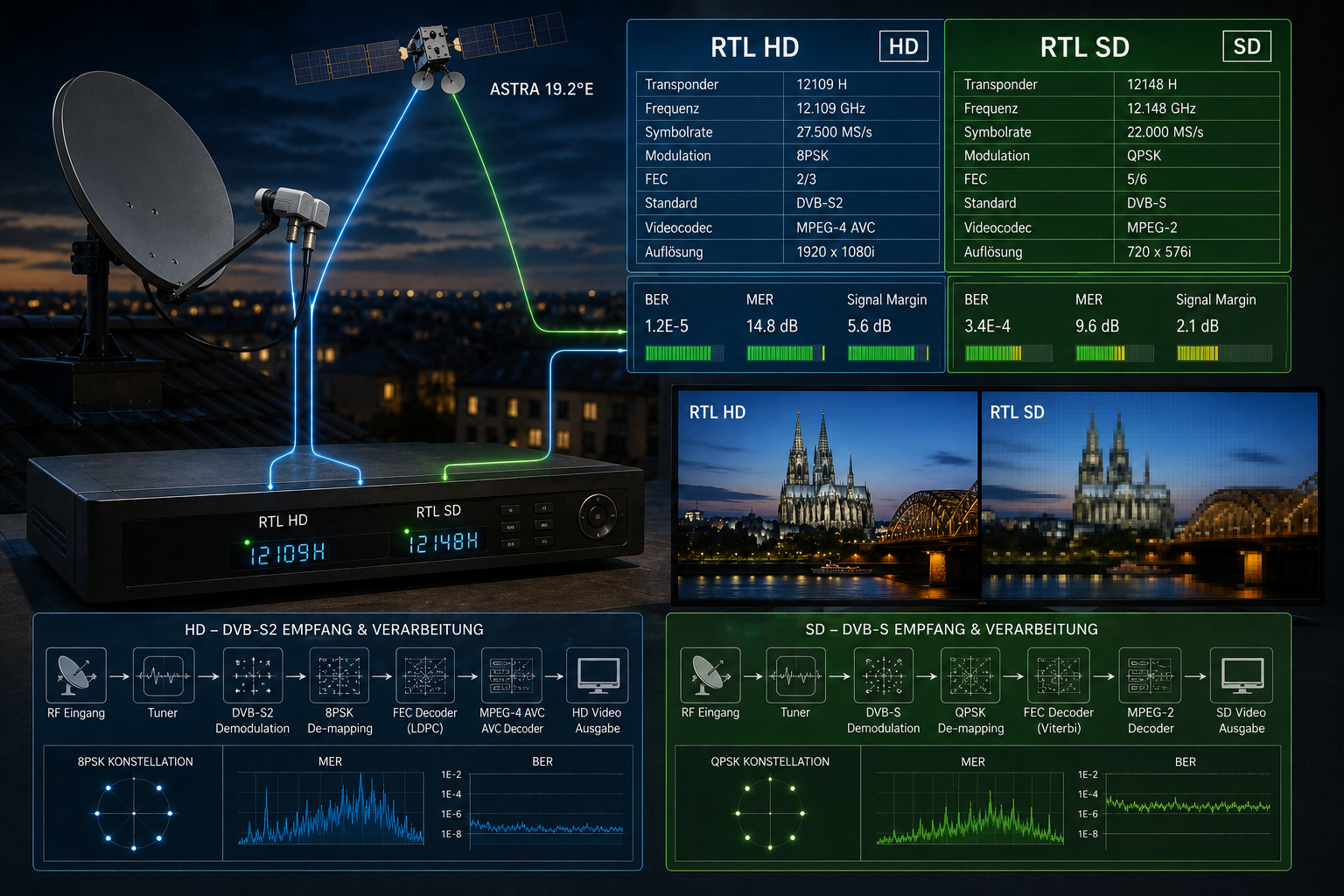
A German satellite viewer may find RTL in SD working normally while RTL HD pixelates, freezes, or disappears. It is tempting to conclude that HD pictures simply require a stronger satellite signal. That explanation is incomplete. The important difference is that RTL HD and RTL SD are separate satellite transmissions on Astra 19.2E, so they do not necessarily experience the same RF conditions or use the same transmission parameters.
Picture resolution is only one part of the system. Before the receiver can decode either HD or SD video, it must successfully recover the transponder carrying that service. Frequency, polarization, modulation, Forward Error Correction, DVB-S or DVB-S2 operation, beam characteristics, MER, BER, and available signal margin can all affect whether one service survives marginal reception better than another. The correct question is therefore not simply why HD needs more signal, but why the RTL HD transmission can have different reception requirements from the RTL SD transmission.
RTL HD and RTL SD on Astra 19.2E should not be treated as two picture qualities extracted from one identical RF carrier. They are separate services distributed through different satellite transmission paths. If RTL SD works while RTL HD fails, compare the two transponders first. Only after the RF path has been understood should the investigation move toward video decoding, service access, or receiver compatibility.
- HD Resolution Is Not the Real RF Explanation
- RTL HD and RTL SD Are Separate Satellite Transmissions
- Why Different Transponders Behave Differently
- How DVB-S2 Changes the Reception Equation
- Why Modulation Matters
- How Forward Error Correction Changes the Threshold
- Signal Margin Explains Why RTL HD Can Fail First
- What MER Reveals About RTL HD Reception
- How BER Changes Before the Picture Breaks
- Why Dish Alignment Can Affect RTL HD First
- How LNB Skew Affects Polarization Quality
- Frequency, LNB, and Cable Effects
- Why Rain Can Expose the Difference
- Video Compression Is a Separate Issue
- When Strong RTL HD Signal Still Produces No Picture
- How to Diagnose RTL HD Reception Correctly
- Reality Check
- Final Verdict
- FAQ
HD Resolution Is Not the Real RF Explanation
The television picture does not travel directly through space as HD or SD pixels.
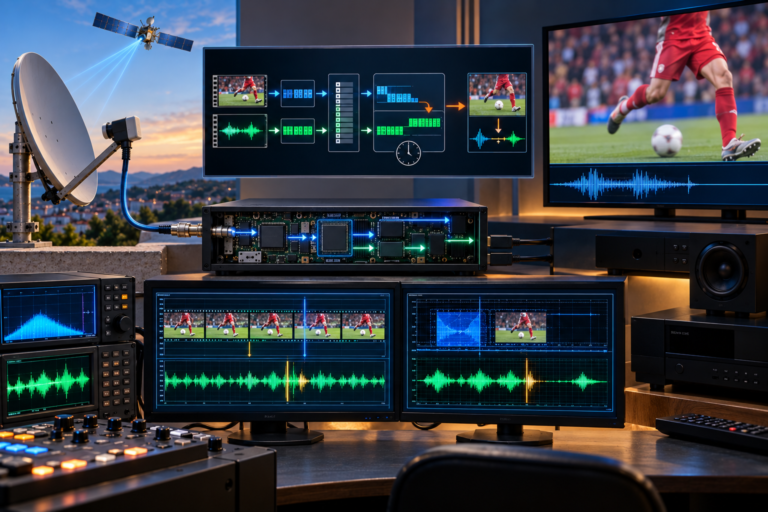
The video is first compressed into digital data. That data is multiplexed with audio and other information and then carried through a satellite transmission system.
The receiver therefore has to recover the RF carrier before it knows whether the programme inside is HD or SD.
This distinction matters because HD resolution itself does not automatically create a higher satellite decoding threshold.
A robust HD transmission could theoretically be easier to receive than a poorly received SD transmission. What matters at the dish and tuner is the complete physical-layer configuration of each carrier.
RTL HD and RTL SD Are Separate Satellite Transmissions
RTL HD and RTL SD are distributed separately on Astra 19.2E.
They use different transponder frequencies and are not simply two video streams being extracted from one identical RF carrier.
That means the receiver tunes to a different satellite carrier when moving between the HD and SD versions.
Each carrier has its own link conditions. Differences can include symbol rate, modulation, coding, frequency, transponder loading, and the receiving system’s performance at that particular frequency.
This immediately explains why the two versions can behave differently even though they contain essentially the same television programming.
Why Different Transponders Behave Differently
No satellite receiving system performs identically on every transponder.
The transmitted carrier power can differ. Frequency changes how the LNB and coaxial distribution system behave. Different modulation and coding configurations create different decoding requirements.
Local interference can also affect one intermediate frequency more than another.
As a result, one RTL carrier may arrive at the tuner with substantial margin while the other operates closer to its digital threshold.
When conditions deteriorate, the carrier with less margin fails first.
| Technical Difference | What It Changes | Possible Viewer Result |
|---|---|---|
| Separate transponders | Different RF transmission conditions | RTL SD works while RTL HD fails |
| Different transmission standard | Different physical-layer processing | Different receiver and signal requirements |
| Different modulation or coding | Changes decoding threshold | One carrier loses lock sooner |
| Different frequency | Changes LNB and cable behaviour | One transponder can have less margin |
| Low MER | Constellation becomes less distinct | BER rises and pixelation begins |
| Poor dish alignment | Reduces carrier quality | Marginal service fails first |
| Rain attenuation | Reduces available link margin | RTL HD may disappear while RTL SD remains stable |
| Codec incompatibility | Video cannot be decoded | Good signal but no usable HD picture |
How DVB-S2 Changes the Reception Equation
DVB-S2 was designed to use satellite capacity more efficiently than the original DVB-S system.
It provides powerful Forward Error Correction and supports flexible combinations of modulation and coding.
This allows broadcasters to carry more useful data through a transponder, which is valuable for HD television.
The tradeoff depends on the selected configuration. A capacity-oriented DVB-S2 transmission can require cleaner reception than a more robust legacy carrier.
The important point is not that DVB-S2 is inherently weak. DVB-S2 can be configured very robustly. Reception requirements depend on the actual modulation and coding configuration being transmitted.
Why Modulation Matters
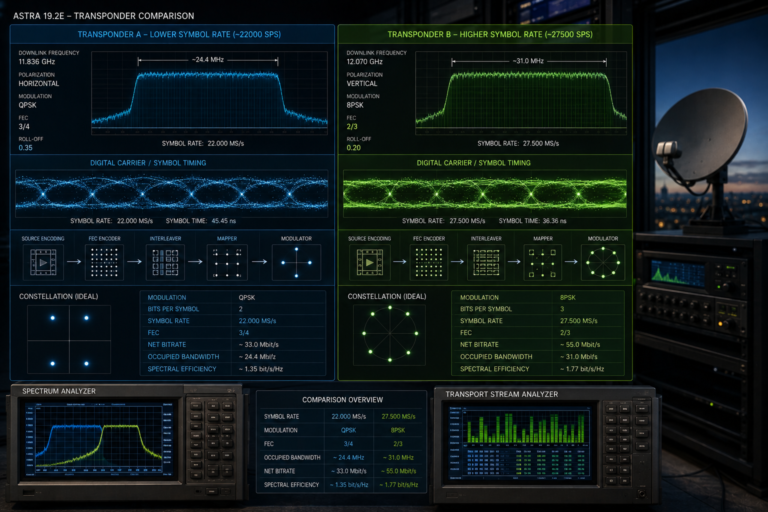
QPSK uses four principal phase states and represents two bits per transmitted symbol.
8PSK uses eight states and can represent three bits per symbol.
The additional states improve spectral efficiency, but they are positioned more closely in the constellation.
Noise, phase errors, interference, and distortion therefore have less room to move the received symbols before the demodulator begins making incorrect decisions.
Under comparable coding assumptions, an 8PSK carrier generally needs better modulation quality than QPSK.
This is one reason a modern HD transmission can expose limited reception margin that an older robust SD carrier does not reveal.
How Forward Error Correction Changes the Threshold
Satellite television relies heavily on Forward Error Correction because the RF signal inevitably collects errors during transmission and reception.
DVB-S2 uses LDPC and BCH coding to reconstruct data that has been damaged by noise and other impairments.
Different coding rates provide different balances between useful payload and error protection.
A configuration with greater redundancy can tolerate more difficult conditions, while a configuration optimized for higher useful bitrate requires better carrier quality.
This means modulation alone cannot tell you which transponder is harder to receive. Modulation and FEC must be considered together.
Signal Margin Explains Why RTL HD Can Fail First
Signal margin is the most useful concept for understanding why one channel remains stable while another fails.
Imagine that both RTL versions currently have enough quality for perfect reception. RTL SD may have a large reserve above its required threshold, while RTL HD may have only a modest reserve.
Both pictures look equally perfect because digital television does not display the size of that reserve in the picture itself.
Rain, dish movement, additional noise, or a small LNB performance change can then reduce both signals.
If RTL HD reaches its threshold first, it begins to fail while RTL SD continues working.
The visible difference is therefore created by available margin, not by HD pixels directly.
What MER Reveals About RTL HD Reception
MER, or Modulation Error Ratio, measures how accurately the received symbols correspond to their ideal constellation positions.
It is one of the best measurements for evaluating digital satellite quality.
A receiver may report high signal strength because substantial RF energy reaches the tuner, yet the carrier can still have poor MER.
Interference, phase noise, cross-polarization leakage, poor alignment, and other distortions can reduce modulation quality without producing a dramatic fall in the strength percentage.
If RTL HD is unstable, comparing its MER with stable transponders is much more informative than looking only at raw signal level.
How BER Changes Before the Picture Breaks
BER describes how many bits are being recovered incorrectly.
As reception quality falls, the raw error rate increases. Forward Error Correction repairs these errors while enough margin remains.
This creates the familiar digital cliff effect.
The viewer can see a perfect picture even while the receiver is correcting a growing number of errors in the background.
Eventually the correction system reaches its practical limit. Uncorrectable errors then reach the recovered data, causing blocks, freezes, audio interruptions, or complete loss of service.
A rising pre-FEC BER is therefore an early warning that the carrier is approaching failure even while the television picture still looks normal.
Why Dish Alignment Can Affect RTL HD First
A dish can be aligned well enough to receive Astra 19.2E without being optimally aligned.
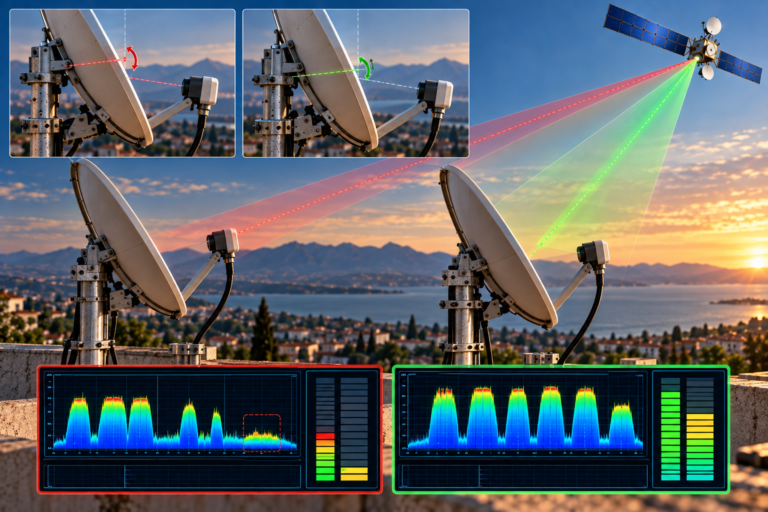
A small azimuth or elevation error reduces the amount of wanted carrier energy delivered to the LNB and lowers the available margin.
Strong transponders can hide this problem.
A more demanding or lower-margin carrier reveals it first, which can make viewers believe that only the HD channel has a problem.
For accurate alignment, the installer should evaluate signal quality, MER, or BER across several representative Astra frequencies instead of maximizing one strong transponder.
How LNB Skew Affects Polarization Quality
Satellite systems reuse spectrum by transmitting carriers with different polarizations.
The LNB must be rotated correctly to separate these signals effectively at the receiving location.
Incorrect skew allows more energy from the opposite polarization to enter the wanted signal path.
This cross-polarization interference can lower MER even though the strength reading remains healthy.
If RTL HD has less margin than RTL SD, a skew error can therefore become visible first on the HD service.
The same principle applies to other channels. A skew problem should never be diagnosed from one service alone.
Frequency, LNB, and Cable Effects
RTL HD and RTL SD using different frequencies means they also travel through different parts of the LNB and coaxial intermediate-frequency response.
An LNB does not have perfectly identical gain, noise performance, and phase behaviour across its entire operating range.
Coaxial cable attenuation also varies with frequency and generally becomes greater as the intermediate frequency rises.
On a short, high-quality cable run, these differences are normally small enough to be irrelevant.
Long cables, poor connectors, old coaxial cable, wall plates, splitters, and multiswitch systems can make frequency-dependent losses more important.
This can remove several decibels of useful system margin from one part of the band while another transponder continues operating normally.
Why Rain Can Expose the Difference
Ku-band satellite reception is affected by precipitation because microwave energy is absorbed and scattered by rain along the propagation path.
This produces rain fade.
A properly engineered receiving system includes clear-sky margin so moderate attenuation does not immediately interrupt television reception.
If RTL HD begins with less margin than RTL SD, rainfall can push the HD carrier below its decoding threshold first.
This does not prove that RTL HD itself is unusually weak. It shows that the complete HD transmission and receiving path has less reserve under those conditions.
If the difference appears mainly during rain, dish alignment, dish size, LNB performance, and clear-sky MER should all be checked.
Video Compression Is a Separate Issue
HD television normally requires more picture information than SD, so efficient compression is important.
Modern HD satellite services commonly use codecs such as H.264 AVC, while older SD services may use MPEG-2 video.
The codec operates after the satellite physical layer has been recovered.
DVB-S or DVB-S2 determines how digital information survives the RF link. MPEG-2, H.264, or another video codec determines how picture information is compressed inside that data.
Confusing these layers can lead to incorrect troubleshooting.
When Strong RTL HD Signal Still Produces No Picture
Not every RTL HD failure is an RF problem.
If the receiver has stable digital lock, good MER, low BER, and other services on the same transponder work normally, the dish is unlikely to be responsible.
The problem may occur later in the processing chain.
The receiver must support the required video and audio formats. Protected HD services also introduce service-access requirements that are separate from satellite signal quality.
A receiver can therefore recover the transponder perfectly but still fail to display the selected programme.
This produces an important diagnostic rule: good RF reception proves only that the broadcast data reached the receiver successfully. It does not prove that every service inside that data can be displayed.
How to Diagnose RTL HD Reception Correctly
Start by comparing RTL HD with other channels carried on the same transponder rather than comparing it only with RTL SD.
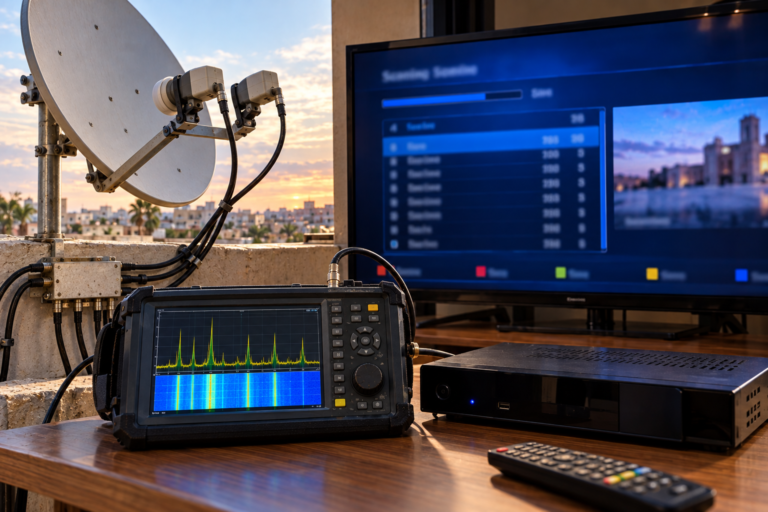
If every service on the RTL HD transponder is unstable, investigate the RF path. Check MER, BER, dish alignment, LNB skew, cable condition, connectors, switches, and weather behaviour.
If RTL HD fails only during rain, measure clear-sky margin. A system operating close to threshold in dry conditions has little reserve available for atmospheric attenuation.
If one polarization performs poorly across multiple transponders, inspect LNB skew and polarization switching.
If failures are concentrated in one frequency range, consider LNB response, local oscillator behaviour, band switching, cable attenuation, and local interference.
If other services on the same RTL HD transponder work perfectly while RTL HD alone is unavailable, stop adjusting the dish and investigate service-level factors instead.
The broader reason German HD services can have different reception requirements is explained in our guide to why German HD channels use DVB-S2, including modulation, Forward Error Correction, MER, BER, and the relationship between transponder efficiency and signal margin.
RTL HD does not need a better satellite signal simply because the picture contains more pixels than RTL SD.
The HD and SD versions are separate satellite services. Their RF behaviour can differ because they use different transponders and can have different frequencies, transmission standards, modulation and coding configurations, and available signal margins.
An HD service can therefore fail before an SD service, but the engineering explanation is found in the complete transmission path rather than in picture resolution alone.
When RTL SD works but RTL HD does not, the correct diagnosis begins at the transponder level.
RTL HD and RTL SD are separate Astra 19.2E transmissions. The receiver tunes a different RF carrier for each service, so differences in frequency, modulation, Forward Error Correction, DVB transmission mode, MER, BER, and available signal margin can make one more sensitive to reception problems than the other.
Dish alignment, LNB skew, oscillator performance, cable attenuation, interference, and rain can reduce that margin further. Forward Error Correction hides many errors until the carrier approaches its threshold, which explains why RTL HD can appear perfect immediately before pixelation or complete loss of lock.
The most important diagnostic rule is simple. Do not compare RTL HD with RTL SD only by picture resolution. Compare their transponders, measure digital quality, and identify whether the failure occurs in the RF path or after the transport stream has already been recovered.
| Question | Answer |
|---|---|
| Why does RTL SD work when RTL HD does not? | The two services use separate satellite transmissions, so their RF parameters and available reception margins can differ. |
| Does RTL HD need more signal because it is HD? | Not simply because of picture resolution. Reception requirements are determined by the transponder’s physical-layer configuration and the quality of the receiving system. |
| Are RTL HD and RTL SD on the same transponder? | No. They are separate services distributed through different Astra 19.2E transponder paths. |
| Why can DVB-S2 reception be more demanding? | Some DVB-S2 modulation and coding configurations prioritize capacity and therefore require good MER and sufficient signal margin. DVB-S2 can also be configured robustly, so the actual MODCOD matters. |
| What does MER tell me? | MER indicates the quality of the received modulation and how accurately the receiver can distinguish the transmitted constellation states. |
| What does BER tell me? | BER shows how many bits are being recovered incorrectly. Rising pre-FEC BER indicates that the error-correction system is working harder. |
| Why does RTL HD fail suddenly? | Digital Forward Error Correction can hide increasing errors until signal margin becomes too small. Failure can then appear rapidly as the decoding threshold is crossed. |
| Can poor dish alignment affect RTL HD before RTL SD? | Yes. If the RTL HD carrier has less margin, a small alignment error can push it closer to threshold while the SD carrier remains stable. |
| Can LNB skew affect RTL reception? | Yes. Incorrect skew can increase cross-polarization interference and reduce MER on affected transponders. |
| Why does RTL HD disappear during rain? | Rain attenuation reduces the available Ku-band link margin. A carrier already close to its threshold will fail sooner. |
| Can the cable affect RTL HD more than RTL SD? | Yes. The services use different frequencies, and cable loss and distribution-system performance vary across the intermediate-frequency range. |
| What if RTL HD has good signal quality but no picture? | The problem may be after RF reception, such as video decoding, service access, receiver compatibility, software, or service configuration. |