How DVB-S2 Really Works: From Satellite Signal to TV Picture
Estimated Reading Time: 13 minutes
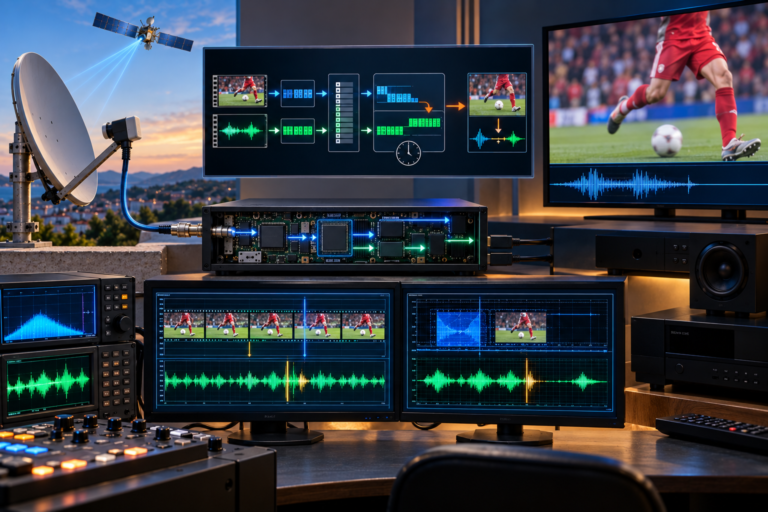
DVB-S2 is often described simply as the technology used for modern satellite television, but that explanation hides what is actually happening. The television picture does not travel directly from the satellite into the screen. The receiver must recover a weak microwave carrier, synchronize with its symbols, identify the modulation, correct transmission errors, rebuild the digital data stream, separate the selected television service, and finally decode compressed video and audio.
Understanding this chain explains many familiar satellite problems. It explains why a receiver can show strong signal but no picture, why BER rises before pixelation appears, why 8PSK can require more reception margin than QPSK, why an LNB affects decoding without decoding anything itself, and why DVB-S2 should never be confused with video formats such as H.264 or HEVC.
DVB-S2 is primarily a satellite transmission system. It defines how input data is adapted, protected with Forward Error Correction, mapped onto modulation symbols, organized into physical-layer frames, and transmitted through a satellite channel. It does not define the television picture compression itself. H.264, HEVC, MPEG-2, or another codec handles the video after the DVB-S2 receiver has recovered the underlying data.
- What DVB-S2 Actually Is
- The Journey Begins Before the Satellite
- From Earth Station to Satellite Transponder
- What the Dish and LNB Do
- How the Receiver Finds the Carrier
- Symbol Rate and Timing Synchronization
- QPSK and 8PSK Explained
- What MODCOD Means
- What BBFRAME and FECFRAME Do
- How LDPC and BCH Correct Errors
- What PLFRAME and PLHEADER Do
- Why DVB-S2 Uses Pilot Symbols
- BER, MER, and the Decoding Threshold
- How the Receiver Rebuilds the Transport Stream
- Why DVB-S2 Is Not a Video Codec
- From Transport Stream to TV Picture
- What Happens When Reception Deteriorates
- Reality Check
- Final Verdict
- FAQ
What DVB-S2 Actually Is
DVB-S2 means Digital Video Broadcasting Satellite Second Generation. It was developed as the successor to DVB-S and provides a more efficient and flexible physical transmission system for satellite broadcasting and data services.
DVB-S2 supports different modulation and coding combinations instead of forcing every service to use exactly the same transmission parameters. Depending on the application, the system can use QPSK, 8PSK, 16APSK, or 32APSK together with a wide range of Forward Error Correction coding rates.
For direct-to-home television, QPSK and 8PSK are especially common. Higher-order APSK modes are more demanding and are frequently associated with professional or specialized satellite applications.
The official DVB-S2 specification describes a system combining flexible input-stream adaptation with LDPC and BCH Forward Error Correction and multiple modulation options. This provides significantly greater spectral efficiency than the original DVB-S system under comparable conditions.
The Journey Begins Before the Satellite
The DVB-S2 process starts at the broadcast facility rather than in orbit.
Television cameras produce video and audio that must first be encoded. A video encoder might use H.264, HEVC, MPEG-2, or another supported compression format. Audio is encoded separately.
The compressed programme components are then organized with service information and timing data. In conventional television broadcasting, multiple services are commonly multiplexed into an MPEG transport stream.
DVB-S2 can accept transport streams and other generic data formats. Its job begins with adapting that input data into the structure required for reliable satellite transmission.
From Earth Station to Satellite Transponder
Once the data has been framed, protected, and modulated, an uplink earth station converts the signal to the required microwave frequency and transmits it toward the satellite.
The satellite receives the uplink through one of its antennas. A transponder processes the signal, shifts it to the downlink frequency range, amplifies it, and retransmits it toward the required coverage area.
For European direct-to-home television, many downlinks use Ku-band frequencies. The satellite does not normally decode each television programme and rebuild the video. It primarily acts as a radio-frequency relay within the broadcast chain.
What the Dish and LNB Do
By the time the signal reaches a household, it is extremely weak because of the enormous free-space path loss between a geostationary satellite and Earth.
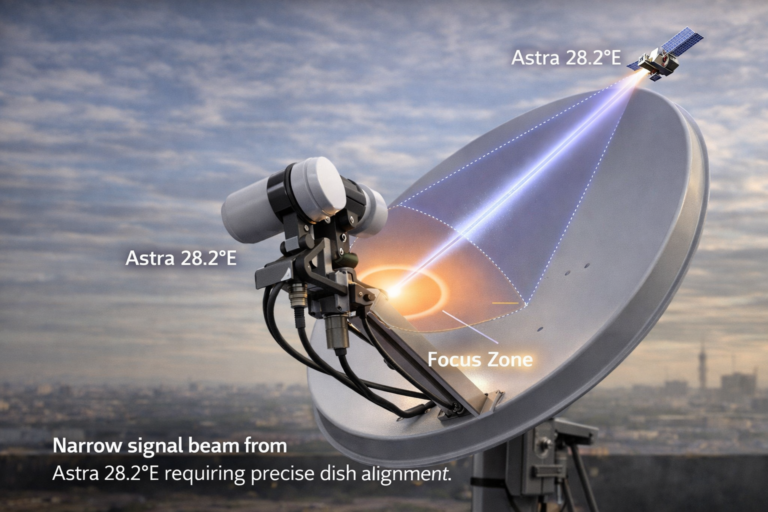
The parabolic dish collects microwave energy and focuses it toward the LNB feedhorn. Dish size and pointing accuracy determine how effectively the wanted carrier is collected.
The LNB then performs low-noise amplification and frequency conversion. A Universal Ku-band LNB typically converts the high satellite frequency into an intermediate-frequency range that can travel through coaxial cable to the receiver.
The LNB does not demodulate DVB-S2 and does not decompress television video. It prepares the RF signal for the receiver.
How the Receiver Finds the Carrier
The tuner selects the required intermediate frequency based on the transponder settings. It must then identify and lock onto the DVB-S2 carrier.
Carrier recovery corrects frequency and phase differences between the received signal and the receiver’s internal reference. These differences can be caused by LNB oscillator error, phase noise, receiver oscillator tolerance, and propagation effects.
If the error remains within the acquisition capability of the demodulator, the receiver locks and begins recovering symbols.
A strong RF level alone does not guarantee carrier lock. The carrier must have adequate quality, the correct symbol rate, and suitable modulation parameters.
Symbol Rate and Timing Synchronization
Digital satellite carriers transmit symbols at a defined symbol rate, commonly measured in symbols per second.
A symbol is not the same as a bit. Depending on the modulation system, one symbol can represent multiple bits.
The receiver must determine exactly where each transmitted symbol begins and where it should be sampled. This process is called symbol timing recovery.
If timing is inaccurate, the measured constellation points become less reliable and the error rate increases.
This is why synchronization is a fundamental part of DVB-S2 reception rather than an optional receiver feature.
QPSK and 8PSK Explained
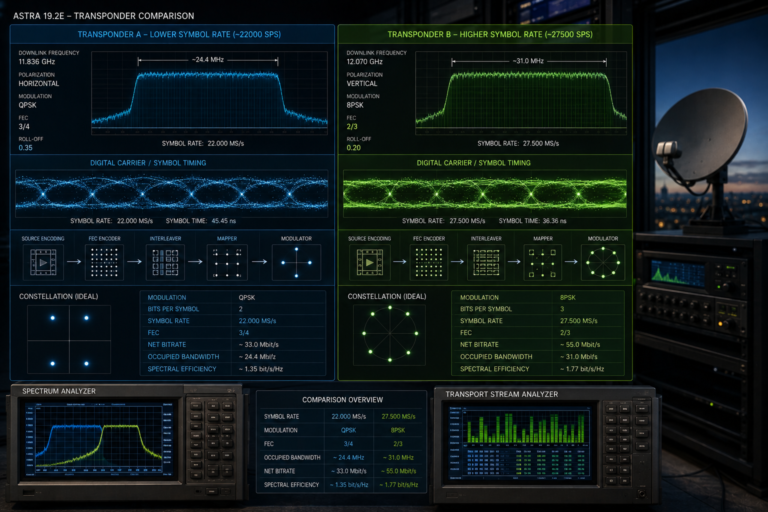
QPSK uses four main constellation positions. Each transmitted symbol can represent two bits.
8PSK uses eight positions and therefore represents three bits per symbol. This allows more information to be transmitted at the same symbol rate.
The tradeoff is reduced separation between valid constellation points. When noise or phase error moves a received symbol away from its correct position, an 8PSK receiver generally has less decision space available than a comparable QPSK transmission.
This is why 8PSK can deliver higher spectral efficiency but commonly requires better carrier quality.
| DVB-S2 Stage | Main Function | What Can Go Wrong |
|---|---|---|
| Dish and LNB | Collect, amplify, and frequency-convert RF signal | Misalignment, noise, skew error, oscillator drift |
| Tuner and carrier recovery | Select and lock onto the wanted carrier | Frequency error, low C/N, interference |
| Symbol synchronization | Determine correct symbol timing | Timing errors and unstable decisions |
| Demodulation | Convert QPSK or 8PSK symbols into coded bits | Poor MER produces incorrect symbol decisions |
| LDPC and BCH | Repair transmission errors | Too many errors exceed correction capability |
| Baseband recovery | Reconstruct original data stream | Damaged frames or lost synchronization |
| Demultiplexer | Select video, audio, and service components | Missing or corrupted transport packets |
| Video decoder | Decode H.264, HEVC, or other video codec | Unsupported codec or damaged compressed frames |
What MODCOD Means
One of DVB-S2’s most important concepts is MODCOD, a combination of modulation and coding parameters.
For example, a carrier might use QPSK with one coding rate or 8PSK with another. Each combination provides a different balance between data capacity and robustness.
A robust MODCOD sacrifices some net capacity for improved resistance to noise. A more efficient MODCOD carries more useful information but requires better signal conditions.
This flexibility lets operators choose transmission parameters that suit the available satellite power, coverage requirements, transponder bandwidth, and service type.
What BBFRAME and FECFRAME Do
Before Forward Error Correction is applied, DVB-S2 organizes input data into BaseBand Frames, normally called BBFRAMEs.
The BBFRAME includes a BaseBand Header containing information needed to describe and recover the underlying input stream.
The BBFRAME then enters the Forward Error Correction subsystem.
After BCH and LDPC coding are applied, the resulting protected structure becomes an FECFRAME. DVB-S2 supports normal and short FEC frame lengths for different applications.
The standard defines this sequence carefully so that the receiver knows exactly how the transmitted data has been constructed and can reverse the process.
How LDPC and BCH Correct Errors
DVB-S2 achieves much of its performance through powerful Forward Error Correction.
The inner correction system uses LDPC, which stands for Low-Density Parity-Check coding. LDPC adds structured parity information that allows the receiver to use iterative mathematical processing to estimate the most likely original data when errors occur.
An outer BCH code provides an additional correction layer for residual errors remaining after LDPC processing.
ETSI specifies the DVB-S2 FEC chain as BCH outer coding followed by LDPC inner coding, with appropriate interleaving for supported modulation modes.
This combination is why DVB-S2 can continue producing clean programme data even while the raw received carrier contains a measurable number of transmission errors.
What PLFRAME and PLHEADER Do
After FEC coding and symbol mapping, DVB-S2 organizes the transmission into Physical Layer Frames, known as PLFRAMEs.
A physical-layer header precedes the frame and provides information needed for receiver synchronization and interpretation of the transmission mode.
This includes signaling related to the modulation and coding configuration.
The receiver uses this physical-layer information to determine how the following symbols should be processed.
Without reliable physical-layer synchronization, the receiver cannot correctly identify the structure required for later decoding stages.
Why DVB-S2 Uses Pilot Symbols
DVB-S2 can optionally insert known pilot symbols into the physical-layer transmission.
Because the receiver already knows what these pilot symbols should look like, it can use them to improve carrier and phase tracking.
This can be especially useful with modulation configurations where maintaining accurate phase recovery is more demanding.
The DVB implementation guidance describes pilot-assisted carrier recovery as an important synchronization aid for several DVB-S2 operating modes.
Pilots consume a small amount of transmission capacity, so their use represents a tradeoff between synchronization assistance and overhead.
BER, MER, and the Decoding Threshold
Once demodulation begins, MER and BER provide useful information about how successfully the receiver is recovering the carrier.
MER measures how closely the received constellation points match their ideal positions. Higher MER generally means the modulation is cleaner.
BER measures incorrect recovered bits. Pre-FEC BER shows errors before correction, while post-FEC errors indicate that the correction system is no longer recovering everything successfully.
Each MODCOD has an operating requirement. When reception remains comfortably above that requirement, decoding is stable.
As signal margin shrinks, BER increases and FEC works harder. Once conditions cross the effective decoding threshold, uncorrected errors rise rapidly and the receiver can lose synchronization.
How the Receiver Rebuilds the Transport Stream
After physical-layer processing and Forward Error Correction, the receiver reverses the baseband adaptation process and recovers the original data stream.
For conventional television broadcasting, that often means recovering an MPEG transport stream containing several television and radio services.
The receiver demultiplexer examines service information and packet identifiers to select the video, audio, subtitles, and other components belonging to the chosen channel.
At this stage, DVB-S2 has essentially completed its job. The receiver has successfully transported digital programme data through the satellite RF link.
Why DVB-S2 Is Not a Video Codec
This distinction is critical.
DVB-S2 defines satellite framing, modulation, coding, and physical transmission. H.264, HEVC, MPEG-2, VVC, or another codec defines how video pictures are compressed and reconstructed.
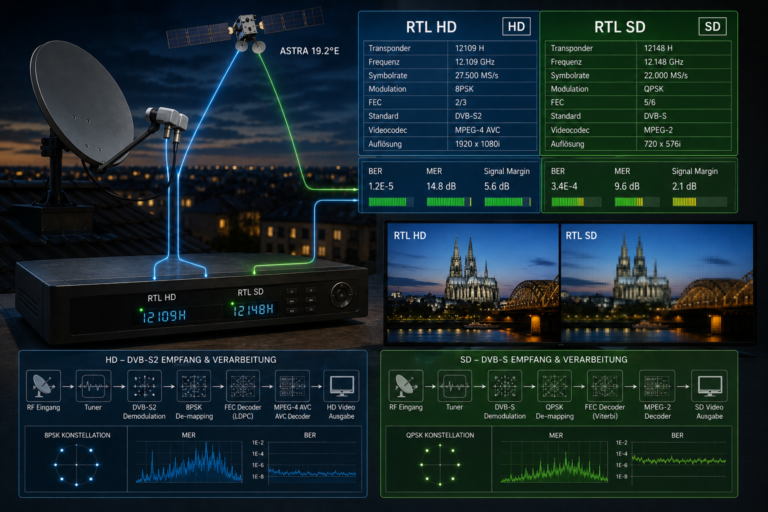
A receiver can therefore support DVB-S2 but still fail to display a channel encoded with an unsupported video codec.
For example, an older receiver may lock perfectly onto a DVB-S2 transponder, show strong MER, display channel information, and possibly decode audio while producing no video because it lacks HEVC support.
The DVB Project maintains separate specifications for satellite transmission and for the use of audio and video coding in broadcast applications, reflecting this technical separation.
From Transport Stream to TV Picture
Once the demultiplexer isolates the selected programme, compressed video packets are sent to the appropriate video decoder.
The decoder reconstructs frames according to the codec. Predicted frames may depend on earlier or later reference pictures, while intra-coded frames provide more independent picture information.
Decoded frames are converted into the required output format and passed through HDMI or another display interface to the television.
Audio follows a similar process through its own decoder and synchronization chain.
The final television image is therefore the end of a long sequence that began with microwave RF reception and passed through several completely different engineering layers.
What Happens When Reception Deteriorates
When dish alignment, rain fade, LNB noise, interference, or cable problems reduce carrier quality, the first visible effect may be nothing at all.
Pre-FEC BER rises while LDPC and BCH continue repairing the damaged information.
As MER falls closer to the required MODCOD threshold, the error-correction system has less reserve.
Once uncorrected errors reach the recovered data stream, compressed video packets become damaged or missing. The picture may break into blocks, audio may mute, or the decoder may hold the last valid frame.
If carrier or physical-layer synchronization fails completely, the receiver can no longer reconstruct the DVB-S2 frames and the channel disappears.
Many of these failures begin before anything visible appears on screen. Our guide explaining why satellite TV works until it suddenly doesn’t examines how signal margin, BER, FEC, and the digital threshold combine to produce this sudden behavior.
DVB-S2 does not automatically mean HD, and DVB-S does not automatically mean SD. DVB-S2 is a transmission standard, while HD and SD describe video resolution.
DVB-S2 also does not mean 8PSK exclusively. The standard supports multiple modulation and coding combinations, including QPSK and 8PSK.
A successful DVB-S2 lock confirms that the receiver has recovered the satellite transmission layer. It does not guarantee that the receiver supports the video codec, encryption system, audio format, or other service requirements inside that recovered data stream.
DVB-S2 is the engineering system that carries digital data reliably across a satellite RF link. It takes input data, organizes it into baseband frames, protects it using BCH and LDPC Forward Error Correction, maps the protected information onto modulation symbols, adds physical-layer framing and synchronization information, and transmits the result through the satellite channel.
At home, the process runs in reverse. The dish collects the microwave carrier, the LNB amplifies and frequency-converts it, the tuner locks onto the signal, synchronization circuits recover symbols, the demodulator reconstructs coded bits, Forward Error Correction repairs damaged information, and the receiver recovers the programme data stream.
Only after that does the video decoder turn H.264, HEVC, MPEG-2, or another compressed format into television pictures. Understanding this separation makes DVB-S2 troubleshooting much more logical because RF reception, transport recovery, and video decoding can be diagnosed as distinct stages instead of being treated as one mysterious signal.
| Question | Answer |
|---|---|
| What does DVB-S2 mean? | DVB-S2 means Digital Video Broadcasting Satellite Second Generation. It defines a second-generation satellite transmission system using flexible modulation, framing, and powerful Forward Error Correction. |
| Is DVB-S2 a video codec? | No. DVB-S2 transports digital data over satellite. H.264, HEVC, MPEG-2, and other codecs handle video compression and decoding. |
| Does DVB-S2 always use 8PSK? | No. DVB-S2 supports several modulation formats, including QPSK, 8PSK, 16APSK, and 32APSK. |
| What is MODCOD? | MODCOD describes a modulation and coding combination. Different MODCODs provide different balances between transmission capacity and required signal quality. |
| What is a BBFRAME? | A BBFRAME is a DVB-S2 BaseBand Frame containing adapted input data and baseband signaling before Forward Error Correction is added. |
| What is an FECFRAME? | An FECFRAME is the protected frame produced after BCH and LDPC Forward Error Correction coding has been applied. |
| What is a PLFRAME? | A PLFRAME is the physical-layer frame transmitted after FEC coding, symbol mapping, and addition of physical-layer signaling. |
| Why does DVB-S2 use LDPC? | LDPC provides powerful error correction, allowing reliable reception under challenging signal conditions while maintaining high spectral efficiency. |
| What does BCH do? | BCH operates as an outer error-correction code that helps remove residual errors associated with the LDPC decoding process. |
| Why are pilot symbols used? | Known pilot symbols can help the receiver maintain accurate carrier and phase synchronization under demanding reception conditions. |
| Why can 8PSK need better reception than QPSK? | 8PSK has more constellation points packed into the same phase space, leaving less separation between valid symbol decisions. |
| What does BER show? | BER indicates how many recovered bits are incorrect. Rising pre-FEC BER shows that the error-correction system is having to repair more damaged information. |
| What does MER show? | MER measures how accurately the received modulation constellation matches its ideal symbol positions. |
| Why can a DVB-S2 receiver lock but show no video? | The receiver may successfully recover the DVB-S2 transport layer but lack support for the channel’s video codec, encryption system, or other service requirements. |
| Does the LNB decode DVB-S2? | No. The LNB performs low-noise amplification and frequency conversion. DVB-S2 synchronization, demodulation, and error correction take place inside the receiver. |