Why Astra 19.2E Changes After Moving Your Dish
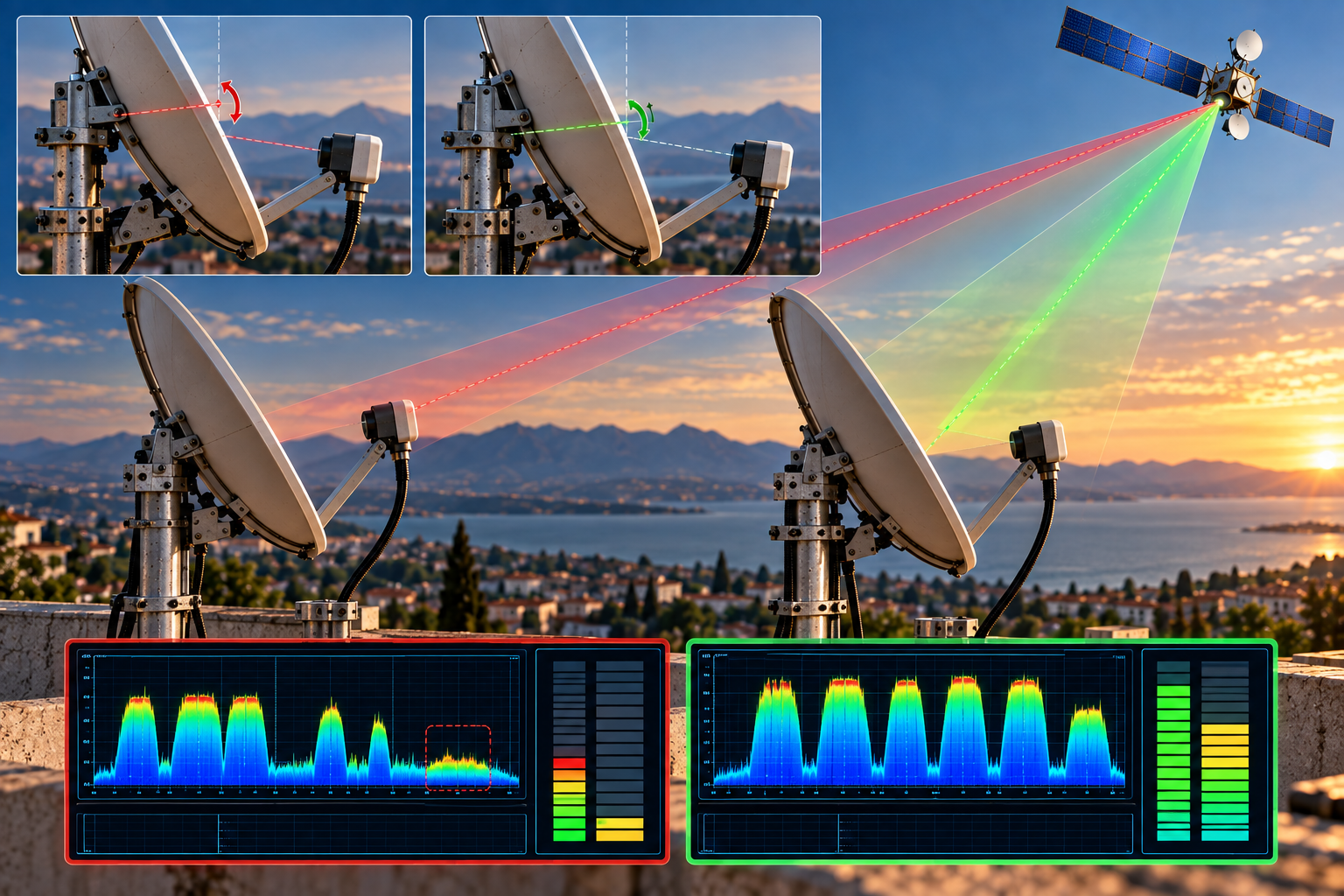
Your Astra 19.2E reception was stable until the dish was moved. After reinstalling it, the receiver still finds Astra, but the results are different. Some transponders are weaker, rain causes problems sooner, or signal strength looks normal while quality has fallen. Even tightening the mounting bolts can sometimes change the final reading.
This happens because a satellite dish is a directional antenna, not simply a reflector that needs to face roughly south. Azimuth, elevation, LNB skew, feed position and reflector geometry all contribute to the final RF margin. A small mechanical change can therefore be almost invisible to the eye while still being large enough to affect lower-margin Astra carriers.
Astra 19.2E remains a major SES European television orbital neighbourhood. Moving a dish does not change Astra itself. What changes is the geometry and performance of your receiving system. If reception becomes different immediately after moving the antenna, first investigate the installation before assuming the satellite or channels have changed.
- Why a Satellite Dish Is So Directional
- A Small Azimuth Change Can Matter
- Elevation Can Change Without Looking Wrong
- Why Tightening the Bolts Can Reduce Signal
- A Different Mount Can Change Everything
- LNB Skew May Have Changed
- Why LNB Focus and Feed Position Matter
- A Slightly Bent Dish Can Still Receive Astra
- Moving the Dish Can Disturb the Cable
- The New Location May Have a Different Line of Sight
- Why Some Astra Transponders Change More Than Others
- Why Strength Can Stay High While Quality Falls
- How to Realign Astra After Moving the Dish
- Reality Check
- Final Verdict
- FAQ
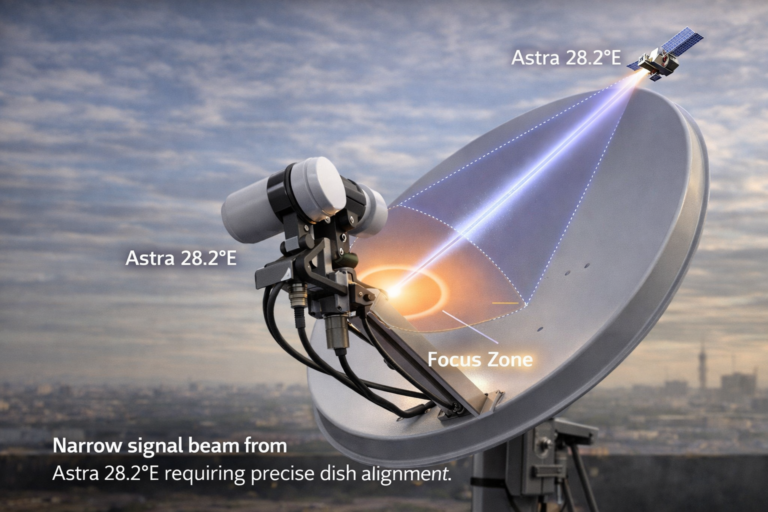
Why a Satellite Dish Is So Directional
The reflector concentrates microwave energy arriving from a particular direction onto the LNB feed.
That directional behaviour provides antenna gain and helps separate the wanted orbital position from other satellites along the geostationary arc.
The strongest reception occurs when the antenna’s main beam is correctly aligned with the wanted direction.
Move away from that optimum point and gain begins to fall.
The important detail is that digital television may continue working while this happens.
If a carrier has enough margin, a small pointing error can reduce its quality without causing immediate picture failure. The receiver may still display every channel perfectly.
A lower-margin carrier can respond very differently.
This explains why moving a dish can produce the strange result where “Astra still works” but no longer works as well as before.
A Small Azimuth Change Can Matter
Azimuth describes the horizontal pointing direction of the antenna.
When a dish is removed and reinstalled, returning it to approximately the same horizontal direction is not enough for optimum reception.
A visual estimate can place the antenna inside the Astra reception peak while leaving it slightly away from the optimum centre.
Strong carriers may still lock immediately.
This often convinces the installer that azimuth is correct.
However, another transponder may have less margin and expose the error.
Fine alignment therefore involves finding the quality fall-off on both sides of the peak and positioning the antenna near the optimum region rather than stopping at the first successful lock.
Finding Astra is not the same as peaking Astra. The first successful channel lock tells you that the dish is close. It does not prove that azimuth and elevation are optimized.
Elevation Can Change Without Looking Wrong
Elevation controls the vertical pointing angle.
It can be surprisingly easy to change during dish movement.
Many mounts include stamped elevation scales, but those markings should be treated as useful starting references rather than precision RF measurements.
Mechanical tolerances, pole alignment and bracket geometry can make the real optimum slightly different.
If elevation is slightly too high or low, the antenna can still acquire Astra while operating away from its best gain.
There is another complication.
Azimuth and elevation are not always mechanically independent in a real installation. If the support pole is not vertical, rotating the dish horizontally can also alter its effective elevation relative to the satellite arc.
This is one reason a dish that worked perfectly on one wall or pole may require more than simply copying its old elevation mark after being moved.
Why Tightening the Bolts Can Reduce Signal
This is a common installation problem because the antenna can move during the final step.
You carefully adjust the dish until quality peaks. Then you tighten the mounting hardware and the reading falls.
The reason is mechanical movement.
Tightening one side of a bracket can pull the mount slightly. A reflector or backing assembly can also flex under uneven force.
The movement may be too small to notice visually but large enough to reduce RF margin.
The solution is to monitor quality while tightening.
Use gradual, balanced tightening rather than fully locking one bolt before the others. After everything is secure, perform a final measurement instead of assuming the alignment remained unchanged.
The alignment measurement that matters is the one obtained after the dish is fully secured, not the peak seen while the mounting bolts were still loose.
A Different Mount Can Change Everything
Moving a dish from one support to another introduces a variable that is easy to overlook: the mounting pole itself.
If the original pole was vertical but the new one leans slightly, the previous mechanical settings no longer reproduce the same pointing geometry.
This matters particularly when the dish is later rotated to another satellite or when a motorized system is involved.
Even for a fixed Astra installation, an uneven support can make fine adjustment more difficult because changes that appear to be horizontal at the bracket can include a vertical component.
Check the mount mechanically before spending large amounts of time compensating with the dish adjustment.
A stable support is also important because a perfectly aligned antenna is of little value if wind can move the bracket afterwards.
LNB Skew May Have Changed
Dish movement often attracts attention to the reflector while the LNB is forgotten.
The LNB’s rotational orientation affects polarization reception.
If the LNB is removed, touched or rotated while relocating the antenna, the new skew may differ from the original position.
A small skew error does not necessarily destroy reception.
Instead, it can reduce polarization isolation and lower the quality margin on certain carriers.
This can produce a particularly confusing symptom: the dish appears to be correctly aligned, most Astra channels work, but one group of transponders is noticeably weaker.
If the weaker group shares a polarization, skew deserves closer attention.
For a detailed diagnosis of that pattern, see Why Astra 19.2E Signal Drops on One Polarization.
Why LNB Focus and Feed Position Matter
The LNB feed must sit in the correct region relative to the reflector’s focal geometry.
With many offset dishes, the holder fixes most of this geometry automatically. But there can still be room for changes in the LNB’s forward or backward position depending on the feed holder design.
If the LNB was removed and reinstalled differently, illumination of the reflector can change.
The result may be reduced usable gain or altered noise performance.
This does not mean sliding the LNB randomly until the receiver displays the highest arbitrary strength number.
Fine feed positioning should be judged by digital quality across representative carriers.
The original bracket geometry should also be preserved. Improvised holders that place the feed away from the intended focal region can waste part of the reflector’s performance even when the dish points in the correct direction.
A Slightly Bent Dish Can Still Receive Astra
Satellite reflectors depend on their shape.
When a dish is moved, it can be bent accidentally by carrying it incorrectly, dropping it, placing weight on the rim or tightening mounting hardware unevenly.
A severely distorted reflector may obviously perform badly.
A smaller deformation is more deceptive.
The antenna can still receive Astra, but the reflector may no longer concentrate incoming energy as efficiently at the feed.
Instead of total signal loss, you may see reduced margin.
This is particularly important with larger reflectors, where structural accuracy and stable mounting become increasingly significant.
Inspect the rim and reflector surface for obvious deformation. Do not try to improve a distorted dish by repeatedly changing azimuth and elevation. Pointing cannot fully compensate for lost reflector geometry.
Moving the Dish Can Disturb the Cable
If reception changes after moving the antenna, the dish angle is not the only thing that changed.
The coaxial cable may have been disconnected, pulled, bent or reterminated.
An F-connector can become loose. The centre conductor may make poor contact. Shielding strands can create an intermittent short. Outdoor weather sealing may also be disturbed.
These faults can reduce RF quality or interfere with LNB power and switching.
Longer cable is another possibility.
If the dish was moved farther from the receiver, the new installation may have greater cable attenuation than the old one.
Coaxial loss is frequency dependent, so the effect may not be identical across every transponder.
| What Changed After Moving? | Possible Reception Effect |
|---|---|
| Azimuth | Reduced antenna gain toward Astra |
| Elevation | Dish operates away from vertical pointing optimum |
| LNB skew | Reduced polarization isolation |
| LNB feed position | Less efficient reflector illumination |
| Reflector shape | Reduced focusing efficiency |
| Longer coax | Additional RF attenuation |
| F-connectors | RF loss, intermittent contact or control problems |
| Physical location | Different line-of-sight conditions |
The New Location May Have a Different Line of Sight
A dish does not need to see the satellite visually, but its RF path must be sufficiently clear.
Moving the antenna a short distance can place a different obstacle in the signal path.
A roof edge, balcony, tree, neighbouring building or other structure can partially obstruct the direction toward the geostationary arc.
This can be deceptive because the antenna may still acquire Astra.
A partial obstruction does not always produce a simple on/off failure. It can reduce available margin or create unstable conditions.
Trees deserve special attention because their effect can change with foliage, wind and moisture.
A location that appears acceptable in dry conditions may become more troublesome when wet leaves add attenuation.
Before spending time on extremely fine alignment, confirm that the new position provides a practical clear path toward 19.2E.
Why Some Astra Transponders Change More Than Others
After moving the dish, you may find that one Astra carrier loses substantial quality while another barely changes.
This does not normally mean each frequency needs a different dish direction.
Different carriers can have different usable reception margins and transmission configurations. The LNB, cable and polarization path can also affect them differently.
A small alignment loss therefore becomes visible first on carriers with less reserve.
This is why testing only the strongest transponder after reinstalling the dish is a poor final check.
Use several representative carriers across different frequencies and polarizations.
If a small azimuth or elevation correction improves most of them, general alignment was likely contributing to the problem.
If the dish is well peaked but one group remains abnormal, investigate the pattern instead of continuing to move the reflector.
The difference between these two situations is explained further in Why Some Astra Frequencies Need Better Alignment.
Why Strength Can Stay High While Quality Falls
This is one of the most misleading symptoms after moving a dish.
The receiver might have shown 90% strength before the move and still show roughly 90% afterwards, yet some channels now freeze.
Consumer strength percentages are not standardized engineering measurements.
They can indicate substantial RF energy at the tuner without accurately describing how cleanly the wanted digital carrier is being received.
Digital quality is more useful.
Professional measurements such as MER provide a clearer view of modulation quality, while BER can reveal the level of errors at the relevant measurement stage.
A slightly misaligned dish can therefore maintain a high-looking strength reading while losing the margin needed for robust DVB-S2 reception.
This is why dish alignment should never be judged from signal strength alone.
How to Realign Astra After Moving the Dish
The best approach is controlled and repeatable.
1. Check that the mounting pole or bracket is mechanically secure.
2. Inspect the reflector for damage and confirm the LNB holder is correctly assembled.
3. Inspect the coax and both F-connectors before adjusting the antenna.
4. Use a currently valid Astra 19.2E carrier to confirm the orbital position.
5. Obtain a stable initial lock.
6. Move azimuth slowly to find both sides of the quality peak, then return toward the optimum point.
7. Repeat the process with elevation.
8. Fine-tune LNB skew using quality rather than appearance.
9. Check several transponders across different frequencies and polarizations.
10. Tighten the mount gradually while continuing to monitor quality.
11. Recheck the same representative carriers after all bolts are fully secure.
If the final readings remain substantially worse than before the move, do not continue turning the dish indefinitely.
Reconsider what else changed: cable length, connectors, LNB position, reflector shape, line of sight or mounting geometry.
Reality Check
Moving your dish does not make Astra 19.2E itself change.
SES continues to operate 19.2E as a major European TV neighbourhood, with ASTRA 1P fully operational there since December 2024. The orbital position continues to support major European television distribution. If reception changes immediately after physically moving your antenna, the installation is the logical starting point for diagnosis.
Do not assume that every post-move problem is simply azimuth. Elevation, skew, feed position, reflector shape, cable condition and line of sight may all have changed at the same time.
Also avoid optimizing the system around one unusually strong carrier. The objective is useful reception margin across the Astra transponders you need, not the highest possible percentage on a single receiver screen.
Final Verdict
If Astra 19.2E changes after moving your dish, the most important clue is the move itself.
A satellite antenna can still find Astra while sitting slightly away from its optimum pointing direction. Strong carriers hide that error, while lower-margin carriers reveal it through reduced quality, earlier rain fade or intermittent lock.
But the reflector is only one part of the system. Moving the installation can also rotate the LNB, change its focal position, damage a connector, increase cable length, introduce a new obstruction or slightly deform the dish.
Realign methodically. Confirm the satellite, peak azimuth and elevation, optimize skew, inspect the complete RF path and test multiple representative transponders after the mount is fully tightened.
The goal is not merely to make Astra appear again. The goal is to recover the reception margin the installation had before it was moved.
Frequently Asked Questions
| Question | Answer |
|---|---|
| Why is Astra weaker after I moved my dish? | The dish may be slightly off its optimum azimuth or elevation, but LNB skew, feed position, cable condition, reflector shape and the new line of sight can also reduce reception margin. |
| Can Astra still work if the dish is slightly misaligned? | Yes. Stronger carriers may continue decoding normally while lower-margin transponders become weaker or unstable. |
| Why did signal quality drop after tightening the dish? | Tightening the mounting hardware can slightly move or flex the antenna. Monitor quality while tightening and perform a final check after the mount is fully secured. |
| Can moving the dish change LNB skew? | Yes. If the LNB or holder was touched during relocation, its rotational position may have changed, reducing polarization isolation. |
| Why is signal strength high but quality lower after the move? | Receiver strength percentages do not directly represent digital carrier quality. A misaligned dish can still deliver substantial RF energy while MER and usable decoding margin fall. |
| Can a bent dish still receive Astra 19.2E? | Yes. A mildly distorted reflector may still acquire Astra but can lose focusing efficiency and therefore reduce reception margin. |
| Can moving the dish damage the coax? | Yes. Pulling, bending or reterminating the cable can damage it or create poor F-connector contact. A longer replacement cable can also add attenuation. |
| Should I align Astra using only the strongest transponder? | No. Use several representative carriers across different frequencies and polarizations so a strong transponder does not hide a marginal alignment. |
| Why do only some Astra channels fail after moving the dish? | Different carriers can have different usable margins. A small loss caused by the move may push marginal carriers below threshold while stronger ones remain stable. |
| What should I check first after relocating an Astra dish? | Start with the mount, reflector, cable and connectors. Then confirm Astra 19.2E, fine-peak azimuth and elevation, optimize LNB skew and verify several transponders after the hardware is fully tightened. |