Why German Channels Use Different Symbol Rates
Estimated Reading Time: 12 minutes
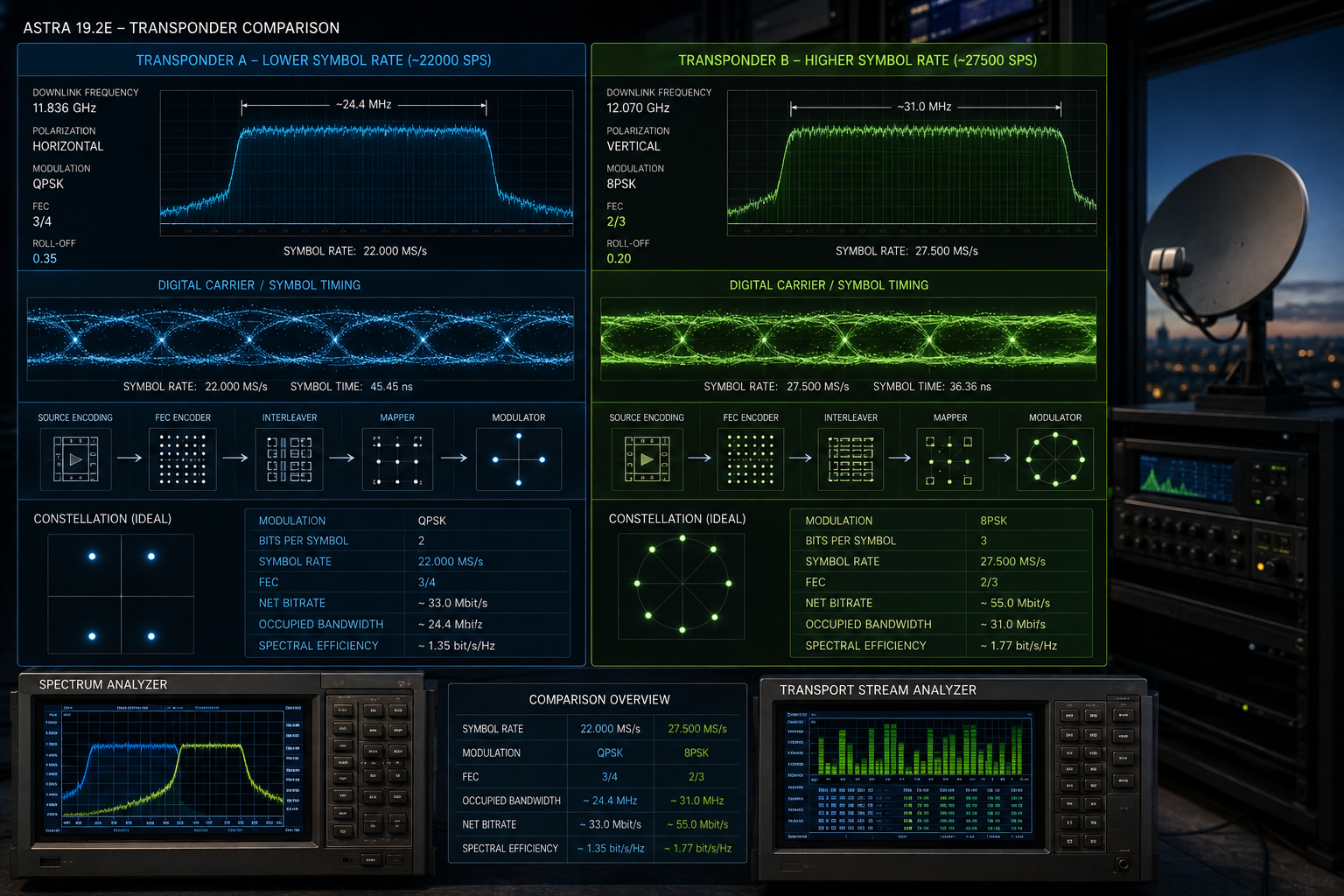
German satellite channels on Astra 19.2E do not all use the same symbol rate. One transponder may use 22000 symbols per second in thousands, while another uses 27500. To a viewer manually entering a frequency, these numbers can look like arbitrary receiver settings. In reality, symbol rate is one of the most important parameters defining how a digital satellite carrier uses its available transponder bandwidth.
The symbol rate is not the video bitrate, signal strength, or number of television channels on a transponder. It describes how many modulation symbols are transmitted every second. The amount of useful data carried by those symbols depends on modulation, Forward Error Correction, framing overhead, and other DVB-S or DVB-S2 parameters. German broadcasters therefore use different symbol rates because different satellite carriers were engineered for different bandwidth, capacity, modulation, and service requirements.
Values such as 22000 and 27500 are commonly shown in satellite receiver menus as 22000 ksym/s and 27500 ksym/s. A higher symbol rate means symbols are being transmitted more rapidly, but it does not automatically mean a stronger signal, better picture quality, or more reliable reception. The complete MODCOD, transponder bandwidth, roll-off, signal margin, and video bitrate determine the final result.
- What a Symbol Actually Is
- Why Symbol Rate Is Not Bitrate
- Why German Channels Use Values Such as 22000 and 27500
- How Symbol Rate Relates to Transponder Bandwidth
- What Roll-Off Does
- Why QPSK and 8PSK Change Data Capacity
- How Forward Error Correction Changes Useful Bitrate
- Why DVB-S2 Makes Symbol Rate More Flexible
- Why a Higher Symbol Rate Is Not Automatically Better
- Why One Symbol Rate Can Carry More Channels Than Another
- How Symbol Rate Affects Receiver Acquisition
- Why an Incorrect Symbol Rate Prevents Lock
- How BER and MER Relate to Symbol Rate
- Why Some Astra Transponders Use Different Rates
- How LNB and Cable Problems Can Mimic Symbol Rate Issues
- How to Troubleshoot Symbol Rate Problems Correctly
- Reality Check
- Final Verdict
- FAQ
What a Symbol Actually Is
Digital satellite broadcasting does not transmit individual bits directly as separate radio pulses.
Instead, groups of bits are represented by modulation states called symbols.
A symbol corresponds to one valid state in the modulation constellation. In QPSK, there are four principal states. In 8PSK, there are eight.
The receiver measures the incoming carrier during each symbol period and decides which state was transmitted.
Symbol rate describes how many of these symbol decisions occur every second.
A carrier operating at 22000 ksym/s therefore transmits about 22 million symbols per second. A 27500 ksym/s carrier transmits about 27.5 million symbols per second.
Why Symbol Rate Is Not Bitrate
This distinction is essential.
Symbol rate tells us how many symbols are transmitted per second. Bitrate tells us how many bits of information are transported per second.
The two are connected through modulation.
QPSK can represent two bits per symbol because four possible states provide four binary combinations.
8PSK can represent three bits per symbol because eight states provide eight combinations.
This means two carriers using the same symbol rate can have very different raw bitrates if they use different modulation formats.
Why German Channels Use Values Such as 22000 and 27500
German satellite transponders were not all designed at the same time or for exactly the same transmission architecture.
Different carriers may use different transponder bandwidths, modulation systems, coding rates, and multiplex requirements.
A symbol rate of 22000 ksym/s may fit one DVB-S2 carrier efficiently within its allocated bandwidth, while another carrier may be configured around 27500 ksym/s.
Historical development also matters. Older DVB-S multiplexes and newer DVB-S2 services were often introduced under different technical and commercial requirements.
There is therefore no engineering rule saying that all German channels on Astra 19.2E should use one universal symbol rate.
| Parameter | What It Describes | What It Does Not Describe |
|---|---|---|
| Symbol Rate | Symbols transmitted per second | Picture resolution or signal strength |
| Bitrate | Bits carried per second | Satellite carrier power |
| Modulation | How bits are mapped to symbols | Video compression format |
| FEC | Amount and structure of error protection | Dish gain |
| MER | Quality of the received modulation | Number of channels in the multiplex |
| BER | Rate of digital bit errors | Symbol rate itself |
| Video Codec | How television pictures are compressed | How RF symbols are transmitted |
How Symbol Rate Relates to Transponder Bandwidth
A modulated satellite carrier occupies a certain amount of radio-frequency bandwidth.
The occupied bandwidth is closely related to symbol rate and the shaping filters used by the transmission system.
Increasing symbol rate generally requires more bandwidth because symbols are transmitted more rapidly.
This means operators cannot choose an arbitrarily high symbol rate. The signal must fit within the available transponder bandwidth and leave appropriate spacing from neighbouring carriers.
Transponder planning is therefore a balance between symbol rate, modulation, filtering, guard requirements, and the total amount of useful data the operator wants to transport.
What Roll-Off Does
A real digitally modulated carrier does not occupy exactly one hertz of spectrum for every symbol per second.
Pulse-shaping filters are used to control the spectral width of the signal and reduce interference with adjacent carriers.
The roll-off factor describes the additional bandwidth required beyond the theoretical minimum.
Lower roll-off values allow the carrier to use spectrum more efficiently, provided transmitters and receivers can handle the tighter filtering requirements.
DVB-S2 supports lower roll-off factors than older DVB-S implementations, helping operators fit useful capacity more efficiently into limited satellite spectrum.
Why QPSK and 8PSK Change Data Capacity
Suppose two DVB-S2 carriers both operate at a symbol rate of 22000 ksym/s.
If one uses QPSK, each symbol represents two raw bits.
If the other uses 8PSK, each symbol represents three raw bits.
Before coding overhead is considered, the 8PSK carrier therefore transports more raw information at the same symbol rate.
The tradeoff is reception difficulty.
The eight constellation states are closer together, so the receiver needs better modulation quality to distinguish them reliably.
This is why capacity planning cannot be based on symbol rate alone.
How Forward Error Correction Changes Useful Bitrate
Not every transmitted bit carries television payload.
Satellite systems add Forward Error Correction information so the receiver can reconstruct data damaged by noise and other impairments.
A coding rate such as 2/3 means a larger proportion of the coded transmission is devoted to error protection than with a rate such as 5/6.
Stronger protection reduces the useful payload bitrate but improves robustness.
A broadcaster therefore chooses symbol rate, modulation, and FEC together.
This combination determines both the useful capacity of the transponder and the carrier quality needed for reliable reception.
Why DVB-S2 Makes Symbol Rate More Flexible
DVB-S2 was designed to provide much more flexibility than the original DVB-S system.
It supports multiple modulation and coding combinations and more efficient physical-layer framing.
This allows satellite operators to optimize each carrier according to the available transponder bandwidth, satellite power, coverage area, and required service capacity.
A German HD multiplex can therefore use a different symbol rate and MODCOD from an older SD multiplex while both remain on the same Astra orbital position.
The receiver simply needs the correct parameters and compatible DVB-S2 hardware.
Why a Higher Symbol Rate Is Not Automatically Better
A common misunderstanding is that 27500 must be better than 22000 because the number is larger.
That is not how digital satellite engineering works.
A higher symbol rate can support more raw capacity when other parameters remain comparable, but it also requires more occupied bandwidth.
The final useful bitrate depends on modulation and FEC.
Picture quality depends further on how many television services share that capacity and which video codecs and bitrates the broadcaster assigns to them.
A 22000 ksym/s DVB-S2 8PSK carrier can therefore carry more useful television data than a 27500 ksym/s legacy DVB-S QPSK carrier under some configurations.
Why One Symbol Rate Can Carry More Channels Than Another
The number of television services in a multiplex is determined by usable data capacity, not symbol rate alone.
A broadcaster using efficient 8PSK modulation and modern Forward Error Correction may achieve a high payload bitrate from a moderate symbol rate.
Efficient video codecs such as H.264 can then reduce the bitrate required by each HD programme.
Another transponder may use a higher symbol rate but carry older MPEG-2 services that consume more bitrate per channel.
The higher symbol-rate transponder does not automatically carry more channels or better pictures.
How Symbol Rate Affects Receiver Acquisition
The receiver must know approximately how quickly symbols are arriving before it can synchronize correctly.
Modern receivers can search across a range of possible symbol rates during blind scanning, but manual tuning requires the correct value or one close enough for the demodulator to acquire the carrier.
Once acquired, timing recovery circuits determine the exact symbol boundaries continuously.
Receivers can differ in their ability to lock extremely low or unusual symbol rates, particularly older hardware.
Common German Astra values such as 22000 and 27500 are well within the normal operating range of modern DVB-S and DVB-S2 receivers.
Why an Incorrect Symbol Rate Prevents Lock
Entering the wrong symbol rate can produce a confusing receiver display.
The tuner may still detect substantial RF energy because the frequency is approximately correct.
Signal strength can therefore appear high.
The demodulator, however, cannot correctly determine the transmitted symbol timing if the configured rate is too far from the actual value.
Digital quality remains at zero or the receiver fails to lock.
This is another example of why signal strength and successful decoding are completely different measurements.
How BER and MER Relate to Symbol Rate
MER and BER do not simply rise or fall because the symbol-rate number is larger or smaller.
MER measures the quality of the received modulation constellation.
BER measures the digital errors produced when symbols are interpreted incorrectly.
The required signal quality depends on the complete modulation and coding configuration.
An 8PSK carrier at 22000 ksym/s may require cleaner reception than a robust QPSK carrier at 27500 ksym/s, depending on the FEC and other physical-layer parameters.
Therefore, comparing two transponders by symbol rate alone tells us very little about which one should be easier to receive.
Why Some Astra Transponders Use Different Rates
Astra 19.2E contains services introduced across many years and several generations of broadcast technology.
Some transponders were planned around older DVB-S QPSK multiplexes, while newer HD services often use DVB-S2 and 8PSK.
Different satellite payloads and carrier allocations can also have different available bandwidths.
The symbol rate selected by an operator is therefore part of a larger capacity plan.
The goal is to fit the required carrier efficiently into the available spectrum while providing the desired useful bitrate and adequate reception margin.
How LNB and Cable Problems Can Mimic Symbol Rate Issues
A receiver failing to lock a 22000 or 27500 carrier does not automatically mean the symbol-rate setting is wrong.
The LNB may be selecting the wrong band because the 22 kHz control tone is missing.
Incorrect local oscillator settings can cause the receiver to tune the wrong intermediate frequency.
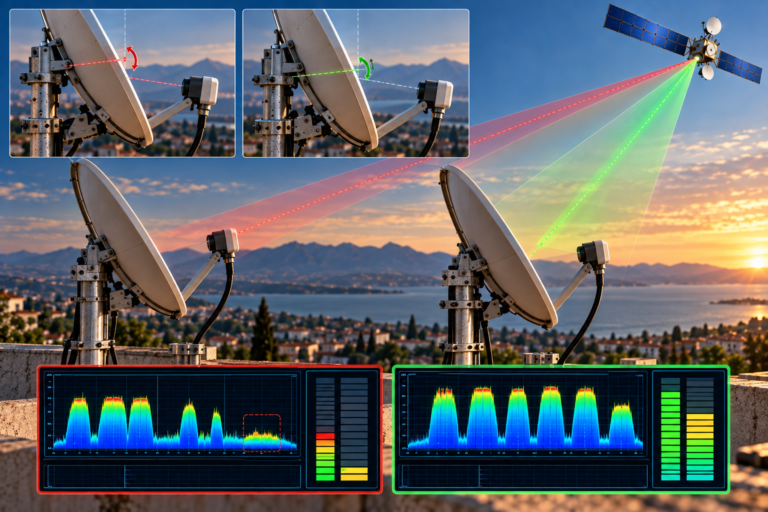
Poor dish alignment, incorrect LNB skew, cable loss, moisture, and local interference can reduce MER enough to prevent acquisition.
A receiver can therefore show the correct frequency and symbol rate in its menu while the real problem exists somewhere else in the RF path.
How to Troubleshoot Symbol Rate Problems Correctly
Begin by verifying the current transponder frequency, polarization, symbol rate, transmission standard, modulation, and FEC.
If the receiver has a blind-scan mode, compare the automatically detected values with the manually entered parameters.
If strength is present but quality remains zero, confirm the symbol rate and then investigate DVB-S versus DVB-S2 compatibility, modulation support, and LNB configuration.
Check whether other transponders using the same symbol rate work. If they do, the receiver clearly supports that rate and the problem is more likely specific to the affected carrier.
Compare MER and BER where available. Poor MER with correct tuning parameters points toward RF quality rather than a symbol-rate mismatch.
When interpreting these German Astra settings, it also helps to understand the broader satellite platform. Our guide to what satellite Germans use for TV explains why Astra 19.2E carries many different transponders, technologies, and service configurations within one orbital neighbourhood.
A symbol rate of 27500 is not inherently stronger, faster, or better than 22000.
Symbol rate describes the speed of modulation symbols. Useful data capacity depends on modulation, Forward Error Correction, framing overhead, and the video services placed inside the multiplex.
Reception reliability also depends on MER, BER, signal margin, dish alignment, LNB performance, and interference. Symbol rate is only one parameter within the complete satellite transmission system.
German satellite channels use different symbol rates because each transponder is engineered around its own bandwidth, modulation, Forward Error Correction, and capacity requirements.
Values such as 22000 and 27500 describe how many modulation symbols are transmitted every second. They do not directly describe signal strength, picture quality, or the number of channels carried.
QPSK and 8PSK can transport different numbers of bits per symbol, while FEC removes part of the raw capacity in exchange for greater error protection. Roll-off and transponder bandwidth determine how much spectrum the carrier occupies.
The receiver therefore needs the correct symbol rate to establish timing synchronization, but the quality of reception depends on the complete MODCOD and RF path. Symbol rate is best understood as one component of a carefully engineered satellite carrier rather than a simple performance number.
| Question | Answer |
|---|---|
| What does symbol rate mean on a satellite receiver? | It describes how many modulation symbols are transmitted every second. |
| What does 22000 mean? | It normally means approximately 22,000 kilobaud, or about 22 million symbols per second. |
| What does 27500 mean? | It represents about 27.5 million symbols per second. |
| Is symbol rate the same as bitrate? | No. Symbol rate measures symbols per second, while bitrate measures bits per second. |
| Why can 8PSK carry more data than QPSK at the same symbol rate? | 8PSK represents three bits per symbol, while QPSK represents two bits per symbol before coding overhead is considered. |
| Is 27500 better than 22000? | No. A higher symbol rate is not automatically better. Modulation, FEC, bandwidth, signal margin, and service bitrate also matter. |
| Why do German Astra channels use both values? | Different transponders have different bandwidth and capacity plans and may use different DVB-S or DVB-S2 configurations. |
| Can the wrong symbol rate cause high strength but zero quality? | Yes. The tuner may detect RF power while the demodulator fails to synchronize with the actual transmitted symbols. |
| Does a high symbol rate need a stronger dish signal? | Not inherently. Required signal quality depends mainly on the complete modulation and coding configuration rather than symbol rate alone. |
| Does symbol rate affect occupied bandwidth? | Yes. Higher symbol rates generally require greater RF bandwidth, with the exact occupied bandwidth also influenced by roll-off filtering. |
| Can one 22000 transponder carry more channels than a 27500 transponder? | Yes. Efficient modulation, coding, and video compression can give the lower symbol-rate carrier greater useful service capacity in some configurations. |
| What should I check if the receiver will not lock a known symbol rate? | Verify frequency, polarization, symbol rate, DVB-S or DVB-S2 mode, modulation, FEC, LNB settings, signal quality, MER, and the complete RF path. |